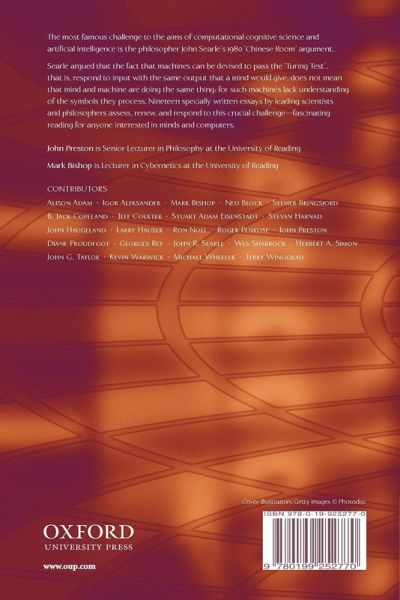
The most famous challenge to the aims of cognitive science and artificial intelligence is the philosopher John Searle's 1980 'Chinese Room' argument. Searle argued that the fact that machines can be devised to respond to input with the same output that a mind would give does not mean that mind and machine are doing the same thing: for the latter lacks understanding. Nineteen specially written essays by leading scientists and philosophers assess, renew, and respond to this crucial challenge--fascinating reading for anyone interested in minds and computers.
The most famous challenge to the aims of cognitive science and artificial intelligence is the philosopher John Searle's 1980 'Chinese Room' argument. Searle argued that the fact that machines can be devised to respond to input with the same output that a mind would give does not mean that mind and machine are doing the same thing: for the latter lacks understanding. Nineteen specially written essays by leading scientists and philosophers assess, renew, and respond to this crucial challenge--fascinating reading for anyone interested in minds and computers.
John Preston is Senior Lecturer in Philosophy at the University of Reading. Mark Bishop is Lecturer in Cybernetics at the University of Reading.
Inhaltsangabe
* Introduction * 1: John R. Searle: Twenty-One Years in the Chinese Room * 2: Ned Block: Searle's Arguments Against Cognitive Science * 3: Terry Winograd: Understanding, Orientations, and Objectivity * 4: Herbert A. Simon, Stuart A. Eisenstadt: A Chinese Room that Understands * 5: B. Jack Copeland: The Chinese Room from a Logical Point of View * 6: Larry Hauser: Nixin' Goes to China * 7: Selmer Bringsjord, Ron Noel: Real Robots and the Missing Thought-Experiment in the Chinese Room Dialectic * 8: Diane Proudfoot: Wittgenstein's Anticipation of the Chinese Room * 9: Jeff Coulter, Wes Sharrock: The Hinterlandof the Chinese Room * 10: Georges Rey: Searle's Misunderstandings of Functionalism and Strong AI * 11: Roger Penrose: Consciousness, Computation, and the Chinese Room * 12: Igor Aleksander: Neural Depictions of 'World' and 'Self': Bringing Computational Understanding to the Chinese Room * 13: John G. Taylor: Do Virtual Actions Avoid the Chinese Room? * 14: Stevan Harnad: Minds, Machines, and Searle 2: What's Right and Wrong about the Chinese Room Argument * 15: Kevin Warwick: Alien Encounters * 16: Alison Adam: Cyborgs in the Chinese Room: Boundaries Transgressed and Boundaries Blurred * 17: Michael Wheeler: Changes in the Rules: Computers, Dynamical Systems, and Searle * 18: Mark Bishop: Dancing with Pixies: Strong Artificial Intelligence and Panpsychism * 19: John Haugeland: Syntax, Semantics, Physics * A Short Bibliography on Searle's Arguments * Name index, Subject index
* Introduction * 1: John R. Searle: Twenty-One Years in the Chinese Room * 2: Ned Block: Searle's Arguments Against Cognitive Science * 3: Terry Winograd: Understanding, Orientations, and Objectivity * 4: Herbert A. Simon, Stuart A. Eisenstadt: A Chinese Room that Understands * 5: B. Jack Copeland: The Chinese Room from a Logical Point of View * 6: Larry Hauser: Nixin' Goes to China * 7: Selmer Bringsjord, Ron Noel: Real Robots and the Missing Thought-Experiment in the Chinese Room Dialectic * 8: Diane Proudfoot: Wittgenstein's Anticipation of the Chinese Room * 9: Jeff Coulter, Wes Sharrock: The Hinterlandof the Chinese Room * 10: Georges Rey: Searle's Misunderstandings of Functionalism and Strong AI * 11: Roger Penrose: Consciousness, Computation, and the Chinese Room * 12: Igor Aleksander: Neural Depictions of 'World' and 'Self': Bringing Computational Understanding to the Chinese Room * 13: John G. Taylor: Do Virtual Actions Avoid the Chinese Room? * 14: Stevan Harnad: Minds, Machines, and Searle 2: What's Right and Wrong about the Chinese Room Argument * 15: Kevin Warwick: Alien Encounters * 16: Alison Adam: Cyborgs in the Chinese Room: Boundaries Transgressed and Boundaries Blurred * 17: Michael Wheeler: Changes in the Rules: Computers, Dynamical Systems, and Searle * 18: Mark Bishop: Dancing with Pixies: Strong Artificial Intelligence and Panpsychism * 19: John Haugeland: Syntax, Semantics, Physics * A Short Bibliography on Searle's Arguments * Name index, Subject index
Es gelten unsere Allgemeinen Geschäftsbedingungen: www.buecher.de/agb
Impressum
www.buecher.de ist ein Internetauftritt der buecher.de internetstores GmbH
Geschäftsführung: Monica Sawhney | Roland Kölbl | Günter Hilger
Sitz der Gesellschaft: Batheyer Straße 115 - 117, 58099 Hagen
Postanschrift: Bürgermeister-Wegele-Str. 12, 86167 Augsburg
Amtsgericht Hagen HRB 13257
Steuernummer: 321/5800/1497
USt-IdNr: DE450055826