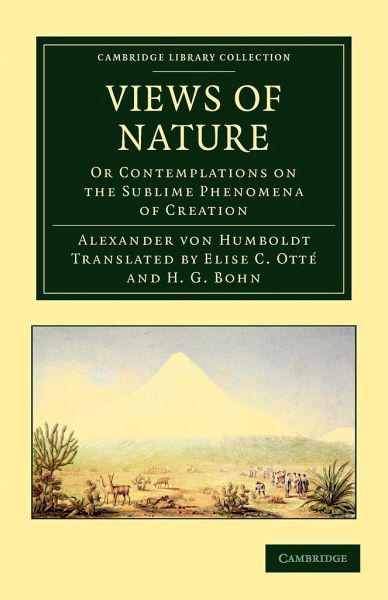
Alexander von Humboldt (1769-1859) was an intellectual giant: an explorer who helped lay the foundations of biogeography, a naturalist who influenced Charles Darwin, and a botanist who developed a model of the Earth's climate zones. He travelled extensively in Europe, carried out scientific explorations across the Russian Empire and in Latin America, and devoted much energy to seeking a unified view of the different branches of scientific knowledge. Ansichten der Natur, published in 1808 with a second edition in 1826, aimed to 'engage the imagination' as well as to communicate new ideas, and…mehr
Alexander von Humboldt (1769-1859) was an intellectual giant: an explorer who helped lay the foundations of biogeography, a naturalist who influenced Charles Darwin, and a botanist who developed a model of the Earth's climate zones. He travelled extensively in Europe, carried out scientific explorations across the Russian Empire and in Latin America, and devoted much energy to seeking a unified view of the different branches of scientific knowledge. Ansichten der Natur, published in 1808 with a second edition in 1826, aimed to 'engage the imagination' as well as to communicate new ideas, and was translated into many European languages. This authorised translation of the third and final 1849 edition, dating from Humboldt's eightieth year, was published in 1850, though another English translation (by Mrs Sabine) had appeared the previous year. The wide coverage, including geology, geography and biology, is typical of Humboldt, as is the precise and engaging style.
Views of Nature, or Ansichten der Natur, was von Humboldt's best-known and most influential work--and his personal favorite. While the essays that comprise it are themselves remarkable as innovative, early pieces of nature writing--they were cited by Thoreau as a model for his own work--the book's extensive endnotes incorporate some of von Humboldt's most beautiful prose and mature thinking on vegetation structure, its origins in climate patterns, and its implications for the arts. Written for both a literary and a scientific audience, Views of Nature was translated into English (twice), Spanish, and French in the nineteenth century, and it was read widely in Europe and the Americas. But in contrast to many of von Humboldt's more technical works, Views of Nature has been unavailable in English for more than one hundred years. Largely neglected in the United States during the twentieth century, von Humboldt's contributions to the humanities and the sciences are now undergoing a revival to which this new translation will be a critical contribution.
Inhaltsangabe
Publisher's preface Author's preface to the first edition Author's preface to the second and third editions Summary of contents Steppes and deserts Cataracts of the Orinoco Nocturnal life of animals in the primeval forest Ideas for a physiognomy of plants On the structure and mode of action of volcanos in different parts of the Earth Vital force, or the Rhodian genius The plateau of Caxamarca, the ancient capital of the Inca Atahuallpa, and first view of the Pacific from the ridge of the Andes Index.
Publisher's preface Author's preface to the first edition Author's preface to the second and third editions Summary of contents Steppes and deserts Cataracts of the Orinoco Nocturnal life of animals in the primeval forest Ideas for a physiognomy of plants On the structure and mode of action of volcanos in different parts of the Earth Vital force, or the Rhodian genius The plateau of Caxamarca, the ancient capital of the Inca Atahuallpa, and first view of the Pacific from the ridge of the Andes Index.
Es gelten unsere Allgemeinen Geschäftsbedingungen: www.buecher.de/agb
Impressum
www.buecher.de ist ein Internetauftritt der buecher.de internetstores GmbH
Geschäftsführung: Monica Sawhney | Roland Kölbl | Günter Hilger
Sitz der Gesellschaft: Batheyer Straße 115 - 117, 58099 Hagen
Postanschrift: Bürgermeister-Wegele-Str. 12, 86167 Augsburg
Amtsgericht Hagen HRB 13257
Steuernummer: 321/5800/1497
USt-IdNr: DE450055826