Building on the success of the first edition and the growth of research in the field over the past decade, this book offers an authoritative overview of the assessment, treatment, and management of violent and sexual offenders. This new and expanded edition reflects the considerable developments in research and empirical data and captures the increasing breadth of risk assessment approaches, the wider range of empirically based therapies, and the more creative means of considering management. The second edition captures key developments in this area, with new chapters drawing on a range of…mehr
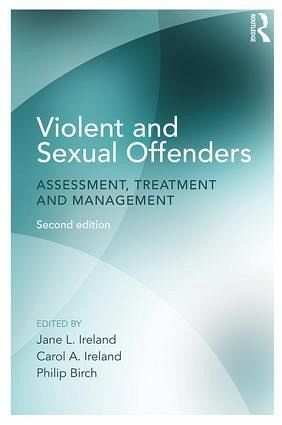
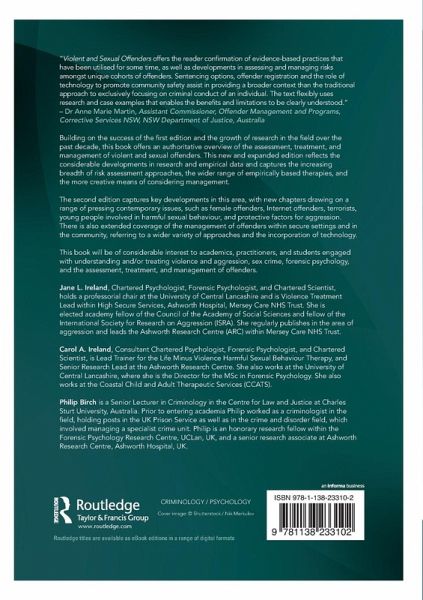
Building on the success of the first edition and the growth of research in the field over the past decade, this book offers an authoritative overview of the assessment, treatment, and management of violent and sexual offenders. This new and expanded edition reflects the considerable developments in research and empirical data and captures the increasing breadth of risk assessment approaches, the wider range of empirically based therapies, and the more creative means of considering management.
The second edition captures key developments in this area, with new chapters drawing on a range of pressing contemporary issues, such as female offenders, Internet offenders, terrorists, young people involved in harmful sexual behaviour, and protective factors for aggression. There is also extended coverage of the management of offenders within secure settings and in the community, referring to a wider variety of approaches and the incorporation of technology.
This book will be of considerable interest to academics, practitioners, and students engaged with understanding and/or treating violence and aggression, sex crime, forensic psychology, and the assessment, treatment, and management of offenders.
Jane L. Ireland, Chartered Psychologist, Forensic Psychologist, and Chartered Scientist, holds a professorial chair at the University of Central Lancashire and is Violence Treatment Lead within High Secure Services, Ashworth Hospital, Mersey Care NHS Trust. She is elected academy fellow of the Council of the Academy of Social Sciences and fellow of the International Society for Research on Aggression (ISRA). She regularly publishes in the area of aggression and leads the Ashworth Research Centre (ARC) within Mersey Care NHS Trust. Carol A. Ireland, Consultant Chartered Psychologist, Forensic Psychologist, and Chartered Scientist, is Lead Trainer for the Life Minus Violence Harmful Sexual Behaviour Therapy, and Senior Research Lead at the Ashworth Research Centre. She also works at the University of Central Lancashire, where she is the Director of Studies for the MSc in Forensic Psychology. She also works at the Coastal Child and Adult Therapeutic Services (CCATS). Philip Birch is a Senior Lecturer in Criminology in the Centre for Law and Justice at Charles Sturt University, Australia. Prior to entering academia Philip worked as a criminologist in the field, holding posts in the UK Prison Service as well as in the crime and disorder field, which involved managing a specialist crime unit. Philip is an honorary research fellow within the Forensic Centre, UCLan, UK, and a senior research associate at Ashworth Research Centre, Ashworth Hospital, UK.
Inhaltsangabe
Foreword David P. Farrington Section I: Risk assessment - Current perspectives. 1. Violence risk assessment Robyn Mooney and Ivan Sebalo 2. Thinking outside of the box: the assessment of sexual offending recidivism and specialist populations Neil Gredecki and Kerensa Hocken 3. Intimate partner violence risk assessment P. Randall Kropp 4. Assessment of internet-related sexual offenders Derek Perkins 5. Risk assessment and management of violent extremists and terrorists: Background principles and practice D. Elaine Pressman 6. Assessing violence risk in youth Andrew L. Gray Catherine S. Shaffer Jodi L. Viljoen Nicole M. Muir and Tonia L. Nicholls 7. Family Lovemap and protective factors: Sex intimacy and sexually abusive youth L.C. Miccio-Fonseca 8. Assessing women who sexually abuse children Hilary J. Eldridge Ian A. Elliott Steven M. Gillespie Alexandra Bailey and Anthony R. Beech 9. Assessing violence and sexual risk among offenders with cognitive intellectual difficulties Nicola Manning 10. Protective factors for violence risk: Additional value to the risk focused approach Michiel de Vries Robbé 11. Violence risk assessment in women: The value of the Female Additional Manual Vivienne de Vogel Miriam Wijkman and Michiel de Vries Robbé Section II: Clinical assessment - Current perspectives. 12. Individual assessments of aggression: Accounting for core factors Jane L. Ireland 13. Assessing the therapeutic needs of sexual offenders Carisa Collins Leigh Harkins and Laleh Dadgardoust 14. Assessing the clinical needs for stalking and domestic violence Werner Tschan 15. Assessing the clinical needs for intellectually disabled sex offenders Chanelle Salonia Heather Hermans and David Hingsburger 16. Assessing for psychopathy using the Psychopathy Checklist Michael Lewis 17. Using offence drivers to guide conceptualisation and treatment of trauma in male sex offenders Ronald J. Ricci and Cheryl A. Clayton 18. The background and clinical use of the Dynamic Appraisal of Situational Aggression -Inpatient Version DASA-IV: Application to a secure setting Mark W. Thorpe Panchu F. Xavier Michael Daffern and Ashley L. Dunne Section III: Treatment - Current perspectives. 19. Therapeutic treatment approaches for violence: Some essential components Jane L. Ireland and Carol A. Ireland 20. Treatment approaches for sexual violence Carol A. Ireland and Rachel Worthington 21. Adapting and evaluating treatment approaches for intellectually disabled sex offenders John Rose 22. Beyond traditional treatment approaches for intimate partner violence: Integrating a dyadic perspective Lindsey M. Rodriguez Nicholas A. Armenti and Julia C. Babcock 23. Treatment of internet-related sexual offenders Derek Perkins and Sarah Wefers 24. Treatment approaches for stalking Rosemary Purcell and Troy McEwan 25. Treatment approaches for terrorists and extremists Kurt Braddock 26. Treatment approaches for women who sexually abuse children Hilary J. Eldridge Alexandra Bailey and Sheila Brotherston Section IV: Management - Current perspectives. 27. Offender supervision and compliance: Managing violent and sexual offenders in the community Chris Trotter 28. Preventative detention and extended sentences: A regressive approach to managing violent and sexual offenders? Andy Williams 29. Managing violent and sexual offenders in contemporary technoculture Mike Nellis and Nicol Shadbolt 30. Sex Offender Registration and public protection: Rethinking the management of sex offenders in the community Philip Birch and Emma Wintle 31. The importance of throughcare and resettlement for working with violent and sexual offenders Julie Trebilcock and Anne Worrall 32. Desistance: Lessons learnt for managing violent and sexual offenders Brian Stout
Foreword David P. Farrington Section I: Risk assessment - Current perspectives. 1. Violence risk assessment Robyn Mooney and Ivan Sebalo 2. Thinking outside of the box: the assessment of sexual offending recidivism and specialist populations Neil Gredecki and Kerensa Hocken 3. Intimate partner violence risk assessment P. Randall Kropp 4. Assessment of internet-related sexual offenders Derek Perkins 5. Risk assessment and management of violent extremists and terrorists: Background principles and practice D. Elaine Pressman 6. Assessing violence risk in youth Andrew L. Gray Catherine S. Shaffer Jodi L. Viljoen Nicole M. Muir and Tonia L. Nicholls 7. Family Lovemap and protective factors: Sex intimacy and sexually abusive youth L.C. Miccio-Fonseca 8. Assessing women who sexually abuse children Hilary J. Eldridge Ian A. Elliott Steven M. Gillespie Alexandra Bailey and Anthony R. Beech 9. Assessing violence and sexual risk among offenders with cognitive intellectual difficulties Nicola Manning 10. Protective factors for violence risk: Additional value to the risk focused approach Michiel de Vries Robbé 11. Violence risk assessment in women: The value of the Female Additional Manual Vivienne de Vogel Miriam Wijkman and Michiel de Vries Robbé Section II: Clinical assessment - Current perspectives. 12. Individual assessments of aggression: Accounting for core factors Jane L. Ireland 13. Assessing the therapeutic needs of sexual offenders Carisa Collins Leigh Harkins and Laleh Dadgardoust 14. Assessing the clinical needs for stalking and domestic violence Werner Tschan 15. Assessing the clinical needs for intellectually disabled sex offenders Chanelle Salonia Heather Hermans and David Hingsburger 16. Assessing for psychopathy using the Psychopathy Checklist Michael Lewis 17. Using offence drivers to guide conceptualisation and treatment of trauma in male sex offenders Ronald J. Ricci and Cheryl A. Clayton 18. The background and clinical use of the Dynamic Appraisal of Situational Aggression -Inpatient Version DASA-IV: Application to a secure setting Mark W. Thorpe Panchu F. Xavier Michael Daffern and Ashley L. Dunne Section III: Treatment - Current perspectives. 19. Therapeutic treatment approaches for violence: Some essential components Jane L. Ireland and Carol A. Ireland 20. Treatment approaches for sexual violence Carol A. Ireland and Rachel Worthington 21. Adapting and evaluating treatment approaches for intellectually disabled sex offenders John Rose 22. Beyond traditional treatment approaches for intimate partner violence: Integrating a dyadic perspective Lindsey M. Rodriguez Nicholas A. Armenti and Julia C. Babcock 23. Treatment of internet-related sexual offenders Derek Perkins and Sarah Wefers 24. Treatment approaches for stalking Rosemary Purcell and Troy McEwan 25. Treatment approaches for terrorists and extremists Kurt Braddock 26. Treatment approaches for women who sexually abuse children Hilary J. Eldridge Alexandra Bailey and Sheila Brotherston Section IV: Management - Current perspectives. 27. Offender supervision and compliance: Managing violent and sexual offenders in the community Chris Trotter 28. Preventative detention and extended sentences: A regressive approach to managing violent and sexual offenders? Andy Williams 29. Managing violent and sexual offenders in contemporary technoculture Mike Nellis and Nicol Shadbolt 30. Sex Offender Registration and public protection: Rethinking the management of sex offenders in the community Philip Birch and Emma Wintle 31. The importance of throughcare and resettlement for working with violent and sexual offenders Julie Trebilcock and Anne Worrall 32. Desistance: Lessons learnt for managing violent and sexual offenders Brian Stout
Rezensionen
"Violent and Sexual Offenders offers the reader confirmation of evidence-based practices that have been utilized for some time, as well as developments in assessing and managing risks amongst unique cohorts of offenders. Sentencing options, offender registration and the role of technology to promote community safety assist in providing a broader context than the traditional approach to exclusively focusing on criminal conduct of an individual. The text flexibly uses research and case examples that enables the benefits and limitations to be clearly understood."
- Dr Anne Marie Martin, Assistant Commissioner, Offender Management & Programs, Corrective Services NSW, NSW Department of Justice, Australia
Es gelten unsere Allgemeinen Geschäftsbedingungen: www.buecher.de/agb
Impressum
www.buecher.de ist ein Internetauftritt der buecher.de internetstores GmbH
Geschäftsführung: Monica Sawhney | Roland Kölbl | Günter Hilger
Sitz der Gesellschaft: Batheyer Straße 115 - 117, 58099 Hagen
Postanschrift: Bürgermeister-Wegele-Str. 12, 86167 Augsburg
Amtsgericht Hagen HRB 13257
Steuernummer: 321/5800/1497
USt-IdNr: DE450055826