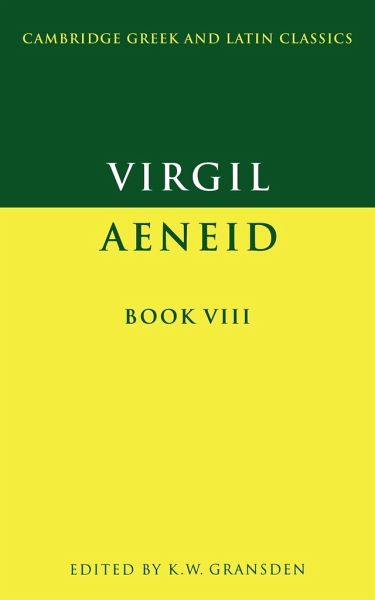
Book VIII is one of the most attractive and important books of Virgil's Aeneid. It includes the visit of Aaneas to the site of the future Rome, the story of Hercules and Cacus, the episode between Venus and Vulcan and the description of the great symbolic shield of Aeneas. Mr Gransden's introduction relates this book to the Aeneid as a whole considers the text in various aspects: the topography, Virgil's sense of history, his typology and symbolism, his literary style and his influence on subsequent vernacular poetry. The commentary discusses points of special interest and difficulty in…mehr
Book VIII is one of the most attractive and important books of Virgil's Aeneid. It includes the visit of Aaneas to the site of the future Rome, the story of Hercules and Cacus, the episode between Venus and Vulcan and the description of the great symbolic shield of Aeneas. Mr Gransden's introduction relates this book to the Aeneid as a whole considers the text in various aspects: the topography, Virgil's sense of history, his typology and symbolism, his literary style and his influence on subsequent vernacular poetry. The commentary discusses points of special interest and difficulty in interpretation, style and prosody and gives detailed explanation of the many allusions in Book VIII to customs, legends, traditions and historical events. This is primarily a textbook for university students and sixth-formers, but it also contains material which may be of interest to students of English and comparative literature.
Publius Vergilius Maro, known to us as Virgil (70 B.C.-19 B.C.), is best remembered for his masterpiece, The Aeneid, in which he represented the Emperor Augustus as a descendant of the half-divine Aeneas, a refugee from the fall of Troy and legendary founder of Rome. Virgil claimed on his deathbed that The Aeneid was unfinished and expressed a desire to have it burned, but it became the national epic of ancient Rome, a monument of Latin literature, and has been regarded as one of the great classics of Western literature ever since. Virgil's other works include the Eclogues and the Georgics, also considered masterpieces.
Inhaltsangabe
Preface Map of the site of Rome introduction 1. Virgil's career and reputation 2. The Aeneid 3. Book VIII 4. The poetry Commentary Appendices Bibliography Indexes to the commentary.
Preface Map of the site of Rome introduction 1. Virgil's career and reputation 2. The Aeneid 3. Book VIII 4. The poetry Commentary Appendices Bibliography Indexes to the commentary.
Es gelten unsere Allgemeinen Geschäftsbedingungen: www.buecher.de/agb
Impressum
www.buecher.de ist ein Internetauftritt der buecher.de internetstores GmbH
Geschäftsführung: Monica Sawhney | Roland Kölbl | Günter Hilger
Sitz der Gesellschaft: Batheyer Straße 115 - 117, 58099 Hagen
Postanschrift: Bürgermeister-Wegele-Str. 12, 86167 Augsburg
Amtsgericht Hagen HRB 13257
Steuernummer: 321/5800/1497
USt-IdNr: DE450055826