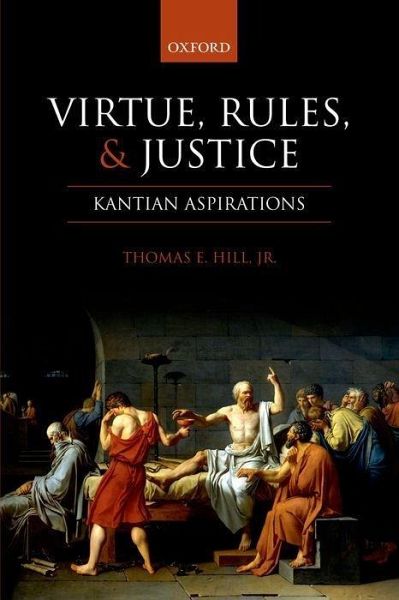
Thomas E. Hill Jr. interprets, explains, and extends Kant's moral theory in a series of essays that highlight its relevance to contemporary ethics. The book is divided into four sections. The first three essays cover basic themes: they introduce the major aspects of Kant's ethics; explain different interpretations of the Categorical Imperative; and sketch a "constructivist" reading of Kantian normative ethics distinct from the Kantian constructivisms of Onora O'Neill and John Rawls. The next section is on virtue, and the essays collected here discuss whether it is a virtue to regard the…mehr
Thomas E. Hill Jr. interprets, explains, and extends Kant's moral theory in a series of essays that highlight its relevance to contemporary ethics. The book is divided into four sections. The first three essays cover basic themes: they introduce the major aspects of Kant's ethics; explain different interpretations of the Categorical Imperative; and sketch a "constructivist" reading of Kantian normative ethics distinct from the Kantian constructivisms of Onora O'Neill and John Rawls. The next section is on virtue, and the essays collected here discuss whether it is a virtue to regard the natural environment as intrinsically valuable, address puzzles about moral weakness, contrast ideas of virtue in Kant's ethics and in "virtue ethics," and comment on duties to oneself, second-order duties, and moral motivation in Kant's Doctrine of Virtue. Four essays on moral rules propose human dignity as a guiding value for a system of norms rather than a self-standing test for isolated cases, contrast the Kantian perspectives on moral rules with rule-utilitarianism and then with Jonathan Dancy's moral particularism, and distinguish often-conflated questions about moral relativism. Hill goes on to outline a Kantian position on two central issues. In the last section of the book, three essays on practical questions show how a broadly Kantian theory, if critical of Kant's official theory of law, might re-visit questions about revolution, prison reform, and forcible interventions in other countries for humanitarian purposes. In the final essay, Hill develops the implications of Kant's Doctrine of Virtue for the responsibility of by-standers to oppression.
Thomas E. Hill, Jr., received an AB from Harvard College, a BPhil as a Rhodes Scholar from the University of Oxford, and a PhD from Harvard University. He is author of Autonomy and Self-Respect (CUP), Dignity and Practical Reason in Kant's Moral Theory (Cornell University Press), Respect, Pluralism, and Justice (OUP), and Human Welfare and Moral Worth (OUP). He edited the Blackwell Guide to Kant's Ethics (Wiley-Blackwell) and, with Arnulf Zweig, co-edited Kant's Groundwork for the Metaphysics of Morals (OUPs). He taught briefly at the Johns Hopkins University and Pomona College, at UCLA for sixteen years, as a visitor at Stanford University and the University of Minnesota, and is currently Kenan Professor in philosophy at the University of North Carolina at Chapel Hill. His essays explore a wide range of topics in moral and political philosophy, with special interest in Kant and broadly Kantian perspectives on practical issues.
Inhaltsangabe
Acknowledgments General Introduction Abstracts 1. Basic themes 1: Kant's Ethical Theory: An Overview 2: Kantian Normative Ethics 3: Kantian Constructivism as Normative Ethics 2. Virtue 4: Finding Value in Nature 5: Kant on Weakness of Will 6: Kantian Virtue and 'Virtue Ethics' 7: Kant's Tugendlehre as Normative Ethics 3. Moral rules and principles 8: The Dignity of Persons: Kant, Problems, and a Proposal 9: Assessing Moral Rules: Utilitarian and Kantian Perspectives 10: The Importance of Moral Rules and Principles 11: Moral Construction as a Task: Sources and Limits 4. Practical Questions 12: Questions about Kant's Opposition to Revolution 13: Treating Criminals as Ends in Themselves 14: Kant and Humanitarian Intervention 15: Moral Responsibilities of Bystanders Bibliography Index
Acknowledgments General Introduction Abstracts 1. Basic themes 1: Kant's Ethical Theory: An Overview 2: Kantian Normative Ethics 3: Kantian Constructivism as Normative Ethics 2. Virtue 4: Finding Value in Nature 5: Kant on Weakness of Will 6: Kantian Virtue and 'Virtue Ethics' 7: Kant's Tugendlehre as Normative Ethics 3. Moral rules and principles 8: The Dignity of Persons: Kant, Problems, and a Proposal 9: Assessing Moral Rules: Utilitarian and Kantian Perspectives 10: The Importance of Moral Rules and Principles 11: Moral Construction as a Task: Sources and Limits 4. Practical Questions 12: Questions about Kant's Opposition to Revolution 13: Treating Criminals as Ends in Themselves 14: Kant and Humanitarian Intervention 15: Moral Responsibilities of Bystanders Bibliography Index
Es gelten unsere Allgemeinen Geschäftsbedingungen: www.buecher.de/agb
Impressum
www.buecher.de ist ein Internetauftritt der buecher.de internetstores GmbH
Geschäftsführung: Monica Sawhney | Roland Kölbl | Günter Hilger
Sitz der Gesellschaft: Batheyer Straße 115 - 117, 58099 Hagen
Postanschrift: Bürgermeister-Wegele-Str. 12, 86167 Augsburg
Amtsgericht Hagen HRB 13257
Steuernummer: 321/5800/1497
USt-IdNr: DE450055826