World-leading researchers, including Nobel Laureates and rising young stars, examine some of the most important and fundamental questions at the forefronts of modern science, philosophy, and theology, taking into account recent discoveries from a range of fields. This fascinating book is ideal for anyone seeking answers to deep questions about the universe and human life. The remarkable career of Charles H. Townes, inventor of the maser and laser for which he shared the 1964 Nobel Prize in Physics, has spanned seven decades. His interests have ranged from the origin of the Universe to the…mehr
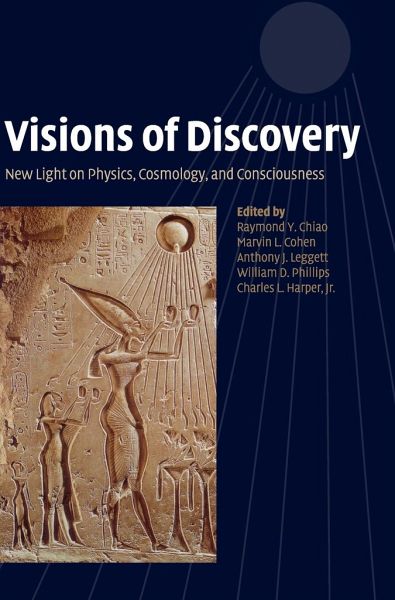
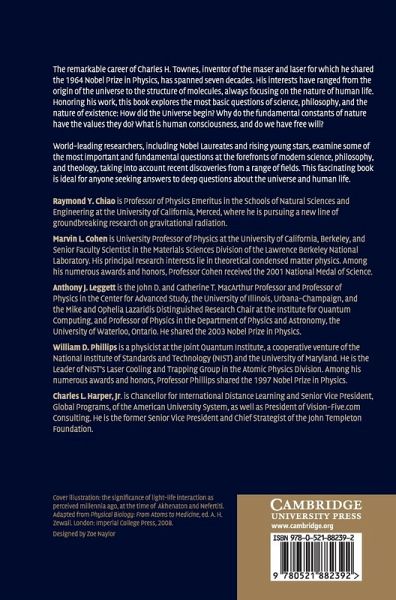
World-leading researchers, including Nobel Laureates and rising young stars, examine some of the most important and fundamental questions at the forefronts of modern science, philosophy, and theology, taking into account recent discoveries from a range of fields. This fascinating book is ideal for anyone seeking answers to deep questions about the universe and human life. The remarkable career of Charles H. Townes, inventor of the maser and laser for which he shared the 1964 Nobel Prize in Physics, has spanned seven decades. His interests have ranged from the origin of the Universe to the structure of molecules, always focusing on the nature of human life. Honouring his work, this book explores the most basic questions of science, philosophy, and the nature of existence: How did the Universe begin? Why do the fundamental constants of nature have the values they do? What is human consciousness, and do we have free will?
List of contributors; Foreword Charles H. Townes; Editors' preface; Preface Freeman J. Dyson; Laureates' preface: reflections from four physics Nobelists Roy J. Glauber, John L. Hall, Theodore W. Hänsch and Wolfgang Ketterle; Acknowledgments; Part I. Illumination: The History and Future of Physical Science and Technology: 1. A short history of light in the Western world John L. Heilbron; 2. Tools and innovation Peter L. Galison; 3. The future of science Freeman J. Dyson; 4. The end of everything: will AI replace humans? Will everything die when the universe freezes over? Michio Kaku; Part II. Fundamental Physics and Quantum Mechanics: 5. Fundamental constants Frank Wilczek; 6. New insights on time symmetry in quantum mechanics Yakir Aharonov and Jeffrey Tollaksen; 7. The major unknowns in particle physics and cosmology David J. Gross; 8. The major unknown in quantum mechanics: Is it the whole truth? Anthony J. Leggett; 9. Precision cosmology and the landscape Raphael Bousso; 10. Hairy black holes, phase transitions, and AdS/CFT Steven S. Gubser; Part III. Astrophysics and Astronomy: 11. The microwave background: a cosmic time machine Adrian T. Lee; 12. Dark matter and dark energy Marc Kamionkowski; 13. New directions and intersections for observational cosmology: the case of dark energy Saul Perlmutter; 14. Inward bound: high-resolution astronomy and the quest for black holes and extrasolar planets Reinhard Genzel; 15. Searching for signatures of life beyond the solar system: astrophysical interferometry and the 150 km Exo-Earth Imager Antoine Labeyrie; 16. New directions for gravitational wave physics via 'Millikan oil drops' Raymond Y. Chiao; 17. An 'ultrasonic' image of the embryonic universe: CMB polarization tests of the inflationary paradigm Brian G. Keating; Part IV. New Approaches in Technology and Science: 18. Visualizing complexity: development of 4D microscopy and diffraction for imaging in space and time Ahmed H. Zewail; 19. Is life based on laws of physics? Steven Chu; 20. Quantum information J. Ignacio Cirac; 21. Emergence in condensed matter physics Marvin L. Cohen; 22. Achieving the highest spectral resolution over the widest spectral bandwidth: precision measurement meets ultrafast science Jun Ye; 23. Wireless non-radiative energy transfer Marin Soljäi¿; Part V. Consciousness and Free Will: 24. The big picture: exploring questions on the boundaries of science - consciousness and free will George F. R. Ellis; 25. Quantum entanglement: from fundamental questions to quantum communication and quantum computation and back Anton Zeilinger; 26. Consciousness, body, and brain: the matter of the mind Gerald M. Edelman; 27. The relation between quantum mechanics and higher brain functions: lessons from quantum computation and neurobiology Christof Koch and Klaus Hepp; 28. Free will and the causal closure of physics Robert C. Bishop; 29. Natural laws and the closure of physics Nancy L. Cartwright; 30. Anti-Cartesianism and downward causation: reshaping the free-will debate Nancey Murphy; 31. Can we understand free will? Charles H. Townes; Part VI. Reflections on the Big Questions: Mind, Matter. Mathematics, and Ultimate Reality: 32. The big picture: exploring questions on the boundaries of science - mind, matter, mathematics George F. R. Ellis; 33. The mathematical universe Max Tegmark; 34. Where do the laws of physics come from? Paul C. W. Davies; 35. Science, energy, ethics, and civilization Vaclav Smil; 36. Life of science, life of faith William T. Newsome; 37. The science of light and the light of science: an appreciative theological reflection on the life and work of Charles Hard Townes Robert J. Russell; 38. Two quibbles about 'ultimate' Gerald Gabrielse; Index.
List of contributors; Foreword Charles H. Townes; Editors' preface; Preface Freeman J. Dyson; Laureates' preface: reflections from four physics Nobelists Roy J. Glauber, John L. Hall, Theodore W. Hänsch and Wolfgang Ketterle; Acknowledgments; Part I. Illumination: The History and Future of Physical Science and Technology: 1. A short history of light in the Western world John L. Heilbron; 2. Tools and innovation Peter L. Galison; 3. The future of science Freeman J. Dyson; 4. The end of everything: will AI replace humans? Will everything die when the universe freezes over? Michio Kaku; Part II. Fundamental Physics and Quantum Mechanics: 5. Fundamental constants Frank Wilczek; 6. New insights on time symmetry in quantum mechanics Yakir Aharonov and Jeffrey Tollaksen; 7. The major unknowns in particle physics and cosmology David J. Gross; 8. The major unknown in quantum mechanics: Is it the whole truth? Anthony J. Leggett; 9. Precision cosmology and the landscape Raphael Bousso; 10. Hairy black holes, phase transitions, and AdS/CFT Steven S. Gubser; Part III. Astrophysics and Astronomy: 11. The microwave background: a cosmic time machine Adrian T. Lee; 12. Dark matter and dark energy Marc Kamionkowski; 13. New directions and intersections for observational cosmology: the case of dark energy Saul Perlmutter; 14. Inward bound: high-resolution astronomy and the quest for black holes and extrasolar planets Reinhard Genzel; 15. Searching for signatures of life beyond the solar system: astrophysical interferometry and the 150 km Exo-Earth Imager Antoine Labeyrie; 16. New directions for gravitational wave physics via 'Millikan oil drops' Raymond Y. Chiao; 17. An 'ultrasonic' image of the embryonic universe: CMB polarization tests of the inflationary paradigm Brian G. Keating; Part IV. New Approaches in Technology and Science: 18. Visualizing complexity: development of 4D microscopy and diffraction for imaging in space and time Ahmed H. Zewail; 19. Is life based on laws of physics? Steven Chu; 20. Quantum information J. Ignacio Cirac; 21. Emergence in condensed matter physics Marvin L. Cohen; 22. Achieving the highest spectral resolution over the widest spectral bandwidth: precision measurement meets ultrafast science Jun Ye; 23. Wireless non-radiative energy transfer Marin Soljäi¿; Part V. Consciousness and Free Will: 24. The big picture: exploring questions on the boundaries of science - consciousness and free will George F. R. Ellis; 25. Quantum entanglement: from fundamental questions to quantum communication and quantum computation and back Anton Zeilinger; 26. Consciousness, body, and brain: the matter of the mind Gerald M. Edelman; 27. The relation between quantum mechanics and higher brain functions: lessons from quantum computation and neurobiology Christof Koch and Klaus Hepp; 28. Free will and the causal closure of physics Robert C. Bishop; 29. Natural laws and the closure of physics Nancy L. Cartwright; 30. Anti-Cartesianism and downward causation: reshaping the free-will debate Nancey Murphy; 31. Can we understand free will? Charles H. Townes; Part VI. Reflections on the Big Questions: Mind, Matter. Mathematics, and Ultimate Reality: 32. The big picture: exploring questions on the boundaries of science - mind, matter, mathematics George F. R. Ellis; 33. The mathematical universe Max Tegmark; 34. Where do the laws of physics come from? Paul C. W. Davies; 35. Science, energy, ethics, and civilization Vaclav Smil; 36. Life of science, life of faith William T. Newsome; 37. The science of light and the light of science: an appreciative theological reflection on the life and work of Charles Hard Townes Robert J. Russell; 38. Two quibbles about 'ultimate' Gerald Gabrielse; Index.
Es gelten unsere Allgemeinen Geschäftsbedingungen: www.buecher.de/agb
Impressum
www.buecher.de ist ein Internetauftritt der buecher.de internetstores GmbH
Geschäftsführung: Monica Sawhney | Roland Kölbl | Günter Hilger
Sitz der Gesellschaft: Batheyer Straße 115 - 117, 58099 Hagen
Postanschrift: Bürgermeister-Wegele-Str. 12, 86167 Augsburg
Amtsgericht Hagen HRB 13257
Steuernummer: 321/5800/1497
USt-IdNr: DE450055826