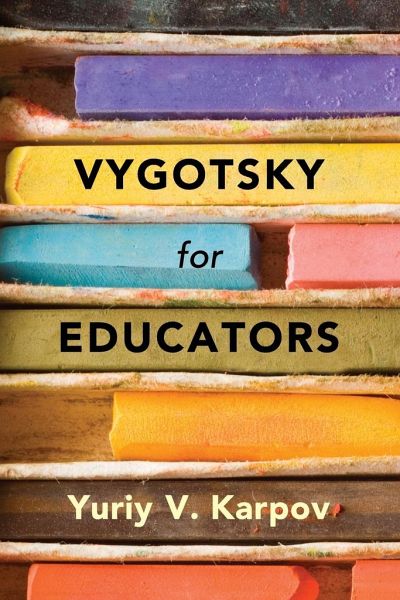
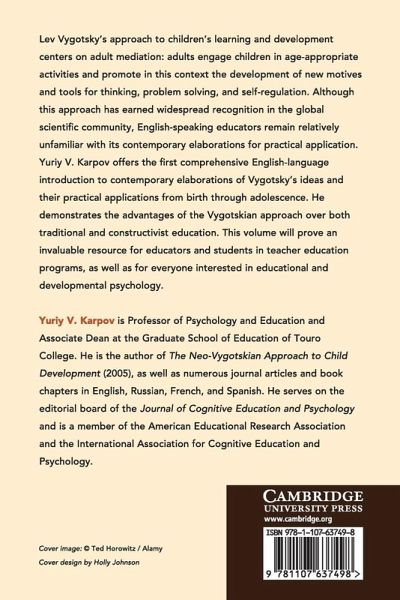
This volume offers the first comprehensive introduction to the contemporary Vygotskian approach to learning and development for English-speaking educators. Yuriy V. Karpov explores the practical applications of this approach from birth through adolescence and shows its advantages over traditional and constructivist education.
This volume offers the first comprehensive introduction to the contemporary Vygotskian approach to learning and development for English-speaking educators. Yuriy V. Karpov explores the practical applications of this approach from birth through adolescence and shows its advantages over traditional and constructivist education.
Yuriy V. Karpov is Professor of Psychology and Education and Associate Dean at the Graduate School of Education of Touro College, New York. He is the author of The Neo-Vygotskian Approach to Child Development (2005), as well as numerous journal articles and book chapters in English, Russian, French and Spanish. He serves on the editorial board of the Journal of Cognitive Education and Psychology and is a member of the American Educational Research Association and the International Association for Cognitive Education and Psychology.
Inhaltsangabe
Introduction: 'there is nothing more practical than a good theory'; Part I. Mediation from Birth through Adolescence: 1. The Vygotskian notion of mediation as the major determinant of children's learning and development; 2. First year of life: infant-caregiver attachment as the foundation of further development; 3. Second and third years: from object-centered explorations to exploration of the world of social roles and relationships; 4. Three- to six-year-olds: why sociodramatic play is important and how to promote it; 5. Mediation of preschoolers' activities to promote school readiness; 6. Learning at school: children not only learn, they develop as well; 7. Understand adolescents and make a difference!; Part II. School: What to Teach, and How to Teach: 8. American cognitive psychologists and Russian Vygotskians about the content and process of learning at school; 9. What do students learn in 'traditional' schools?; 10. Does constructivist instruction present a good alternative to 'traditional' teaching?; 11. The Vygotskian theoretical learning approach as an alternative to 'traditional' explicit instruction and to constructivist instruction; Conclusion: don't blame it on genes!
Introduction: 'there is nothing more practical than a good theory'; Part I. Mediation from Birth through Adolescence: 1. The Vygotskian notion of mediation as the major determinant of children's learning and development; 2. First year of life: infant-caregiver attachment as the foundation of further development; 3. Second and third years: from object-centered explorations to exploration of the world of social roles and relationships; 4. Three- to six-year-olds: why sociodramatic play is important and how to promote it; 5. Mediation of preschoolers' activities to promote school readiness; 6. Learning at school: children not only learn, they develop as well; 7. Understand adolescents and make a difference!; Part II. School: What to Teach, and How to Teach: 8. American cognitive psychologists and Russian Vygotskians about the content and process of learning at school; 9. What do students learn in 'traditional' schools?; 10. Does constructivist instruction present a good alternative to 'traditional' teaching?; 11. The Vygotskian theoretical learning approach as an alternative to 'traditional' explicit instruction and to constructivist instruction; Conclusion: don't blame it on genes!
Es gelten unsere Allgemeinen Geschäftsbedingungen: www.buecher.de/agb
Impressum
www.buecher.de ist ein Internetauftritt der buecher.de internetstores GmbH
Geschäftsführung: Monica Sawhney | Roland Kölbl | Günter Hilger
Sitz der Gesellschaft: Batheyer Straße 115 - 117, 58099 Hagen
Postanschrift: Bürgermeister-Wegele-Str. 12, 86167 Augsburg
Amtsgericht Hagen HRB 13257
Steuernummer: 321/5800/1497
USt-IdNr: DE450055826