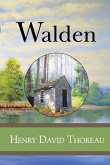
Henry David Thoreau’s 1854 Walden is an indisputable masterpiece of American literature. The book is an intensely influential philosophical work exploring Thoreau’s decision to expand his understanding of society through personal introspection from a small cabin at the edge of Concord Massachusetts. Rather than devolving into Luddite or antiquarian escapism, Thoreau takes this reprise from daily life to engage in philosophical explorations of man, nature and those things which mediate between the two. These explorations are the central reason why Walden endures within the cannon of American…mehr
Henry David Thoreau’s 1854 Walden is an indisputable masterpiece of American literature. The book is an intensely influential philosophical work exploring Thoreau’s decision to expand his understanding of society through personal introspection from a small cabin at the edge of Concord Massachusetts. Rather than devolving into Luddite or antiquarian escapism, Thoreau takes this reprise from daily life to engage in philosophical explorations of man, nature and those things which mediate between the two. These explorations are the central reason why Walden endures within the cannon of American philosophical thought and would go on to confer the moniker, "the father of environmentalism" upon Thoreau. Thoreau’s decision to move into the woodlands near Walden Pond initiates an exploration of a central theme; the exploration of barriers between man and nature (ultimately the divine). Imminently quotable and often paraphrased, Walden offers the reader a number starting points for examining our environment and the nature of our relationship with the aforesaid. Walden stands the test of time because the concepts explored within this work are perennial in nature. "We do not ride on the railroad; it rides upon us", quoted from the book could easily question our 21st century relationship with digital technology. Moreover, the American belief in self-reliance is expanded in Walden into the concept of spiritual self-reliance. The adjoining work, Civil Disobedience is equally influential having informed the non-violent resistance movements of Leo Tolstoy, Mohandas K. Gandhi, and Martin Luther King, Jr.
Henry David Thoreau was an American author who lived from July 12, 1817, to May 6, 1862. He wrote essays, poems, and philosophical works. More than 20 books, articles, essays, diaries, and poems were written by Thoreau. His works on natural history and philosophy, in which he predicted the methods and results of ecology and environmental history, two sources of modern environmentalism, are some of the things that will last forever. He writes in a way that combines close observation of nature, personal experience, sharp rhetoric, symbolic meanings, and historical knowledge. It has a poetic sensibility, a philosophical austerity, and an attention to practical detail. He was also very interested in how to survive in harsh conditions, as well as in historical change and natural decay. At the same time, he pushed people to give up waste and fantasy in order to find out what life's real needs are. Thoreau fought against slavery his whole life. In his speeches, he criticized the law for fugitive slaves, praised the works of Wendell Phillips, and defended John Brown, who also worked to end slavery.
Es gelten unsere Allgemeinen Geschäftsbedingungen: www.buecher.de/agb
Impressum
www.buecher.de ist ein Internetauftritt der buecher.de internetstores GmbH
Geschäftsführung: Monica Sawhney | Roland Kölbl | Günter Hilger
Sitz der Gesellschaft: Batheyer Straße 115 - 117, 58099 Hagen
Postanschrift: Bürgermeister-Wegele-Str. 12, 86167 Augsburg
Amtsgericht Hagen HRB 13257
Steuernummer: 321/5800/1497
USt-IdNr: DE450055826