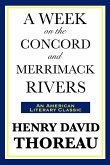
In 1845, Henry David Thoreau went into the woods to experience a simplistic lifestyle dictated by his transcendentalist beliefs. The life he lived, including how and why he chose to seclude himself from society, is detailed in Walden. Thoreau demonstrates the utility of living both simply and deliberately while appreciating the serenity of nature. He chose to live fully in nature by Walden Pond for two years and details the lasting impression this time had on him. While living modestly in the woods may not be the call-to-action for all, it is still possible to appreciate and perhaps even adopt…mehr
In 1845, Henry David Thoreau went into the woods to experience a simplistic lifestyle dictated by his transcendentalist beliefs. The life he lived, including how and why he chose to seclude himself from society, is detailed in Walden. Thoreau demonstrates the utility of living both simply and deliberately while appreciating the serenity of nature. He chose to live fully in nature by Walden Pond for two years and details the lasting impression this time had on him. While living modestly in the woods may not be the call-to-action for all, it is still possible to appreciate and perhaps even adopt some of Thoreau’s beliefs. Included in this book is "Civil Disobedience", Thoreau’s famous essay which has influenced figures such as Gandhi, Leo Tolstoy, and Martin Luther King Jr.
Henry David Thoreau, born July 12, 1817, was a naturalist, author, philosopher and transcendentalist who was best known for his 1854 book Walden; or Life in the Woods. That book, and many of Thoreau's essays and speeches, concerned themselves with the importance of living a plain and simple life in natural environments removed from civilization, leading to more self-reliance and spiritual discovery. Thoreau's other most well-known work is his 1849 essay "Civil Disobedience" which led to his often being referred to as an anarchist, which he heartily accepted. In his later years he maintained his fascination with travel and excursions and became more interested in land surveying. He died on May 6, 1862, at the age of 44 just a couple of years after a late-night rainstorm outing to count the rings of tree stumps when he fell ill with bronchitis, which eventually led to him becoming bedridden. Ralph Waldo Emerson, who wrote the biographical sketch to Excursions, which was published a posthumously in 1862, wrote the eulogy that was read at Thoreau's funeral. His remains, originally buried at a family plot, were later relocated to Author's Ridge at Sleepy Hollow Cemetery in Concord, Massachusetts. Other notable writers buried in that location include Louisa May Alcott, Nathaniel Hawthorne, and Ralph Waldo Emerson.
Es gelten unsere Allgemeinen Geschäftsbedingungen: www.buecher.de/agb
Impressum
www.buecher.de ist ein Internetauftritt der buecher.de internetstores GmbH
Geschäftsführung: Monica Sawhney | Roland Kölbl | Günter Hilger
Sitz der Gesellschaft: Batheyer Straße 115 - 117, 58099 Hagen
Postanschrift: Bürgermeister-Wegele-Str. 12, 86167 Augsburg
Amtsgericht Hagen HRB 13257
Steuernummer: 321/5800/1497
USt-IdNr: DE450055826