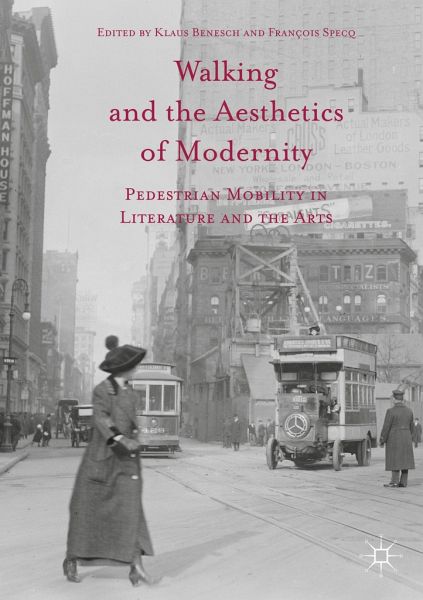
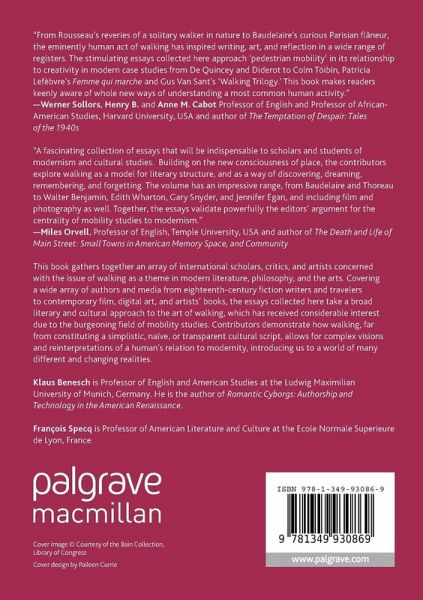
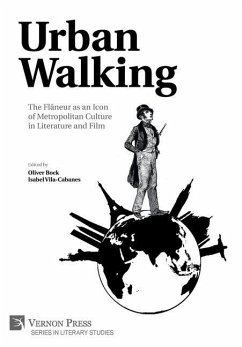
This book gathers together an array of international scholars, critics, and artists concerned with the issue of walking as a theme in modern literature, philosophy, and the arts. Covering a wide array of authors and media from eighteenth-century fiction writers and travelers to contemporary film, digital art, and artists' books, the essays collected here take a broad literary and cultural approach to the art of walking, which has received considerable interest due to the burgeoning field of mobility studies. Contributors demonstrate how walking, far from constituting a simplistic, naïve, or…mehr
This book gathers together an array of international scholars, critics, and artists concerned with the issue of walking as a theme in modern literature, philosophy, and the arts. Covering a wide array of authors and media from eighteenth-century fiction writers and travelers to contemporary film, digital art, and artists' books, the essays collected here take a broad literary and cultural approach to the art of walking, which has received considerable interest due to the burgeoning field of mobility studies. Contributors demonstrate how walking, far from constituting a simplistic, naïve, or transparent cultural script, allows for complex visions and reinterpretations of a human's relation to modernity, introducing us to a world of many different and changing realities.
Klaus Benesch is Professor of English and American Studies at the Ludwig Maximilian University of Munich, Germany. He is the author of Romantic Cyborgs: Authorship and Technology in the American Renaissance . François Specq is Professor of American Literature and Culture at the Ecole Normale Superieure de Lyon, France.
Inhaltsangabe
Klaus Benesch and François Specq, Modern(s) Walking: An Introduction.- Part I. Poetics.- Emmanuelle Peraldo, Walking the streets of London in the eighteenth century: a performative art?.- Juliette Fabre, Musing, Painting & Writing: Walking as an Art in Diderot's Promenade Vernet(Salon de 1767).- Estelle Murail, "Du croisement de leurs innombrables rapports": Baudelaire and De Quincey's flâneurs.- Thomas Pughe, How Poetry Comes to Him: An Excursion to Gary Snyder's Wild Poetics.- Lacy Rumsey, Revisiting the American "walk poem": A.R. Ammons, Charles Olson, and Jonathan Williams.- Part II. Performance.- Isabelle Baudino, Marianne Colston's Art of Walking: Gendering the Picturesque in Journal of a Tour in France, Switzerland, and Italy.- Bridget Sheridan, Following Footprints: photography, writing and the artist's book in art walking.- Gabrielle Finnane, Wayfaring in the Megacity: Tsai Ming Liang's Walker and Lav Diaz's Melancholia.- Tatiana Pogossian, The Art of Walking in Space and Time:the Quest for London.- Andrew Goodman, Walking with the world: towards an ecological approach to performative art practice.- Part III. Pathology.- Françoise Dupeyron-Lafay, The Art of Walking and the Mindscapes of Trauma in Thomas De Quincey's Autobiographical Works: The Pains of Wandering, the Pains of Remembering.- Sarah Mombert, Writing Dromomania in the Romantic Era: Nerval, Collins and Charlotte Brontë.- Catherine M. Welter, A Juggernaut in the Streets of London: Walking as Destructive Force in R.L. Stevenson's Strange Case of Dr. Jekyll and Mr. Hyde.- Amélie Moisy, Thomas Wolfe and the urban night prowl: walking, modernism and myth.- Sophie Walon, Existential wanderings in Gus Van Sant's "Walking Trilogy": Gerry, Elephant, and Last Days.- Part IV. Politics.- Julien Nègre, Perambulating the village: Henry David Thoreau and the politics of"Walking".- Virginia Ricard, Walking in Wartime: Edith Wharton's "The Look of Paris".- Andrew S. Gross, Pound, Peripatetic Verse, and the Postwar Liberal Aesthetic.- Marie Mianowski, The art of the 'good step' in Colm Tóibín's Bad Blood: A Walk Along the Irish Border (1987).- Andrew Estes, Walking and Technology in the Fiction of Jennifer Egan: Moving towards the Posthuman.
Klaus Benesch and François Specq, Modern(s) Walking: An Introduction.- Part I. Poetics.- Emmanuelle Peraldo, Walking the streets of London in the eighteenth century: a performative art?.- Juliette Fabre, Musing, Painting & Writing: Walking as an Art in Diderot's Promenade Vernet(Salon de 1767).- Estelle Murail, "Du croisement de leurs innombrables rapports": Baudelaire and De Quincey's flâneurs.- Thomas Pughe, How Poetry Comes to Him: An Excursion to Gary Snyder's Wild Poetics.- Lacy Rumsey, Revisiting the American "walk poem": A.R. Ammons, Charles Olson, and Jonathan Williams.- Part II. Performance.- Isabelle Baudino, Marianne Colston's Art of Walking: Gendering the Picturesque in Journal of a Tour in France, Switzerland, and Italy.- Bridget Sheridan, Following Footprints: photography, writing and the artist's book in art walking.- Gabrielle Finnane, Wayfaring in the Megacity: Tsai Ming Liang's Walker and Lav Diaz's Melancholia.- Tatiana Pogossian, The Art of Walking in Space and Time:the Quest for London.- Andrew Goodman, Walking with the world: towards an ecological approach to performative art practice.- Part III. Pathology.- Françoise Dupeyron-Lafay, The Art of Walking and the Mindscapes of Trauma in Thomas De Quincey's Autobiographical Works: The Pains of Wandering, the Pains of Remembering.- Sarah Mombert, Writing Dromomania in the Romantic Era: Nerval, Collins and Charlotte Brontë.- Catherine M. Welter, A Juggernaut in the Streets of London: Walking as Destructive Force in R.L. Stevenson's Strange Case of Dr. Jekyll and Mr. Hyde.- Amélie Moisy, Thomas Wolfe and the urban night prowl: walking, modernism and myth.- Sophie Walon, Existential wanderings in Gus Van Sant's "Walking Trilogy": Gerry, Elephant, and Last Days.- Part IV. Politics.- Julien Nègre, Perambulating the village: Henry David Thoreau and the politics of"Walking".- Virginia Ricard, Walking in Wartime: Edith Wharton's "The Look of Paris".- Andrew S. Gross, Pound, Peripatetic Verse, and the Postwar Liberal Aesthetic.- Marie Mianowski, The art of the 'good step' in Colm Tóibín's Bad Blood: A Walk Along the Irish Border (1987).- Andrew Estes, Walking and Technology in the Fiction of Jennifer Egan: Moving towards the Posthuman.
Es gelten unsere Allgemeinen Geschäftsbedingungen: www.buecher.de/agb
Impressum
www.buecher.de ist ein Internetauftritt der buecher.de internetstores GmbH
Geschäftsführung: Monica Sawhney | Roland Kölbl | Günter Hilger
Sitz der Gesellschaft: Batheyer Straße 115 - 117, 58099 Hagen
Postanschrift: Bürgermeister-Wegele-Str. 12, 86167 Augsburg
Amtsgericht Hagen HRB 13257
Steuernummer: 321/5800/1497
USt-IdNr: DE450055826