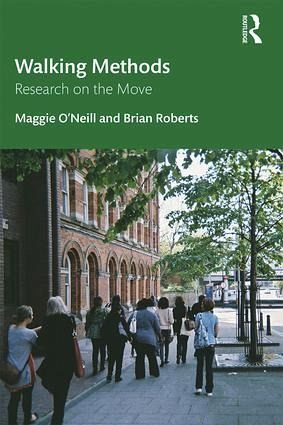
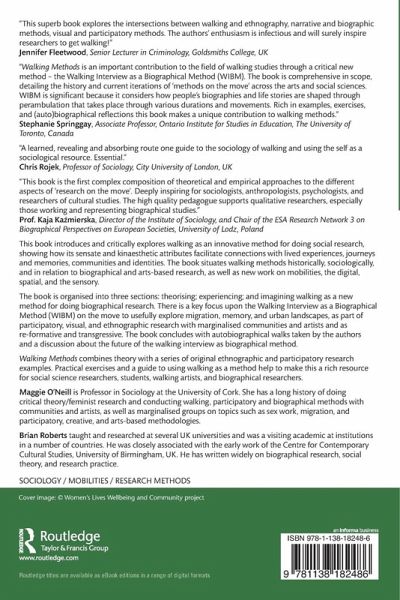
This book introduces and critically explores walking as an innovative method for doing social research, showing how its sensate and kinaesthetic attributes facilitate connections with lived experiences, journeys and memories, communities and identities.
This book introduces and critically explores walking as an innovative method for doing social research, showing how its sensate and kinaesthetic attributes facilitate connections with lived experiences, journeys and memories, communities and identities.
Maggie O'Neill is Professor in Sociology at the University of Cork. She has a long history of doing critical theory/feminist research and conducting walking, participatory and biographical methods with communities and artists, as well as marginalised groups on topics such as sex work, migration, and participatory, creative, and arts-based methodologies. Brian Roberts taught and researched at several UK universities and was a visiting academic at institutions in a number of countries. He was closely associated with the early work of the Centre for Contemporary Cultural Studies, University of Birmingham, UK. He has written widely on biographical research, social theory, and research practice.
Inhaltsangabe
Introduction Part I: Theorizing/Observing/Thinking 1. Methods on the Move: Moving Methods 2. Theorizing Walking in the Sociological Imagination - Walking in Context 3. Walking, Art-Making and Biographical Research Exercise One: Walking and Theorizing - Observing/Thinking Part II: Experiencing 4. Migration, Memory and Place - Connecting with Memory and Place in Urban Landscapes 5. Walking as Re-Formative and Transgressive: Health, Pilgrimage, Trespass, Marching 6. Walking in the Downtown Eastside - Experiencing the WIBM as Participatory, Visual and Ethnographic Exercise Two: Walking, Sensing, Experiencing Part III: Imagining 7. Walking, Sex Work, and Community: Towards a Radical Democratic and Imaginative Space for addressing Sexual and Social Inequalities 8. The Phenomenology of Walking in a Garden 9. Walking Artists: Critical Dialogues and Imaginaries 10. Auto/Biographical Encounters in Time and Space - Roots and Routes Exercise Three: Walking and Imagining - Time/Memory/Making Conclusion: The Future of the Walking Interview as a Biographical Method Exercise Four: WIBM Exercise - Observing, Experiencing, Imagining The Walking Interview as a Biographical Method - Principles and Practice: A Framework
Introduction Part I: Theorizing/Observing/Thinking 1. Methods on the Move: Moving Methods 2. Theorizing Walking in the Sociological Imagination - Walking in Context 3. Walking, Art-Making and Biographical Research Exercise One: Walking and Theorizing - Observing/Thinking Part II: Experiencing 4. Migration, Memory and Place - Connecting with Memory and Place in Urban Landscapes 5. Walking as Re-Formative and Transgressive: Health, Pilgrimage, Trespass, Marching 6. Walking in the Downtown Eastside - Experiencing the WIBM as Participatory, Visual and Ethnographic Exercise Two: Walking, Sensing, Experiencing Part III: Imagining 7. Walking, Sex Work, and Community: Towards a Radical Democratic and Imaginative Space for addressing Sexual and Social Inequalities 8. The Phenomenology of Walking in a Garden 9. Walking Artists: Critical Dialogues and Imaginaries 10. Auto/Biographical Encounters in Time and Space - Roots and Routes Exercise Three: Walking and Imagining - Time/Memory/Making Conclusion: The Future of the Walking Interview as a Biographical Method Exercise Four: WIBM Exercise - Observing, Experiencing, Imagining The Walking Interview as a Biographical Method - Principles and Practice: A Framework
Es gelten unsere Allgemeinen Geschäftsbedingungen: www.buecher.de/agb
Impressum
www.buecher.de ist ein Internetauftritt der buecher.de internetstores GmbH
Geschäftsführung: Monica Sawhney | Roland Kölbl | Günter Hilger
Sitz der Gesellschaft: Batheyer Straße 115 - 117, 58099 Hagen
Postanschrift: Bürgermeister-Wegele-Str. 12, 86167 Augsburg
Amtsgericht Hagen HRB 13257
Steuernummer: 321/5800/1497
USt-IdNr: DE450055826