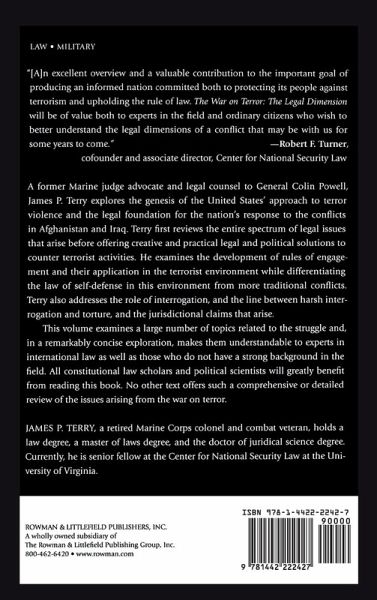
Examining the legal dimension of the war on terror, James P. Terry carefully explores the myriad juridical concerns that must be addressed in prosecuting a war with few established legal boundaries.
Examining the legal dimension of the war on terror, James P. Terry carefully explores the myriad juridical concerns that must be addressed in prosecuting a war with few established legal boundaries.
James P Terry, a retired Marine Corps colonel and combat veteran, holds a law degree, a master of laws degree, and the doctor of juridical science degree. Currently, he is Senior Fellow at the Center for National Security Law at the University of Virginia. He and his wife Dr Michelle Terry live in Annandale, Virginia.
Inhaltsangabe
Preface Foreword I. The Threat of Terrorism in Perspective II. Legal Requirements for Unconventional Warfare: The Operational Context III. State-Sponsored Terrorism: The International Political Context IV. The Law of Self-Defense as Applied to the Terrorist Threat in Iraq and Southwest Asia V. The Development of Rules of Engagement and Their Application in the Terrorist Environment VI. Use of Force by the President: Defensive Uses Short of War VII. Covert Action and the War on Terror VIII. Access to Federal Courts for Enemy Combatants IX. Torture and the Interrogation of Detainees X. Federal Court or Military Commission: The Dilemma XI. The International Criminal Court and the Trial of Terror-Related Crimes XII. High Seas Terror and the Elimination of Piracy XIII. Outsourcing Defense Support Operations in the War on Terror XIV. Stabilization Operations: Addressing Post-Conflict Unrest in Iraq and Afghanistan XV. Environmental Terrorism: From Oil Fires to Fouling Gulf Waters XVI. Defense of Critical Computer Infrastructure from Terrorists: Computer Network Defense (CND) XVII. The Legality of Attack on Foreign Infrastructure Posing a Threat to the U.S.: Computer Network Attack (CNA) XVIII. War Powers in the Age on Terror: The 2011 Libya Operation XIX. The War on Terror and Media Access XX. Future Perspectives in Addressing Terror Violence Appendix: Selected Bibliography and Sources About the author
Preface Foreword I. The Threat of Terrorism in Perspective II. Legal Requirements for Unconventional Warfare: The Operational Context III. State-Sponsored Terrorism: The International Political Context IV. The Law of Self-Defense as Applied to the Terrorist Threat in Iraq and Southwest Asia V. The Development of Rules of Engagement and Their Application in the Terrorist Environment VI. Use of Force by the President: Defensive Uses Short of War VII. Covert Action and the War on Terror VIII. Access to Federal Courts for Enemy Combatants IX. Torture and the Interrogation of Detainees X. Federal Court or Military Commission: The Dilemma XI. The International Criminal Court and the Trial of Terror-Related Crimes XII. High Seas Terror and the Elimination of Piracy XIII. Outsourcing Defense Support Operations in the War on Terror XIV. Stabilization Operations: Addressing Post-Conflict Unrest in Iraq and Afghanistan XV. Environmental Terrorism: From Oil Fires to Fouling Gulf Waters XVI. Defense of Critical Computer Infrastructure from Terrorists: Computer Network Defense (CND) XVII. The Legality of Attack on Foreign Infrastructure Posing a Threat to the U.S.: Computer Network Attack (CNA) XVIII. War Powers in the Age on Terror: The 2011 Libya Operation XIX. The War on Terror and Media Access XX. Future Perspectives in Addressing Terror Violence Appendix: Selected Bibliography and Sources About the author
Es gelten unsere Allgemeinen Geschäftsbedingungen: www.buecher.de/agb
Impressum
www.buecher.de ist ein Internetauftritt der buecher.de internetstores GmbH
Geschäftsführung: Monica Sawhney | Roland Kölbl | Günter Hilger
Sitz der Gesellschaft: Batheyer Straße 115 - 117, 58099 Hagen
Postanschrift: Bürgermeister-Wegele-Str. 12, 86167 Augsburg
Amtsgericht Hagen HRB 13257
Steuernummer: 321/5800/1497
USt-IdNr: DE450055826