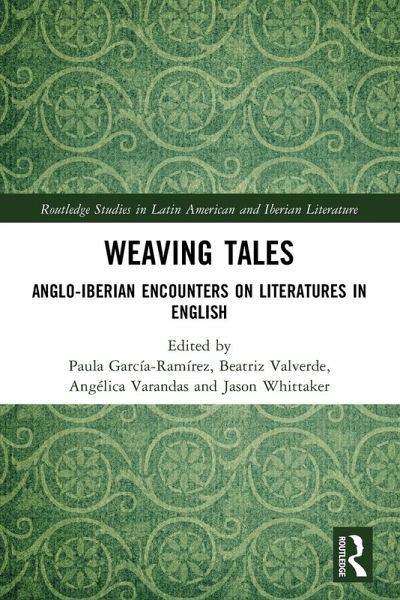
This collection of essays brings together a wide range of Spanish and Portuguese academics and writers exploring the ways in which our encounters with literatures in English inform our assumptions about texts and identities (or texts as identities) and the way we read them. Mapping, examining, reading and re-reading, fashioning and self-fashioning and, especially, weaving appear as appropriate images that convey the complexity and the nature of creative writing. Such a metaphor has been fundamental for the history of world literature since the Roman poet Ovid had included a tale in his…mehr
This collection of essays brings together a wide range of Spanish and Portuguese academics and writers exploring the ways in which our encounters with literatures in English inform our assumptions about texts and identities (or texts as identities) and the way we read them. Mapping, examining, reading and re-reading, fashioning and self-fashioning and, especially, weaving appear as appropriate images that convey the complexity and the nature of creative writing. Such a metaphor has been fundamental for the history of world literature since the Roman poet Ovid had included a tale in his Metamorphoses in which weaving, narration, uncertain identities, and the risks of telling uncomfortable truths all figure prominently. As such, these essays trace the intertwined patterns that knit texts together, weaving identities as well as undoing them and, in the process, interrogating established and official truths.
Produktdetails
Produktdetails
Routledge Studies in Latin American and Iberian Literature
Paula García-Ramírez is Associate Professor at the Department of English Philology at the Universidad de Jaén. She is a specialist in English-speaking postcolonial literature, with particular attention to African literature. Within this field of research, she has published several studies on authors including Chinua Achebe, Wole Soyinka, Ben Okri, Ngugi Wa Thiong'o, among others. Beatriz Valverde Jiménez is Assistant Professor at the Department of English Philology at the Universidad de Jaén. She has been a visiting researcher at Loyola University Chicago, Georgetown University and Boston College. She has published articles in journals such as English Studies, and European Journal of English Studies, and with Mark Bosco (Georgetown University) has also edited Reading Flannery O'Connor in Spain: From Andalusia to Andalucía (2020). Angélica Varandas is Assistant Professor of Medieval English Literature and Culture at the Department of English Studies of the School of Arts and Humanities of the University of Lisbon where she also teaches Fantasy Literature and Science Fiction in English and English Descriptive Linguistics. Her main area of research is English Medieval Literature and Culture as well as medievalism. She co-edited the book From Manuscript to Digital in 2020. She is also the author of two books published in 2012, Mitos e Lendas Celtas: Irlanda and Mitos e Lendas Celtas: País de Gales. With a colleague, she has just published the first Portuguese critical edition of the translation of Beowulf from the Old English (Lisboa: Assírio e Alvim, 2022). At the moment, she is the Principal Investigator of the research project English Studies Literature at ULICES (University of Lisbon Center for English Studies) and she is a member of the Executive Board of the same Research Center. Jason Whittaker is a Professor in the College of Arts at the University of Lincoln. He specializes in Romantic literature and the reception of William Blake, and his most recent books include Divine Images: The Life and Work of William Blake (2021) and Jerusalem: Blake, Parry and the Fight for Englishness (2022).
Inhaltsangabe
Acknowledgments; List of Contributors; Introduction: Weaving Tales 1. Urizen Now: Reading Anew William Blake's Response to His Times, Alcinda Pinheiro de Sousa and Jason Whitaker 2. William Blake in Spanish Popular Culture and Literature, M. Cecilia Marchetto Santorun 3. (Re)reading Classical Mythology through the Aztec Gods: Cherríe Moraga's Lesbian Mexican Medea, Marta Villalba-Lázaro 4. From Influence to Response: Angela Carter's Selected Novels Come to Terms with William Shakespeare's Tragedies, Maria José Pires 5. PD James's The Black Tower: "almost Iris Murdoch with murders in it"?, Jesús Nieto 6. Romanticism and heteronymic theory: John Keats and the Poetics of Fernando Pessoa, Nuno Ribeiro 7. Jennifer Egan and Digital Fiction after Postmodernism, Mairi Power 8. "Non Angli, sed angeli": The Christianization of the Anglo-Saxons and the dawn of Englishness, Angélica Varandas 9. Exploring the "Outsider Consciousness" in a Selection of Stories by Alice Munro, Pilar Sánchez Calle 10. Depiction of Enforced Identity in Hazaar Chaurasi Ki Maa - The Novel and the Film, Ritu Mohan 11. A Transmodern Reading of Joanna Kavenna's Zed: Digital Reason and the Attempt to Transcend Cartesian Dialectics, Jessica Aliaga Lavrijsen 12. Hospitable Loci: the Spatialisation of Oppositional Worldviews in the Eighteenth- Century Women's Writings, Yolanda Caballero Aceituno 13. "REMEMBEREST THOU ME?" Violent Women in Louisa Medina Hamblin's The Panorama of Life, Milagros López-Peláez Casellas 14. Patriarchal Orthorexia and Embodied Dissidence in Contemporary Feminist Dystopias, Almudena Machado-Jiménez 15. Instapoetry and the Transmodern Paradigm: Transnational Feminism in Nikita Gill's Work, Alejandro Nadal Ruiz 16. Index
Acknowledgments; List of Contributors; Introduction: Weaving Tales 1. Urizen Now: Reading Anew William Blake's Response to His Times, Alcinda Pinheiro de Sousa and Jason Whitaker 2. William Blake in Spanish Popular Culture and Literature, M. Cecilia Marchetto Santorun 3. (Re)reading Classical Mythology through the Aztec Gods: Cherríe Moraga's Lesbian Mexican Medea, Marta Villalba-Lázaro 4. From Influence to Response: Angela Carter's Selected Novels Come to Terms with William Shakespeare's Tragedies, Maria José Pires 5. PD James's The Black Tower: "almost Iris Murdoch with murders in it"?, Jesús Nieto 6. Romanticism and heteronymic theory: John Keats and the Poetics of Fernando Pessoa, Nuno Ribeiro 7. Jennifer Egan and Digital Fiction after Postmodernism, Mairi Power 8. "Non Angli, sed angeli": The Christianization of the Anglo-Saxons and the dawn of Englishness, Angélica Varandas 9. Exploring the "Outsider Consciousness" in a Selection of Stories by Alice Munro, Pilar Sánchez Calle 10. Depiction of Enforced Identity in Hazaar Chaurasi Ki Maa - The Novel and the Film, Ritu Mohan 11. A Transmodern Reading of Joanna Kavenna's Zed: Digital Reason and the Attempt to Transcend Cartesian Dialectics, Jessica Aliaga Lavrijsen 12. Hospitable Loci: the Spatialisation of Oppositional Worldviews in the Eighteenth- Century Women's Writings, Yolanda Caballero Aceituno 13. "REMEMBEREST THOU ME?" Violent Women in Louisa Medina Hamblin's The Panorama of Life, Milagros López-Peláez Casellas 14. Patriarchal Orthorexia and Embodied Dissidence in Contemporary Feminist Dystopias, Almudena Machado-Jiménez 15. Instapoetry and the Transmodern Paradigm: Transnational Feminism in Nikita Gill's Work, Alejandro Nadal Ruiz 16. Index
Es gelten unsere Allgemeinen Geschäftsbedingungen: www.buecher.de/agb
Impressum
www.buecher.de ist ein Internetauftritt der buecher.de internetstores GmbH
Geschäftsführung: Monica Sawhney | Roland Kölbl | Günter Hilger
Sitz der Gesellschaft: Batheyer Straße 115 - 117, 58099 Hagen
Postanschrift: Bürgermeister-Wegele-Str. 12, 86167 Augsburg
Amtsgericht Hagen HRB 13257
Steuernummer: 321/5800/1497
USt-IdNr: DE450055826