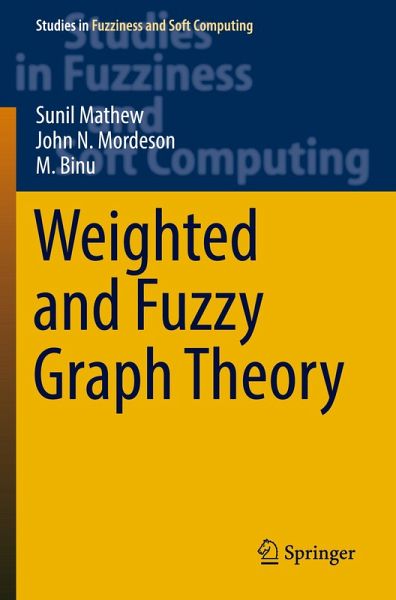
One of the most preeminent ways of applying mathematics in real-world scenario modeling involves graph theory. A graph can be undirected or directed depending on whether the pairwise relationships among objects are symmetric or not. Nevertheless, in many real-world situations, representing a set of complex relational objects as directed or undirected is not su¢ cient. Weighted graphs o§er a framework that helps to over come certain conceptual limitations. We show using the concept of an isomorphism that weighted graphs have a natural connection to fuzzy graphs. As we show in the book, this…mehr
One of the most preeminent ways of applying mathematics in real-world scenario modeling involves graph theory. A graph can be undirected or directed depending on whether the pairwise relationships among objects are symmetric or not. Nevertheless, in many real-world situations, representing a set of complex relational objects as directed or undirected is not su¢ cient. Weighted graphs o§er a framework that helps to over come certain conceptual limitations. We show using the concept of an isomorphism that weighted graphs have a natural connection to fuzzy graphs. As we show in the book, this allows results to be carried back and forth between weighted graphs and fuzzy graphs. This idea is in keeping with the important paper by Klement and Mesiar that shows that many families of fuzzy sets are lattice isomorphic to each other. We also outline the important work of Head and Weinberger that show how results from ordinary mathematics can be carried over to fuzzy mathematics. We focus on the concepts connectivity, degree sequences and saturation, and intervals and gates in weighted graphs.
Dr. John N. Mordeson is Professor Emeritus of Mathematics at Creighton University. He received his B.S., M.S., and Ph.D. from Iowa State University. He is a Member of Phi Kappa Phi. He is the President of the Society for Mathematics of Uncertainty. He has published 15 books and 200 journal articles. He is on the editorial board of numerous journals. He has served as an external examiner of Ph.D. candidates from India, South Africa, Bulgaria, and Pakistan. He has refereed for numerous journals and granting agencies. He is particularly interested in applying mathematics of uncertainty to combat the problem of human trafficking. Dr. Sunil Mathew is currently a Faculty Member in the Department of Mathematics, NIT Calicut, India. He has acquired his masters from St. Joseph's College Devagiri, Calicut, and Ph.D. from National Institute of Technology Calicut in the area of Fuzzy Graph Theory. He has published more than 75 research papers and written two books. He is a member of several academic bodies and associations. He is editor and reviewer of several international journals. He has an experience of 20 years in teaching and research. His current research topics include fuzzy graph theory, bio-computational modeling, graph theory, fractal geometry, and chaos.
Inhaltsangabe
Graphs and Weighted Graphs.- Connectivity.- More on Connectivity.- Cycle Connectivity.- Distance and Convexity.- Degree Sequences and Saturation.- Intervals and Gates.- Weighted Graphs and Fuzzy Graphs.- Fuzzy Results from Crisp Results.
Graphs and Weighted Graphs.- Connectivity.- More on Connectivity.- Cycle Connectivity.- Distance and Convexity.- Degree Sequences and Saturation.- Intervals and Gates.- Weighted Graphs and Fuzzy Graphs.- Fuzzy Results from Crisp Results.
Es gelten unsere Allgemeinen Geschäftsbedingungen: www.buecher.de/agb
Impressum
www.buecher.de ist ein Internetauftritt der buecher.de internetstores GmbH
Geschäftsführung: Monica Sawhney | Roland Kölbl | Günter Hilger
Sitz der Gesellschaft: Batheyer Straße 115 - 117, 58099 Hagen
Postanschrift: Bürgermeister-Wegele-Str. 12, 86167 Augsburg
Amtsgericht Hagen HRB 13257
Steuernummer: 321/5800/1497
USt-IdNr: DE450055826