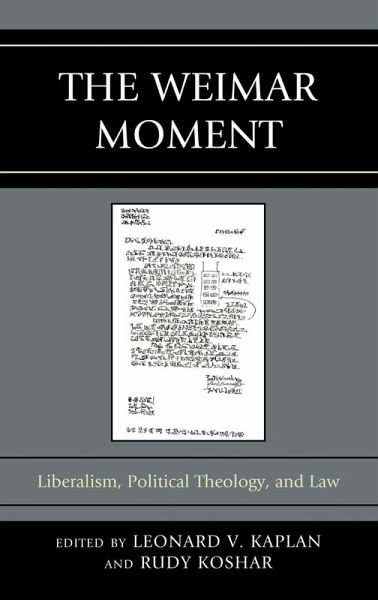
The Weimar Moment's evocative assault on closure and political reaction, its offering of democracy against the politics of narrow self-interest cloaked in nationalist appeals to Volk and "community"-or, as would be the case in Nazi Germany, "race"-cannot but appeal to us today. This appeal-its historical grounding and content, its complexities and tensions, its variegated expressions across the networks of power and thought-is the essential context of the present volume, whose basic premise is unhappiness with Hegel's remark that we learn no more from history than we cannot learn from it. The…mehr
The Weimar Moment's evocative assault on closure and political reaction, its offering of democracy against the politics of narrow self-interest cloaked in nationalist appeals to Volk and "community"-or, as would be the case in Nazi Germany, "race"-cannot but appeal to us today. This appeal-its historical grounding and content, its complexities and tensions, its variegated expressions across the networks of power and thought-is the essential context of the present volume, whose basic premise is unhappiness with Hegel's remark that we learn no more from history than we cannot learn from it. The challenge of the papers in this volume is to provide the material to confront the present effectively drawing from what we can and do understand.
Leonard V. Kaplan is Mortimer M. Jackson Professor of Law at the University of Wisconsin Law School. Rudy Koshar is the George L. Mosse WARF Professor of History, German & Religious Studies at the University of Wisconsin-Madison.
Inhaltsangabe
Introduction Rudy Koshar I. Political Theologies Chapter 1: Protestant Revolt Against Modernity by Klaus Tanner Chapter 2: Catholic Anti-Liberalism in the Weimar Republic: Political Theology and its Criticsby Michael Hollerich Chapter 3: "Together a Step Towards the Messianic Goal": Jewish-Protestant Encounter in the Weimar Republic by Ulrich Rosenhagen Chapter 4: Hannah Arendt in Weimar: Beyond the Theological-Political Predicament? by Rodrigo Chacón Chapter 5: Walter Benjamin, Religion, and a Theological Politics, ca. 1922 by Michael Jennings Chapter 6: The Creaturely Limits of Knowledge: Martin Heidegger's Theological Critique of Immanuel Kant by Samuel Moyn and Azzan Yadin-Israel Chapter 7: Politics, Theology, Race, and Religion: The 1916-1924 Dialogue of Franz Rosenzweig and Eugen Rosenstock-Huessy by Gregory Kaplan Chapter 8: Authority Beyond the Bounds of Mere Reason: A Political-Theological Sketch of the Schmitt-Strauss Exchange by John McCormick Chapter 9: The Political from Weimar to the Present by Leonard Kaplan II. Karl Barth Chapter 10: Barthian Dialectics: "Yes" and "No" on the Barthian Revolt and its Legacy by Gary Dorrien Chapter 11: Karl Barth and the Weimar Republic by Christophe Chalamet Chapter 12: Theology's Weimar Moment: History before the Eschatological Limit by Michael McGillen Chapter 13: Barth Among Anselm and Augustine: Realism in Karl Barth's Anselm Commentary by Carl Rasmussen Chapter 14: Demythologizing the Secular: Karl Barth and the Politics of the Weimar Republic by Rudy Koshar Liberalism, Law, Politics Chapter 15: German Idealism and German Liberalism in the 1920s: Remarks on Ernst Cassirer and the Historicity of Interpretation by Peter Gordon Chapter 16: Sovereignty, Constitutionalism, and the Myth of the State: Article Four of the Weimar Constitution by Peter Caldwell Chapter 17: The Grammar of Laws by Robert Gibbs Chapter 18: Haunted by the Ghost of Weimar: Leo Strauss' Critique of Hans Kelsen by David Novak Chapter 19: Displacement, Abstraction and Historical Specificity: Comments on the Frankfurt School's Critical Theory by Jeffrey Herf Chapter 20: The Ideological Struggle for the German Soul in Thomas Mann's Magic Mountain by Garbriel Ricci Chapter 21: The Limits of Dictatorship and the Origins of Democracy: The Political Theory of Carl J. Friedrich from Weimar to the Cold War by Udi Greenberg Conclusion: Notes toward a Theory of Political and Legal Resistance by Leonard Kaplan
Introduction Rudy Koshar I. Political Theologies Chapter 1: Protestant Revolt Against Modernity by Klaus Tanner Chapter 2: Catholic Anti-Liberalism in the Weimar Republic: Political Theology and its Criticsby Michael Hollerich Chapter 3: "Together a Step Towards the Messianic Goal": Jewish-Protestant Encounter in the Weimar Republic by Ulrich Rosenhagen Chapter 4: Hannah Arendt in Weimar: Beyond the Theological-Political Predicament? by Rodrigo Chacón Chapter 5: Walter Benjamin, Religion, and a Theological Politics, ca. 1922 by Michael Jennings Chapter 6: The Creaturely Limits of Knowledge: Martin Heidegger's Theological Critique of Immanuel Kant by Samuel Moyn and Azzan Yadin-Israel Chapter 7: Politics, Theology, Race, and Religion: The 1916-1924 Dialogue of Franz Rosenzweig and Eugen Rosenstock-Huessy by Gregory Kaplan Chapter 8: Authority Beyond the Bounds of Mere Reason: A Political-Theological Sketch of the Schmitt-Strauss Exchange by John McCormick Chapter 9: The Political from Weimar to the Present by Leonard Kaplan II. Karl Barth Chapter 10: Barthian Dialectics: "Yes" and "No" on the Barthian Revolt and its Legacy by Gary Dorrien Chapter 11: Karl Barth and the Weimar Republic by Christophe Chalamet Chapter 12: Theology's Weimar Moment: History before the Eschatological Limit by Michael McGillen Chapter 13: Barth Among Anselm and Augustine: Realism in Karl Barth's Anselm Commentary by Carl Rasmussen Chapter 14: Demythologizing the Secular: Karl Barth and the Politics of the Weimar Republic by Rudy Koshar Liberalism, Law, Politics Chapter 15: German Idealism and German Liberalism in the 1920s: Remarks on Ernst Cassirer and the Historicity of Interpretation by Peter Gordon Chapter 16: Sovereignty, Constitutionalism, and the Myth of the State: Article Four of the Weimar Constitution by Peter Caldwell Chapter 17: The Grammar of Laws by Robert Gibbs Chapter 18: Haunted by the Ghost of Weimar: Leo Strauss' Critique of Hans Kelsen by David Novak Chapter 19: Displacement, Abstraction and Historical Specificity: Comments on the Frankfurt School's Critical Theory by Jeffrey Herf Chapter 20: The Ideological Struggle for the German Soul in Thomas Mann's Magic Mountain by Garbriel Ricci Chapter 21: The Limits of Dictatorship and the Origins of Democracy: The Political Theory of Carl J. Friedrich from Weimar to the Cold War by Udi Greenberg Conclusion: Notes toward a Theory of Political and Legal Resistance by Leonard Kaplan
Es gelten unsere Allgemeinen Geschäftsbedingungen: www.buecher.de/agb
Impressum
www.buecher.de ist ein Internetauftritt der buecher.de internetstores GmbH
Geschäftsführung: Monica Sawhney | Roland Kölbl | Günter Hilger
Sitz der Gesellschaft: Batheyer Straße 115 - 117, 58099 Hagen
Postanschrift: Bürgermeister-Wegele-Str. 12, 86167 Augsburg
Amtsgericht Hagen HRB 13257
Steuernummer: 321/5800/1497
USt-IdNr: DE450055826