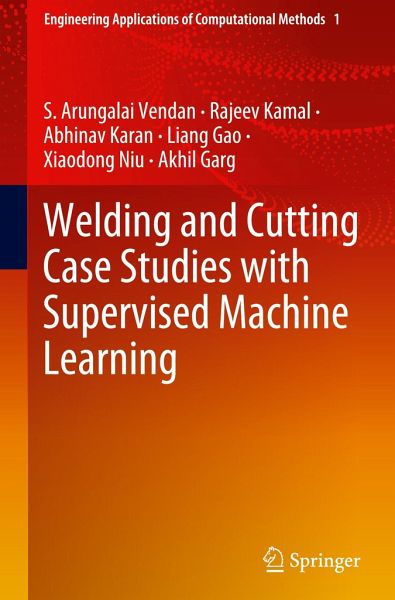
This book presents machine learning as a set of pre-requisites, co-requisites, and post-requisites, focusing on mathematical concepts and engineering applications in advanced welding and cutting processes. It describes a number of advanced welding and cutting processes and then assesses the parametrical interdependencies of two entities, namely the data analysis and data visualization techniques, which form the core of machine learning. Subsequently, it discusses supervised learning, highlighting Python libraries such as NumPy, Pandas and Scikit Learn programming. It also includes case studies…mehr
This book presents machine learning as a set of pre-requisites, co-requisites, and post-requisites, focusing on mathematical concepts and engineering applications in advanced welding and cutting processes. It describes a number of advanced welding and cutting processes and then assesses the parametrical interdependencies of two entities, namely the data analysis and data visualization techniques, which form the core of machine learning. Subsequently, it discusses supervised learning, highlighting Python libraries such as NumPy, Pandas and Scikit Learn programming. It also includes case studies that employ machine learning for manufacturing processes in the engineering domain. The book not only provides beginners with an introduction to machine learning for applied sciences, enabling them to address global competitiveness and work on real-time technical challenges, it is also a valuable resource for scholars with domain knowledge.
Produktdetails
Produktdetails
Engineering Applications of Computational Methods 1
Dr. S. Arungalai Vendan is an associate professor at the Industrial Automation and Instrumentation Division, VIT University, Vellore, India. He has been working on advanced welding processes since 2006. He received his Ph.D. degree from the National Institute of Technology (Institute of national importance), Tiruchirappalli, India in 2010. He has received several fellowships and awards for his technical contributions by various government agencies. He has successfully completed government funded research projects and industrial consultancy projects, and has published more than 70 research papers in international journal and conference proceedings. He has associations with top manufacturing industries and Research and Development centers under various capacities. His research interests mainly focus on the interdisciplinary science which has confluence of terminologies from electrical/mechanical/metallurgical/ materials and magnetic technologies. Prof. Liang Gao received his Ph.D. degree in Mechatronic Engineering from the Huazhong University of Science and Technology (HUST), Wuhan, China, in 2002. He is currently a professor at the Department of Industrial and Manufacturing System Engineering, School of Mechanical Science and Engineering, HUST and the vice director of the State Key Lab of Digital Manufacturing Equipment & Technology. His chief research interests include optimization in design and manufacturing, and he has published more than 150 academic papers,. He is currently an associate editor for Swarm and Evolutionary Computation and the Journal of Industrial and Production Engineering, and an editorial board member of the European Journal of Industrial Engineering and Operations Research Perspectives.Dr. Akhil Garg is an associate professor at the Ministry of Education's Intelligent Manufacturing Key Laboratory, Shantou University, China. He has been working on sustainable manufacturing processes and optimization methods since 2011. He received his doctoral degree from Nanyang Technological University (NTU), Singapore in 2014. He has published over 50 SCI-indexed articles in the areas of manufacturing and optimization. Dr. P. Kavitha is an associate professor at the School of Electrical Engineering, VIT University, Vellore, India. Her research interests include control systems, analog and digital circuits, advanced control theory, process automation and process control. Dr. G. Dhivyasri is an assistant professor at the School of Electrical Engineering, VIT University, Vellore, India. Dr. Dhivyasri's research interests include, control system, MEMS, sensors and signal conditioning, as well as analog & digital communication systems. Dr. Rahul SG is an assistant professor at the School of Electrical Engineering, VIT University, Vellore, India. His research interests include control systems, industrial instrumentation, analytical instrumentation, programmable logic controller (PLC), and digital electronics.
Inhaltsangabe
Supervised machine learning in magnetically impelled arc butt welding (MIAB).- Supervised machine learning in cold metal transfer (CMT).- Supervised machine learning in friction stir welding (FSW).- Supervised machine learning in wire cut electric discharge maching (WEDM).- Appendix: coding in python, numpy, panda, scikit-learn used for analysis with emphasis on libraries.
Supervised machine learning in magnetically impelled arc butt welding (MIAB).- Supervised machine learning in cold metal transfer (CMT).- Supervised machine learning in friction stir welding (FSW).- Supervised machine learning in wire cut electric discharge maching (WEDM).- Appendix: coding in python, numpy, panda, scikit-learn used for analysis with emphasis on libraries.
Es gelten unsere Allgemeinen Geschäftsbedingungen: www.buecher.de/agb
Impressum
www.buecher.de ist ein Internetauftritt der buecher.de internetstores GmbH
Geschäftsführung: Monica Sawhney | Roland Kölbl | Günter Hilger
Sitz der Gesellschaft: Batheyer Straße 115 - 117, 58099 Hagen
Postanschrift: Bürgermeister-Wegele-Str. 12, 86167 Augsburg
Amtsgericht Hagen HRB 13257
Steuernummer: 321/5800/1497
USt-IdNr: DE450055826