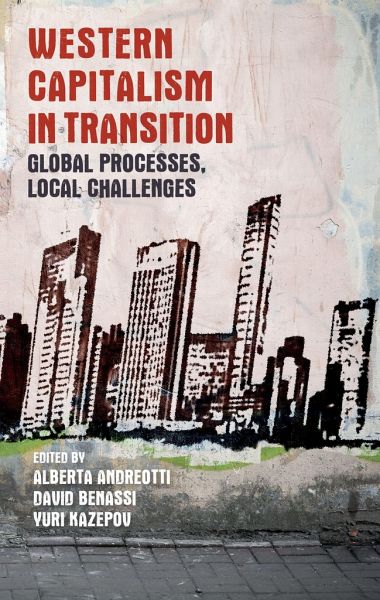
Since its emergence at the end of the seventeenth century, industrial capitalism as a specific form of social organisation has set recurrent challenges to its own persistence, and until today, it has proved to be successful to develop new ways of accumulation based on its capacity of adaptation. Is this process of transition now accelerating or reaching an end point? This book is a critical exploration of capitalism in transition, bringing together cutting edge, world renowned scholars who reflect from different disciplinary points of view. This collection engages with the primarily Western…mehr
Since its emergence at the end of the seventeenth century, industrial capitalism as a specific form of social organisation has set recurrent challenges to its own persistence, and until today, it has proved to be successful to develop new ways of accumulation based on its capacity of adaptation. Is this process of transition now accelerating or reaching an end point? This book is a critical exploration of capitalism in transition, bringing together cutting edge, world renowned scholars who reflect from different disciplinary points of view. This collection engages with the primarily Western themes of welfare capitalism and social fragmentation. Structured over three parts, the book analyses; the transformations of welfare societies and capitalism with a focus on South European welfare states and their (in)capacity to tackle poverty; the transformation of work and migration with a special attention to informality and the question of social rights; and the transformation of cities.
Alberta Andreotti is Associate Professor of Economic Sociology at the University of Milan-Bicocca David Benassi is Associate Professor of Economic Sociology at the University of Milan-Bicocca Yuri Kazepov is Professor of Urban Sociology at the University of Vienna
Inhaltsangabe
Framing the issues at stake 1 Western capitalism in transition: global processes, local challenges - Alberta Andreotti, David Benassi, Yuri Kazepov 2 A child of its times: the "new urban sociology" in context and its legacy - Michael Harloe Part I: The transformations of global capitalism 3 Abstract from the concrete: capitalism spiralling out of control - David Harvey 4 Rethinking social reproduction in an era of the dominance of finance capital - Gavin Smith 5 On the social (dis)embedding of the economy in a local context: where anthropology and sociology share metaphors as analytical tools - Simone Ghezzi Part II: Welfare capitalism and rights 6 The underclass and international comparison, variety and universalism - Jean-Claude Barbier 7 Welfare migration and civic stratification: Britain's emergent rights regime - Lydia Morris 8 The Mediterranean welfare states between recalibration and change in the cultural paradigm - Nicola Negri and Chiara Saraceno Part III: Citizenship and migration 9 Deconstructing labour demand: implications for low wage employment - Saskia Sassen 10 International migrations and the Mediterranean - Enrico Pugliese 11 Cities under economic austerity: the return of citizenship claims - Marisol García Part IV: Cities and urban transformations 12 The sense of touch - Richard Sennett 13 Urban disorder and the transformation of global governance - Sophie Body-Gendrot 14 Urban political economy beyond convergence: robust but differentiated unequal European cities - Patrick Le Galès Part V: Segregation and the spatial dimension of poverty 15 The spatial dimension of poverty - Susan S. Fainstein and Norman Fainstein 16 Urban segregation, inequalities and local welfare: the challenges of neoliberalisation - Marco Oberti and Edmond Préteceille 17 Urban poverty and social cohesion: lessons from Naples - Enrica Morlicchio Perspectives on the future of western capitalism 18 The double movement and the perspectives of contemporary capitalism - Enzo Mingione Index
Framing the issues at stake 1 Western capitalism in transition: global processes, local challenges - Alberta Andreotti, David Benassi, Yuri Kazepov 2 A child of its times: the "new urban sociology" in context and its legacy - Michael Harloe Part I: The transformations of global capitalism 3 Abstract from the concrete: capitalism spiralling out of control - David Harvey 4 Rethinking social reproduction in an era of the dominance of finance capital - Gavin Smith 5 On the social (dis)embedding of the economy in a local context: where anthropology and sociology share metaphors as analytical tools - Simone Ghezzi Part II: Welfare capitalism and rights 6 The underclass and international comparison, variety and universalism - Jean-Claude Barbier 7 Welfare migration and civic stratification: Britain's emergent rights regime - Lydia Morris 8 The Mediterranean welfare states between recalibration and change in the cultural paradigm - Nicola Negri and Chiara Saraceno Part III: Citizenship and migration 9 Deconstructing labour demand: implications for low wage employment - Saskia Sassen 10 International migrations and the Mediterranean - Enrico Pugliese 11 Cities under economic austerity: the return of citizenship claims - Marisol García Part IV: Cities and urban transformations 12 The sense of touch - Richard Sennett 13 Urban disorder and the transformation of global governance - Sophie Body-Gendrot 14 Urban political economy beyond convergence: robust but differentiated unequal European cities - Patrick Le Galès Part V: Segregation and the spatial dimension of poverty 15 The spatial dimension of poverty - Susan S. Fainstein and Norman Fainstein 16 Urban segregation, inequalities and local welfare: the challenges of neoliberalisation - Marco Oberti and Edmond Préteceille 17 Urban poverty and social cohesion: lessons from Naples - Enrica Morlicchio Perspectives on the future of western capitalism 18 The double movement and the perspectives of contemporary capitalism - Enzo Mingione Index
Es gelten unsere Allgemeinen Geschäftsbedingungen: www.buecher.de/agb
Impressum
www.buecher.de ist ein Internetauftritt der buecher.de internetstores GmbH
Geschäftsführung: Monica Sawhney | Roland Kölbl | Günter Hilger
Sitz der Gesellschaft: Batheyer Straße 115 - 117, 58099 Hagen
Postanschrift: Bürgermeister-Wegele-Str. 12, 86167 Augsburg
Amtsgericht Hagen HRB 13257
Steuernummer: 321/5800/1497
USt-IdNr: DE450055826