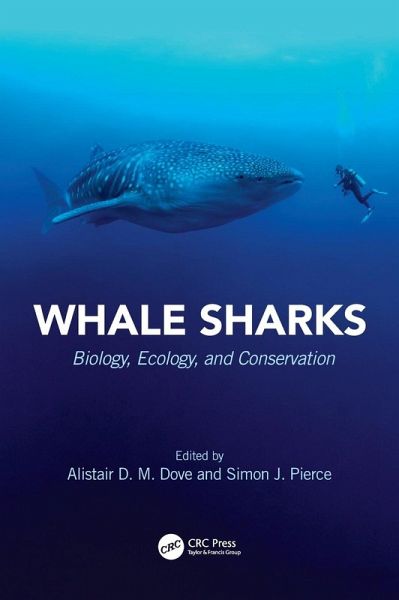
Written by the world's leading experts in whale shark biology, ecology, and conservation, this book is the first definitive volume about the world's biggest fish.
Written by the world's leading experts in whale shark biology, ecology, and conservation, this book is the first definitive volume about the world's biggest fish.
Alistair D.M. Dove Ph.D. is a broadly trained marine biologist and currently Vice President of Science and Education at Georgia Aquarium in Atlanta, USA, where he oversees international research programs on whale sharks, manta rays, coral reefs, sharks and dolphins. Alistair graduated from the University of Queensland in Brisbane, Australia with a B.Sc. Honours first class in 1995 and a Ph.D. in Microbiology and Parasitology in 1999, for which he was awarded a University Medal and Dean's List commendation. His early research focus was on parasites and diseases in freshwater and marine environments, but after a period studying diseases of lobsters, he began focusing on the biology and ecology of whale sharks after moving to Georgia Aquarium in 2006. Simon J. Pierce Ph.D. is a co-founder and Principal Scientist at the Marine Megafauna Foundation, where he leads the global whale shark research and conservation program. Simon is also a Co-Chair for the Sub-Equatorial Africa region within the IUCN Shark Specialist Group, a Science Advisor to the Wildbook for Whale Sharks global database, and a founding board member of the Sawfish Conservation Society. Simon holds a BSc in Ecology from Victoria University of Wellington in New Zealand, and a BSc (Hons, 1st Class) and doctoral degree in marine biology from The University of Queensland in Brisbane, Australia. Simon began working with whale sharks in Mozambique in 2005, and now leads or collaborates on conservation biology and population ecology research programs across the world.
Inhaltsangabe
Introduction. 1. How and why is the whale shark the world's largest fish? 2. Whale shark reproduction, growth, and demography 3. Whale shark sensory biology and neuroanatomy 4. Parasites and other associates of whale sharks 5. Population genetic structure of whale sharks 6. Whale shark movements and migrations 7. Population ecology of whale sharks 8. Whale shark foraging, feeding, and diet 9. Lessons from care of whale sharks in public aquariums 10. Whale shark tourism as an incentive-based conservation approach 11. Global threats to whale sharks 12. Conservation of whale sharks 13. Outstanding questions in whale shark research and conservation.
Introduction. 1. How and why is the whale shark the world's largest fish? 2. Whale shark reproduction, growth, and demography 3. Whale shark sensory biology and neuroanatomy 4. Parasites and other associates of whale sharks 5. Population genetic structure of whale sharks 6. Whale shark movements and migrations 7. Population ecology of whale sharks 8. Whale shark foraging, feeding, and diet 9. Lessons from care of whale sharks in public aquariums 10. Whale shark tourism as an incentive-based conservation approach 11. Global threats to whale sharks 12. Conservation of whale sharks 13. Outstanding questions in whale shark research and conservation.
Es gelten unsere Allgemeinen Geschäftsbedingungen: www.buecher.de/agb
Impressum
www.buecher.de ist ein Internetauftritt der buecher.de internetstores GmbH
Geschäftsführung: Monica Sawhney | Roland Kölbl | Günter Hilger
Sitz der Gesellschaft: Batheyer Straße 115 - 117, 58099 Hagen
Postanschrift: Bürgermeister-Wegele-Str. 12, 86167 Augsburg
Amtsgericht Hagen HRB 13257
Steuernummer: 321/5800/1497
USt-IdNr: DE450055826