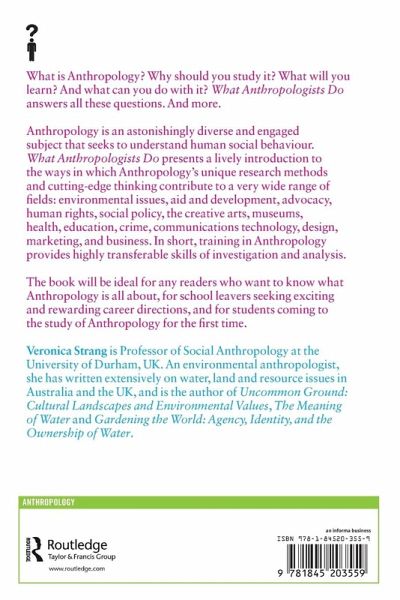
What is Anthropology? Why should you study it? What will you learn? And what can you do with it? What Anthropologists Do answers all these questions. And more.
What is Anthropology? Why should you study it? What will you learn? And what can you do with it? What Anthropologists Do answers all these questions. And more.
Veronica Strang is Professor of Social Anthropology at the University of Auckland. An environmental anthropologist, she has written extensively on water, land and resource issues in Australia and the UK, and is the author of Uncommon Ground: cultural landscapes and environmental values (Berg 1997), and The Meaning of Water (Berg 2004).
Inhaltsangabe
GlossaryIntroductionWhat do anthropologists do?Employing AnthropologyConducting ResearchChapter 1. Anthropology and AdvocacyBalancing ActsFacilitating Cross-cultural CommunicationDefending Livelihoods and KnowledgeHuman Rights Land RightsParticipatory ActionChapter 2. Anthropology and AidCrossing BoundariesAid and AmbiguityNGO-graphyAssisting AidDealing with DisplacementUnderstanding Race and RacismChapter 3. Anthropology and DevelopmentCritiquing DevelopmentIn DevelopmentConnecting Multiple RealitiesConserving Cultural DiversityGlobalizationChapter 4. Anthropology and the Environment'Environmental' Problems Indigenous KnowledgesPolitical EcologyUnpacking GarbageHuman-Animal RelationsAnthropology and EnvironmentalismChapter 5. Anthropology and GovernanceThe Big PictureThe Not So Big PictureHome WorkPrescription and PersuasionEducationChapter 6. Anthropology, Business and IndustryMoney MattersAnthropologists in BusinessMultinational and Multicultural CommunicationAnthropology and Communications MediaMarketing AnthropologyDesigning AnthropologyChapter 7. Anthropology and HealthHealth in a Cultural ContextFrom The Cradle to The GraveFood and LifestyleUnderstanding DiseaseDrug Cultures and CrimeManaging HealthChapter 8. Anthropology, Art and Identity Defining IdentityGender and SexualityRace, Nationalism and Social Movements Representing IdentityArt and PerformanceMuseums and Cultural HeritageFilm and PhotographyConclusionApplying AnthropologyInterdisciplinary AnthropologyTransferring Anthropology What Kind of People Become Anthropologists?Appendix 1. Studying AnthropologyAppendix 2. Further ReadingAppendix 3. Other resourcesAnthropology Associations and NetworksAnthropology JournalsVirtual Libraries in AnthropologyBibliographyAcknowledgements
1. Anthropology and Advocacy 2. Anthropology and Aid 3. Anthropology and Development 4. Anthropology and the Environment 5. Anthropology and Governance 6. Anthropology, Business and Industry 7. Anthropology and Health 8. Anthropology and Identity 9. Anthropology and the Arts Glossary
GlossaryIntroductionWhat do anthropologists do?Employing AnthropologyConducting ResearchChapter 1. Anthropology and AdvocacyBalancing ActsFacilitating Cross-cultural CommunicationDefending Livelihoods and KnowledgeHuman Rights Land RightsParticipatory ActionChapter 2. Anthropology and AidCrossing BoundariesAid and AmbiguityNGO-graphyAssisting AidDealing with DisplacementUnderstanding Race and RacismChapter 3. Anthropology and DevelopmentCritiquing DevelopmentIn DevelopmentConnecting Multiple RealitiesConserving Cultural DiversityGlobalizationChapter 4. Anthropology and the Environment'Environmental' Problems Indigenous KnowledgesPolitical EcologyUnpacking GarbageHuman-Animal RelationsAnthropology and EnvironmentalismChapter 5. Anthropology and GovernanceThe Big PictureThe Not So Big PictureHome WorkPrescription and PersuasionEducationChapter 6. Anthropology, Business and IndustryMoney MattersAnthropologists in BusinessMultinational and Multicultural CommunicationAnthropology and Communications MediaMarketing AnthropologyDesigning AnthropologyChapter 7. Anthropology and HealthHealth in a Cultural ContextFrom The Cradle to The GraveFood and LifestyleUnderstanding DiseaseDrug Cultures and CrimeManaging HealthChapter 8. Anthropology, Art and Identity Defining IdentityGender and SexualityRace, Nationalism and Social Movements Representing IdentityArt and PerformanceMuseums and Cultural HeritageFilm and PhotographyConclusionApplying AnthropologyInterdisciplinary AnthropologyTransferring Anthropology What Kind of People Become Anthropologists?Appendix 1. Studying AnthropologyAppendix 2. Further ReadingAppendix 3. Other resourcesAnthropology Associations and NetworksAnthropology JournalsVirtual Libraries in AnthropologyBibliographyAcknowledgements
1. Anthropology and Advocacy 2. Anthropology and Aid 3. Anthropology and Development 4. Anthropology and the Environment 5. Anthropology and Governance 6. Anthropology, Business and Industry 7. Anthropology and Health 8. Anthropology and Identity 9. Anthropology and the Arts Glossary
Es gelten unsere Allgemeinen Geschäftsbedingungen: www.buecher.de/agb
Impressum
www.buecher.de ist ein Internetauftritt der buecher.de internetstores GmbH
Geschäftsführung: Monica Sawhney | Roland Kölbl | Günter Hilger
Sitz der Gesellschaft: Batheyer Straße 115 - 117, 58099 Hagen
Postanschrift: Bürgermeister-Wegele-Str. 12, 86167 Augsburg
Amtsgericht Hagen HRB 13257
Steuernummer: 321/5800/1497
USt-IdNr: DE450055826