What Remains presents a grassy field with a complicated and fraught history. What is now a suburban park where people play soccer and flag football in the City of Akron, Ohio, was once a Progressive-era county infirmary's burial ground for people who were poor, infirm, troubled, immigrant, injured, alcoholic, elderly, or otherwise deemed "unemployable" during the late nineteenth and early twentieth centuries. Through community-engaged scholarship, this book uses legal, historical, archaeological, and anthropological lenses to consider what is above and below the grass. What Remains is about…mehr
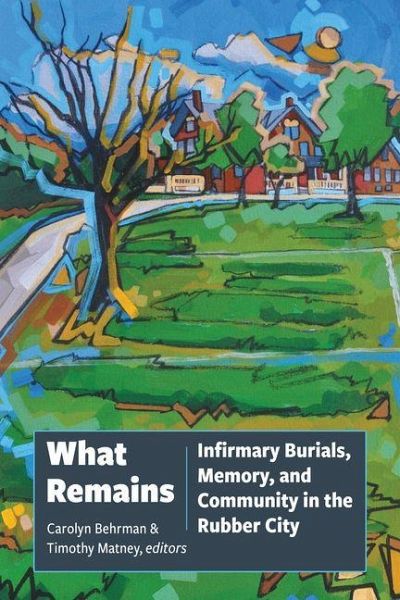
What Remains presents a grassy field with a complicated and fraught history. What is now a suburban park where people play soccer and flag football in the City of Akron, Ohio, was once a Progressive-era county infirmary's burial ground for people who were poor, infirm, troubled, immigrant, injured, alcoholic, elderly, or otherwise deemed "unemployable" during the late nineteenth and early twentieth centuries. Through community-engaged scholarship, this book uses legal, historical, archaeological, and anthropological lenses to consider what is above and below the grass. What Remains is about memories and stories; how at times we collectively remember, forget, or even invent new pasts through the process of tracing and uncovering our own histories. It is about what is worth remembering, what is better left forgotten, and who gets to decide.
Carolyn Behrman has worked in community-based and community-engaged research in Akron for more than twenty years. The work she and her students have done include documenting and addressing food security for elementary school students, analyzing health concerns with resettling refugees, supporting leadership development in the Karen Community of Akron, and addressing social and environmental justice issues with Neighborhood Network and the Families Against City Transfer Stations (FACTS) group. She is a professor emerita of anthropology and former codirector of the EXL Center at the University of Akron. Timothy Matney is a professor of archaeology at the University of Akron. He has conducted fieldwork in the United States, Europe, and Asia, including over thirty seasons of work in Turkey, Syria, and Iraq. In addition to archaeology, he has taught applied geophysical survey at the University of Akron since 1998. His previous book, Ziyaret Tepe: Exploring the Anatolian Frontier of the Assyrian Empire (2017, Cornucopia Press), coauthored with three collaborators, was winner of the Archaeological Institute of America's national 2019 Felicia A. Holton Book Award for a popular presentation of archaeology.
Es gelten unsere Allgemeinen Geschäftsbedingungen: www.buecher.de/agb
Impressum
www.buecher.de ist ein Internetauftritt der buecher.de internetstores GmbH
Geschäftsführung: Monica Sawhney | Roland Kölbl | Günter Hilger
Sitz der Gesellschaft: Batheyer Straße 115 - 117, 58099 Hagen
Postanschrift: Bürgermeister-Wegele-Str. 12, 86167 Augsburg
Amtsgericht Hagen HRB 13257
Steuernummer: 321/5800/1497
USt-IdNr: DE450055826