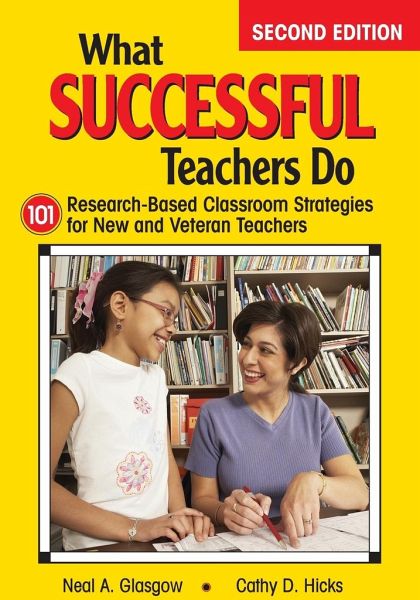
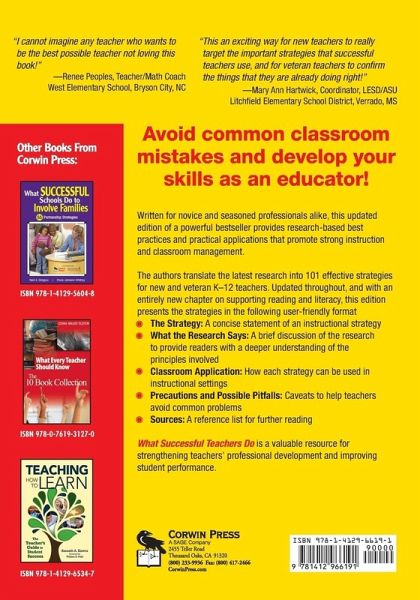
Providing classroom applications, precautions, and references, this updated edition translates the latest research into 101 strategies for successful instruction for new and veteran teachers.
Providing classroom applications, precautions, and references, this updated edition translates the latest research into 101 strategies for successful instruction for new and veteran teachers.
Neal A. Glasgow has been involved in education on many levels for many years. His experience includes serving as a secondary school science and art teacher both in California and New York, as a university biotechnology teaching laboratory director and laboratory technician, and as an educational consultant and frequent speaker on many educational topics. He is the author or coauthor of ten books on educational topics: What Successful Schools Do to Involve Families: Fifty Research-Based Strategies for Teachers and Administrators (2008), What Successful Literacy Teachers Do: 70 Research-Based Strategies for Teachers, Reading Coaches, and Instructional Planners (2007), What Successful Teachers Do in Diverse Classrooms: 71 Research-Based Strategies for New and Veteran Teachers (2006); What Successful Teachers Do in Inclusive Classrooms: 60 Research-Based Strategies That Help Special Learners (2005); What Successful Mentors Do: 81 Researched-Based Strategies for New Teacher Induction, Training, and Support (2004); What Successful Teachers Do: 91 Research-Based Strategies for New and Veteran Teachers (2003); Tips for Science Teachers: Research-Based Strategies to Help Students Learn (2001); New Curriculum for New Times: A Guide to Student-Centered, Problem-Based Learning (1997); Doing Science: Innovative Curriculum Beyond the Textbook for the Life Sciences (1997); and Taking the Classroom to the Community: A Guidebook (1996).
Inhaltsangabe
Foreword by Stephen Sroka Preface Acknowledgments About the Authors 1. Interacting and Collaborating With Students 2. Managing the Classroom Environment, Time, and Discipline 3. Organizing Curricular Goals, Lesson Plans, and Instructional Delivery 4. Using Student Assessment and Feedback to Maximize Instructional Effectiveness 5. Celebrating Diversity in the Classroom 6. Integrating Technology in the Classroom 7. Enhancing Reading and Literacy Skills 8. Developing a Professional Identity 9. Fostering a Positive Relationship With Families and Community Index
Foreword by Stephen Sroka Preface Acknowledgments About the Authors 1. Interacting and Collaborating With Students 2. Managing the Classroom Environment, Time, and Discipline 3. Organizing Curricular Goals, Lesson Plans, and Instructional Delivery 4. Using Student Assessment and Feedback to Maximize Instructional Effectiveness 5. Celebrating Diversity in the Classroom 6. Integrating Technology in the Classroom 7. Enhancing Reading and Literacy Skills 8. Developing a Professional Identity 9. Fostering a Positive Relationship With Families and Community Index
Es gelten unsere Allgemeinen Geschäftsbedingungen: www.buecher.de/agb
Impressum
www.buecher.de ist ein Internetauftritt der buecher.de internetstores GmbH
Geschäftsführung: Monica Sawhney | Roland Kölbl | Günter Hilger
Sitz der Gesellschaft: Batheyer Straße 115 - 117, 58099 Hagen
Postanschrift: Bürgermeister-Wegele-Str. 12, 86167 Augsburg
Amtsgericht Hagen HRB 13257
Steuernummer: 321/5800/1497
USt-IdNr: DE450055826