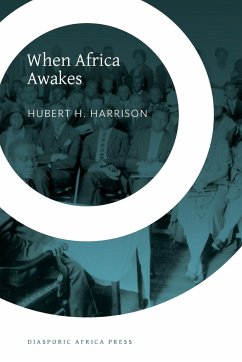
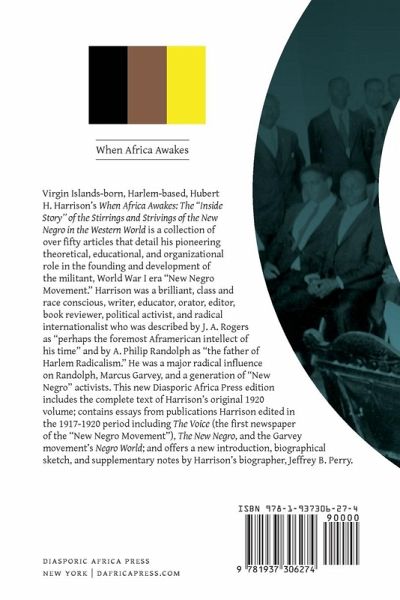
Virgin Islands-born, Harlem-based, Hubert H. Harrison's "When Africa Awakes: The "Inside Story" of the Stirrings and Strivings of the New Negro in the Western World" is a collection of over fifty articles that detail his pioneering theoretical, educational, and organizational role in the founding and development of the militant, World War I era "New Negro Movement." Harrison was a brilliant, class and race conscious, writer, educator, orator, editor, book reviewer, political activist, and radical internationalist who was described by J. A. Rogers as "perhaps the foremost Aframerican intellect…mehr
Virgin Islands-born, Harlem-based, Hubert H. Harrison's "When Africa Awakes: The "Inside Story" of the Stirrings and Strivings of the New Negro in the Western World" is a collection of over fifty articles that detail his pioneering theoretical, educational, and organizational role in the founding and development of the militant, World War I era "New Negro Movement." Harrison was a brilliant, class and race conscious, writer, educator, orator, editor, book reviewer, political activist, and radical internationalist who was described by J. A. Rogers as "perhaps the foremost Aframerican intellect of his time" and by A. Philip Randolph as "the father of Harlem Radicalism." He was a major radical influence on Randolph, Marcus Garvey, and a generation of "New Negro" activists. This new Diasporic Africa Press edition includes the complete text of Harrison's original 1920 volume; contains essays from publications Harrison edited in the 1917-1920 period including The Voice (the first newspaper of the "New Negro Movement"), The New Negro, and the Garvey movement's Negro World; and offers a new introduction, biographical sketch, and supplementary notes by Harrison's biographer, Jeffrey B. Perry.
Hubert Henry Harrison was born on April 27, 1883, in Saint Croix to parents of African and possibly Indian descent. Raised in poverty, Harrison immigrated to New York City as a teenager and pursued education passionately, eventually attending DeWitt Clinton High School. He became an influential figure in early 20th-century intellectual and political life, known for his sharp criticism of both racial injustice and class oppression. Harrison was deeply involved in socialist politics, aligning briefly with the Socialist Party of America, but later grew disillusioned with its treatment of Black issues. As an advocate for radical thought, he emphasized the need for racial consciousness alongside class struggle and developed a reputation as one of Harlem's leading orators and thinkers. Harrison s marriage to Irene Horton in 1909 supported his personal life as he expanded his influence through writing and activism. A founder of the Liberty League and editor of The Voice, he became a key figure in promoting unity among oppressed groups and advancing a vision of international solidarity. He died on December 17, 1927, in New York City at the age of 44.
Es gelten unsere Allgemeinen Geschäftsbedingungen: www.buecher.de/agb
Impressum
www.buecher.de ist ein Internetauftritt der buecher.de internetstores GmbH
Geschäftsführung: Monica Sawhney | Roland Kölbl | Günter Hilger
Sitz der Gesellschaft: Batheyer Straße 115 - 117, 58099 Hagen
Postanschrift: Bürgermeister-Wegele-Str. 12, 86167 Augsburg
Amtsgericht Hagen HRB 13257
Steuernummer: 321/5800/1497
USt-IdNr: DE450055826