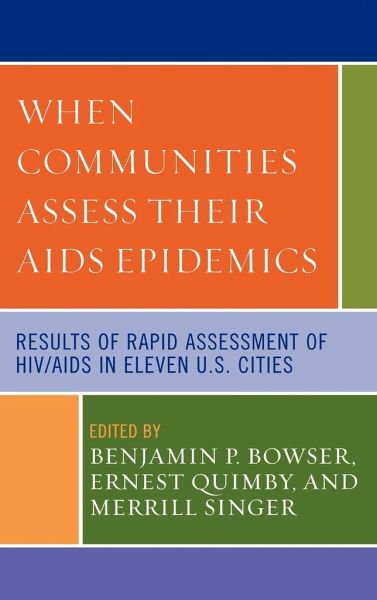
When Communities Assess their AIDS Epidemics is a detailed ethnographic description of the AIDS epidemic in ten U.S. cities and the U.S. Virgin Islands.
When Communities Assess their AIDS Epidemics is a detailed ethnographic description of the AIDS epidemic in ten U.S. cities and the U.S. Virgin Islands.
Benjamin P. Bowser is professor of sociology and social services at California State University at Hayward. Ernest Quimby is graduate associate professor of sociology at Howard University. Merrill Singer is professor of anthropology and senior research scientist at the Center for Health, Intervention, and Prevention at the University of Connecticut.
Inhaltsangabe
Chapter 1 Exploring the Boundaries of the AIDS Epidemic in the U.S. Chapter 2 Rapid Assessment: A Method in Community-Based Research Chapter 3 Responding to the AIDS Crisis in Newark, New Jersey Chapter 4 AIDS Health Emergency in Chicago Chapter 5 Confined Youth Try to Make it Real, Despite the Odds: RARE in Baltimore Chapter 6 AIDS in Philadelphia: Emerging from the Shadow of Crack Chapter 7 AIDS in the Shadow of Power: Washington, D.C. Chapter 8 Rapid Assessment in Oakland: HIV, Race, Class, and Bureaucracy Chapter 9 The AIDS Epidemic in Palm Beach County, Florida Chapter 10 The Risks of Paradise: Project RARE and the Fight Against AIDS in the U.S. Virgin Islands Chapter 11 The RARE Experience in Miami Chapter 12 Twilight's Last Gleaning: Rapid Assessment of Late Night HIV Risk in Hartford, CT Chapter 13 RARE Research in Preventing HIV among Men Who Have Sex with Men in Pima County, Arizona Chapter 14 Conclusion: Assessing Primary, Secondary, and Future Benefits of Project RARE
Chapter 1 Exploring the Boundaries of the AIDS Epidemic in the U.S. Chapter 2 Rapid Assessment: A Method in Community-Based Research Chapter 3 Responding to the AIDS Crisis in Newark, New Jersey Chapter 4 AIDS Health Emergency in Chicago Chapter 5 Confined Youth Try to Make it Real, Despite the Odds: RARE in Baltimore Chapter 6 AIDS in Philadelphia: Emerging from the Shadow of Crack Chapter 7 AIDS in the Shadow of Power: Washington, D.C. Chapter 8 Rapid Assessment in Oakland: HIV, Race, Class, and Bureaucracy Chapter 9 The AIDS Epidemic in Palm Beach County, Florida Chapter 10 The Risks of Paradise: Project RARE and the Fight Against AIDS in the U.S. Virgin Islands Chapter 11 The RARE Experience in Miami Chapter 12 Twilight's Last Gleaning: Rapid Assessment of Late Night HIV Risk in Hartford, CT Chapter 13 RARE Research in Preventing HIV among Men Who Have Sex with Men in Pima County, Arizona Chapter 14 Conclusion: Assessing Primary, Secondary, and Future Benefits of Project RARE
Es gelten unsere Allgemeinen Geschäftsbedingungen: www.buecher.de/agb
Impressum
www.buecher.de ist ein Internetauftritt der buecher.de internetstores GmbH
Geschäftsführung: Monica Sawhney | Roland Kölbl | Günter Hilger
Sitz der Gesellschaft: Batheyer Straße 115 - 117, 58099 Hagen
Postanschrift: Bürgermeister-Wegele-Str. 12, 86167 Augsburg
Amtsgericht Hagen HRB 13257
Steuernummer: 321/5800/1497
USt-IdNr: DE450055826