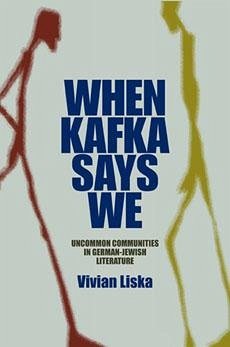
Taking as its starting point Franz Kafka's complex relationship to Jews and to communities in general, When Kafka Says We explores the ambivalent responses of major German-Jewish writers to self-enclosed social, religious, ethnic, and ideological groups. Vivian Liska shows that, for Kafka and others, this ambivalence inspired innovative modes of writing which, while unmasking the oppressive cohesion of communal groupings, also configured original and uncommon communities. Interlinked close readings of works by German-Jewish writers such as Kafka, Else Lasker-Schüler, Nelly Sachs, Paul Celan,…mehr
Taking as its starting point Franz Kafka's complex relationship to Jews and to communities in general, When Kafka Says We explores the ambivalent responses of major German-Jewish writers to self-enclosed social, religious, ethnic, and ideological groups. Vivian Liska shows that, for Kafka and others, this ambivalence inspired innovative modes of writing which, while unmasking the oppressive cohesion of communal groupings, also configured original and uncommon communities. Interlinked close readings of works by German-Jewish writers such as Kafka, Else Lasker-Schüler, Nelly Sachs, Paul Celan, Ilse Aichinger, and Robert Schindel illuminate the ways in which literature can subvert, extend, or reconfigure established visions of communities. Liska's rich and astute analysis uncovers provocative attitudes and insights on a subject of continuing controversy.
Vivian Liska is Professor of German Literature and Director of the Institute of Jewish Studies at the University of Antwerp, Belgium. She is author of The Night of the Hymns: Paul Celan's Poems, 1938-1944 (in German) and editor (with Thomas Nolden) of Contemporary Jewish Writing in Europe: A Guide (IUP, 2008).
Inhaltsangabe
Acknowledgments List of Abbreviations Introduction: Uncommon Communities Part 1. Kafka's Communities 1. When Kafka Says We 2. Shooting at the Audience: Kafka's Speech on the Yiddish Language 3. An Alliance of Foes: Kafka and the Feminine Part 2. Revisiting the Common Ground 4. A Vision out of Sight: Theodor Herzl's Late "Philosophical Tales" 5. Diverting the Lineage: Biblical Women in Else Lasker-Schüler's Hebrew Ballads 6. Saving Confusions: Else Lasker-Schüler's Poetics of Redemption Part 3. Communities of Fate 7. A Counter-Prayer: Paul Celan's "In Front of a Candle" 8. Roots against Heaven: A Motif in Paul Celan 9. The Voice of Israel: Nelly Sachs's "Choirs after Midnight" Part 4. Contentious Commemorations 10. A Broken Ring: The Gruppe 47 and Ilse Aichinger's Poetics of Resistance 11. After the Silence: Holocaust Remembrance in Contemporary Austrian-Jewish Literature 12. Jewish Voices, Human Tone: Robert Menasse's The Expulsion from Hell Part 5. Kafka's Companions 13. Of Language and Destiny: Paul Celan and Kafka 14. A Permanent Shadow: Ilse Aichinger and Kafka 15. The Gap between Hannah Arendt and Kafka Notes Bibliography Index
Es gelten unsere Allgemeinen Geschäftsbedingungen: www.buecher.de/agb
Impressum
www.buecher.de ist ein Internetauftritt der buecher.de internetstores GmbH
Geschäftsführung: Monica Sawhney | Roland Kölbl | Günter Hilger
Sitz der Gesellschaft: Batheyer Straße 115 - 117, 58099 Hagen
Postanschrift: Bürgermeister-Wegele-Str. 12, 86167 Augsburg
Amtsgericht Hagen HRB 13257
Steuernummer: 321/5800/1497
USt-IdNr: DE450055826