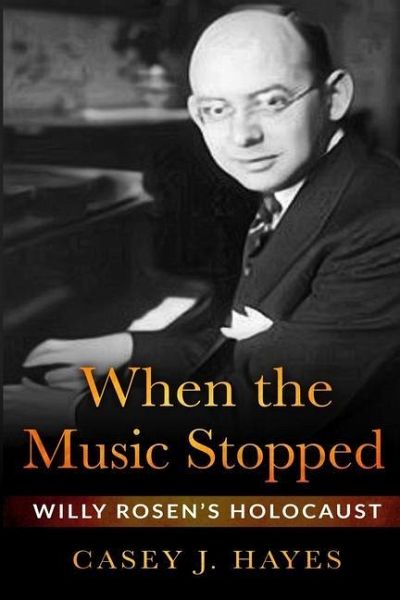
When music is your only chance of survival Despite his success as a renowned songwriter, composer, and cabaret player, Willy Rosen's life was interrupted when his Jewish status leads him to flee Germany to the Netherlands as a result of growing Nazi powers. His escape to relative safety is short-lived when he is captured and deported to the Westerbork transit camp. Willy Rosen tries to avoid - or at least delay - death in a concentration camp for him and his theater group by performing for commandant Gemmeker and their fellow prisoners. Such a fragile existence demanded that every show be…mehr
When music is your only chance of survival Despite his success as a renowned songwriter, composer, and cabaret player, Willy Rosen's life was interrupted when his Jewish status leads him to flee Germany to the Netherlands as a result of growing Nazi powers. His escape to relative safety is short-lived when he is captured and deported to the Westerbork transit camp. Willy Rosen tries to avoid - or at least delay - death in a concentration camp for him and his theater group by performing for commandant Gemmeker and their fellow prisoners. Such a fragile existence demanded that every show be better than the one before; an ultimate test of skill and talent. Every dance, every song, and every performance reminded them that their lives were at stake, that they could easily be eradicated if they didn't put a smile on their oppressor's face. Rosen's cabaret group survived with this incessant fear for two years. They were among the last to be sent on transport east. When the Music Stopped is a fictionalized historical account that follows the inspiring life of Willy Rosen from his time as a celebrated German soldier in WWI, a famous entertainer, and finally, a victim of Auschwitz's gas chambers. It is a heart-warming yet tragic story that reminds us that beauty can exist amidst horror.
Dr. Casey J. Hayes earned his bachelor and Master of Music in music education from Butler University in Indianapolis, IN and PhD in music education from the Steinhardt School of Education, New York University (2009). His doctoral research focused on educational outreach within Lesbian / Gay / Bisexual / Transgender choral ensembles. His studies of the LGBTQI+ Choral Movement led him to be the co-music director of the New York City Gay Men's Chorus. In 2007, Casey founded the Gay Men's Chorus of Manhattan, an ensemble which raised funds for not-for-profit organizations in need across the tri-state area; the first ensemble of its kind in the United States.He currently serves as professor and the A.J. Thurston Chair of Music, music department chair, and director of choral activities at Franklin College in Franklin, Indiana.He also serves as the Artistic Director of the Quarryland Men's Chorus, an ensemble of gay, bisexual, and transgender men and their straight allies located in Bloomington, IN. Dr. Hayes has addressed audiences on issues surrounding LGBTQI+ Rights and Culture at conferences around the globe and remains in high demand on issues involving Education, the Roman Catholic Church, and their intersection within the paradigm of human rights.Dr. Hayes' interest in Weimar Germany and its brief yet beautiful emergence of LGBTQI+ culture grew out of his interest in music written to disseminate gay culture, such as Mischa Spoliansky's Das Lila Lied. His desire to learn more about this vibrant, yet largely unknown period of music history led him to discover the music of Willy Rosen and his fascinating but largely unknown life.In 2021, Casey was selected as an Austrian Fulbright scholar and was named the Fulbright-Botstiber Visiting Professor of Austrian-American Studies at the University for Music and Performing Arts, Vienna. His research topic, Rosa Wien; Gay Rights, Schlager and Self-Exile: 1918-1938 focused upon the plight of Vienna's LGBTQI+ and Jewish cabaret communities during the Anschluss, and their recreation of Viennese cabaret in the United States. Through the eyes of gay Weimar cabaret performer Paul O'Montis, his research re-examined the role Europe played in the early days of emerging LGBTQI+ Rights in Berlin and Vienna. Currently, Dr. Hayes' developing partnership with Literaturhaus Wien enables him to continue his research of Vienna's cabaret history throughout the coming years.
Es gelten unsere Allgemeinen Geschäftsbedingungen: www.buecher.de/agb
Impressum
www.buecher.de ist ein Internetauftritt der buecher.de internetstores GmbH
Geschäftsführung: Monica Sawhney | Roland Kölbl | Günter Hilger
Sitz der Gesellschaft: Batheyer Straße 115 - 117, 58099 Hagen
Postanschrift: Bürgermeister-Wegele-Str. 12, 86167 Augsburg
Amtsgericht Hagen HRB 13257
Steuernummer: 321/5800/1497
USt-IdNr: DE450055826