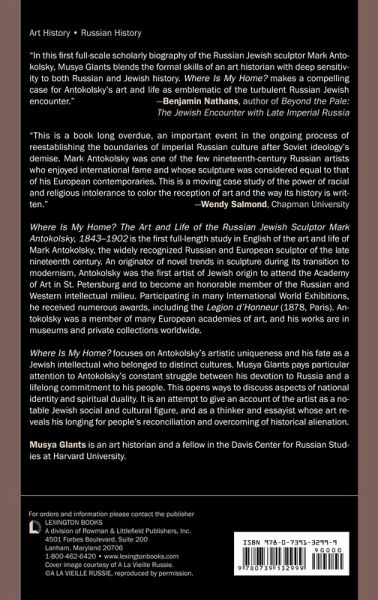
Where Is My Home? is a biography of Mark Antokolski (1843-1902), one of the leading innovative sculptors in Russian and Western art of the late 19th century. This interdisciplinary study pays particular attention to his status as a great Jewish social figure as well as to the theme of national identity.
Where Is My Home? is a biography of Mark Antokolski (1843-1902), one of the leading innovative sculptors in Russian and Western art of the late 19th century. This interdisciplinary study pays particular attention to his status as a great Jewish social figure as well as to the theme of national identity.
Musya Glants is a fellow in the Davis Center for Russian Studies atHarvard University.
Inhaltsangabe
Chapter 1 Introduction: Mark Antokolskii and his role in Russian, Jewish, and European Culture. Chapter 2 Chapter 1: Vilna. Childhood and youth. Family and friends. Jewish life under Nicholas I and Alexander II: religion, tradition, and the struggle for secularism and education; the Jewish Enlightenment. Antokolskii's search for his own way in life and his fi Chapter 3 Chapter 2: St. Petersburg. The Academy of Arts: a dream fulfilled. The liberal atmosphere of the 1860s-early 1870s. Professors and new friends. Il'ia Repin. Estrangement from classicism. The Russian intellectual milieu. New friends outside the Academy. Th Chapter 4 Chapter 3: The strong links to home and Jewishness. Letters to Yakov Barel and the hardship of life in the capital. Between past and present: the intensifying sense of duality. Summer vacations at home. Images of Jews: "The Tailor" (1864), "The Miser" (18 Chapter 5 Chapter 4: Towards a new style: "Ivan the Terrible" (1871)-an innovative turn in Russian sculpture. The success and the sweetness of fame. Serious Illness. Chapter 6 Chapter 5: Trip to Italy: a window to the world. Rising hopes and inspirations. Life in Rome. Images of Italy. New friends: the Mamontov family, the Polenovs. The Mamontov circle. "Peter the Great" (1872). Marriage to Elena Apatova (1872). Chapter 7 Chapter 6: Disturbing news from the homeland: the growth of anti-Semitism. The expanding feeling of dual belonging. The death of his son Lev (1876). Search for his own style in sculpture. Christian images as a reflection of his strong ideas to draw Jews a Chapter 8 Chapter 7: Removal to Paris, 1877. Life in Paris. The Russian intellectual community. The "Society of Russian Artists in Paris". I. Turgenev; A. Bogoliubov. Art in Paris and French sculpture of that time. The portrait gallery; World Exhibition, 1878 and A Chapter 9 Chapter 8: Exploring genres: distinctive memorials (M. Obolenskaia, 1875-1877) and monuments, accomplished (Catherine II, 1901-1902) and unrealized (A. Pushkin, 1875; I. Fiodorov). Political reaction in Russia: persecution of Jews and pogroms. Visits to R Chapter 10 Chapter 9: Images of Russian historical figures: "Nestor" (1890) and "Yermak" (1891) as a silent call for national tolerance. Official and unofficial manifestations of intensifying ill will towards the sculptor. Antokolskii and his path to Modernism: a ne Chapter 11 Chapter 10: The late 1880s and 1890s: prolific last years. Triumph in Munich (1892). Extensive writing. "Dreyfus". "Reminiscences of Italy". "Letter to H. Gintsburg." The pain of lost ideals and illusions. Illness and death. The funeral-a symbolic homecom Chapter 12 Conclusion: M. Antokolskii's human and artistic fate as emblematic for an artist and a Jew in Late Imperial Russia.
Chapter 1 Introduction: Mark Antokolskii and his role in Russian, Jewish, and European Culture. Chapter 2 Chapter 1: Vilna. Childhood and youth. Family and friends. Jewish life under Nicholas I and Alexander II: religion, tradition, and the struggle for secularism and education; the Jewish Enlightenment. Antokolskii's search for his own way in life and his fi Chapter 3 Chapter 2: St. Petersburg. The Academy of Arts: a dream fulfilled. The liberal atmosphere of the 1860s-early 1870s. Professors and new friends. Il'ia Repin. Estrangement from classicism. The Russian intellectual milieu. New friends outside the Academy. Th Chapter 4 Chapter 3: The strong links to home and Jewishness. Letters to Yakov Barel and the hardship of life in the capital. Between past and present: the intensifying sense of duality. Summer vacations at home. Images of Jews: "The Tailor" (1864), "The Miser" (18 Chapter 5 Chapter 4: Towards a new style: "Ivan the Terrible" (1871)-an innovative turn in Russian sculpture. The success and the sweetness of fame. Serious Illness. Chapter 6 Chapter 5: Trip to Italy: a window to the world. Rising hopes and inspirations. Life in Rome. Images of Italy. New friends: the Mamontov family, the Polenovs. The Mamontov circle. "Peter the Great" (1872). Marriage to Elena Apatova (1872). Chapter 7 Chapter 6: Disturbing news from the homeland: the growth of anti-Semitism. The expanding feeling of dual belonging. The death of his son Lev (1876). Search for his own style in sculpture. Christian images as a reflection of his strong ideas to draw Jews a Chapter 8 Chapter 7: Removal to Paris, 1877. Life in Paris. The Russian intellectual community. The "Society of Russian Artists in Paris". I. Turgenev; A. Bogoliubov. Art in Paris and French sculpture of that time. The portrait gallery; World Exhibition, 1878 and A Chapter 9 Chapter 8: Exploring genres: distinctive memorials (M. Obolenskaia, 1875-1877) and monuments, accomplished (Catherine II, 1901-1902) and unrealized (A. Pushkin, 1875; I. Fiodorov). Political reaction in Russia: persecution of Jews and pogroms. Visits to R Chapter 10 Chapter 9: Images of Russian historical figures: "Nestor" (1890) and "Yermak" (1891) as a silent call for national tolerance. Official and unofficial manifestations of intensifying ill will towards the sculptor. Antokolskii and his path to Modernism: a ne Chapter 11 Chapter 10: The late 1880s and 1890s: prolific last years. Triumph in Munich (1892). Extensive writing. "Dreyfus". "Reminiscences of Italy". "Letter to H. Gintsburg." The pain of lost ideals and illusions. Illness and death. The funeral-a symbolic homecom Chapter 12 Conclusion: M. Antokolskii's human and artistic fate as emblematic for an artist and a Jew in Late Imperial Russia.
Es gelten unsere Allgemeinen Geschäftsbedingungen: www.buecher.de/agb
Impressum
www.buecher.de ist ein Internetauftritt der buecher.de internetstores GmbH
Geschäftsführung: Monica Sawhney | Roland Kölbl | Günter Hilger
Sitz der Gesellschaft: Batheyer Straße 115 - 117, 58099 Hagen
Postanschrift: Bürgermeister-Wegele-Str. 12, 86167 Augsburg
Amtsgericht Hagen HRB 13257
Steuernummer: 321/5800/1497
USt-IdNr: DE450055826