How are we to understand the actor's work as a fully embodied process? 'Embodied cognition' is a branch of contemporary philosophy which attempts to frame human understanding as fully embodied interaction with the environment. Engaging with ideas of contemporary significance from neuroscience, psychology, linguistics, and philosophy, Why Do Actors Train? challenges the outmoded dualistic notions of body and mind that permeate common conceptions of how actors work. Theories of embodiment are drawn up to shed important light on the ways and reasons actors do what they do. Through detailed,…mehr
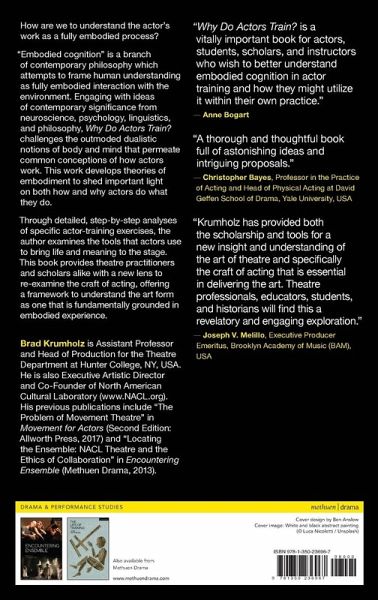
How are we to understand the actor's work as a fully embodied process? 'Embodied cognition' is a branch of contemporary philosophy which attempts to frame human understanding as fully embodied interaction with the environment. Engaging with ideas of contemporary significance from neuroscience, psychology, linguistics, and philosophy, Why Do Actors Train? challenges the outmoded dualistic notions of body and mind that permeate common conceptions of how actors work. Theories of embodiment are drawn up to shed important light on the ways and reasons actors do what they do. Through detailed, step-by-step analyses of specific actor-training exercises, the author examines the tools that actors use to bring life and meaning to the stage. This book provides theatre practitioners and scholars alike with a new lens to re-examine the craft of acting, offering a framework to understand the art form as one that is fundamentally grounded in embodied experience.
Brad Krumholz is Distinguished Lecturer and Head of Production for the Hunter College Theatre Department, Hunter College, USA. He is also Artistic Director and Co-Founder of North American Cultural Laboratory (www.NACL.org). His recent publications include "The Problem of Movement Theatre" in Movement for Actors(Methuen Drama, 2013) and Encountering Ensemble(Methuen Drama, 2013).
Inhaltsangabe
Overview i.What A Body Can Be - Defining Our Subject ii.The Trouble with Mind/Body Dualism iii.Embodied Cognition Defined iv.Performance Philosophy - Contours of The Field v.Acting and Technique vi.Performance Styles Considered vii.Making Meaning through Acting viii.My Methodology ix.Structure of This Book Part One: Action in Theory and Practice i.Introduction ii.Training Exercises and The Plastiques iii.Approaching Action through Wittgenstein a.What Is Intention? iv.Principles of Scenic Behavior a.Mark Johnson and Image Schemas v.Maxine Sheets-Johnstone and Animate Forms vi.Where Is Meaning Located? vii.The Importance of Interaction viii.Concluding Thoughts Part Two: Encountering Perception and Proprioception in The Actor's Craft i.Introduction ii.The 3 Layers of Actor Training iii.Alva Noë and The Enactive View iv.The Role of Attention v.Proprioception: Body Image and Body Schema vi.Dynamic Space vii.Competency and Presence viii.Ways of Seeing ix.Bodies Working Together x.Achieving Fluency xi.Concluding Thoughts Part Three: Approaching The Voice beyond The Word i.Introduction ii.The Voice as Action iii.Theorizing Sound and Voice iv.Awakening The Resonators v.Kreiman and Sidtis: Voice and Voice Quality vi.The Embodied Voice vii.The Components of Prosody viii.Listening ix.Gesture and Speech, Connected x.Simulation and Vocal Production xi.The Embodied Voice and Sociality xii.Theatre as A Site of Engagement xiii.Concluding Thoughts Afterthinking i.Introduction ii.An Enactive Theory of Emotion iii.Imagination as An Embodied Process iv.Some Possible Concerns about This Book a.Ethnographic Challenges b.Epistemological Uncertainty c.Other Limitations v.Escaping The Dualistic Language Trap vi.The Proficiency Model: Real Life Benefits of Actor Training vii.Concluding Thoughts Bibliography Index
Es gelten unsere Allgemeinen Geschäftsbedingungen: www.buecher.de/agb
Impressum
www.buecher.de ist ein Internetauftritt der buecher.de internetstores GmbH
Geschäftsführung: Monica Sawhney | Roland Kölbl | Günter Hilger
Sitz der Gesellschaft: Batheyer Straße 115 - 117, 58099 Hagen
Postanschrift: Bürgermeister-Wegele-Str. 12, 86167 Augsburg
Amtsgericht Hagen HRB 13257
Steuernummer: 321/5800/1497
USt-IdNr: DE450055826