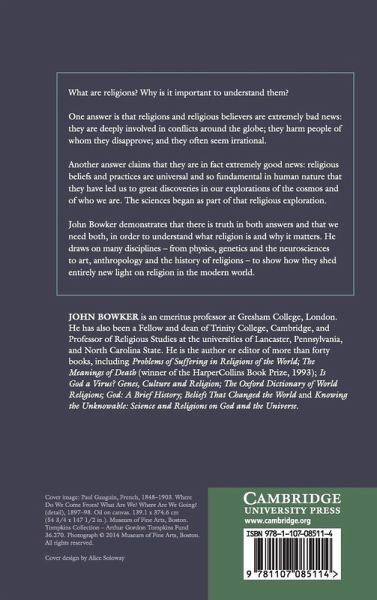
What are religions? Why is it important to understand them? One answer is that religions and religious believers are extremely bad news: they are deeply involved in conflicts around the globe; they harm people of whom they disapprove; and they often seem irrational. Another answer claims that they are in fact extremely good news: religious beliefs and practices are universal and so fundamental in human nature that they have led us to great discoveries in our explorations of the cosmos and of who we are. The sciences began as part of that religious exploration. John Bowker demonstrates that…mehr
What are religions? Why is it important to understand them? One answer is that religions and religious believers are extremely bad news: they are deeply involved in conflicts around the globe; they harm people of whom they disapprove; and they often seem irrational. Another answer claims that they are in fact extremely good news: religious beliefs and practices are universal and so fundamental in human nature that they have led us to great discoveries in our explorations of the cosmos and of who we are. The sciences began as part of that religious exploration. John Bowker demonstrates that there is truth in both answers and that we need both to understand what religion is and why it matters. He draws on many disciplines - from physics, genetics and the neurosciences to art, anthropology and the history of religions - to show how they shed entirely new light on religion in the modern world.
John Bowker is an Emeritus Professor at Gresham College, London. He has also been a Fellow and Dean of Trinity College, Cambridge, and Professor of Religious Studies at the universities of Lancaster, Pennsylvania, and North Carolina State. He is the author or editor of more than forty books, including Problems of Suffering in Religions of the World; The Meanings of Death (winner of the HarperCollins Book Prize, 1993); Is God a Virus? Genes, Culture and Religion; The Oxford Dictionary of World Religions; God: A Brief History; Beliefs that Changed the World and Knowing the Unknowable: Science and Religions on God and the Universe.
Inhaltsangabe
1. Introduction 2. The paradox of religions 3. Religions and sciences I: 'the warfare between science and religion' 4. Religions and sciences II: dogmatism and doubt 5. Religions and sciences III: the selfless gene: genetic determinism and human freedom 6. Religions and sciences IV: causes and constraints 7. Understanding religions I: issues of translation and interpretation 8. Understanding religions II: being religiously human the internalisation of constraint in ethics and art 9. Understanding religions III: ritual and the human imagination of death 10. Understanding religions IV: communities of shared exploration and discovery.
1. Introduction 2. The paradox of religions 3. Religions and sciences I: 'the warfare between science and religion' 4. Religions and sciences II: dogmatism and doubt 5. Religions and sciences III: the selfless gene: genetic determinism and human freedom 6. Religions and sciences IV: causes and constraints 7. Understanding religions I: issues of translation and interpretation 8. Understanding religions II: being religiously human the internalisation of constraint in ethics and art 9. Understanding religions III: ritual and the human imagination of death 10. Understanding religions IV: communities of shared exploration and discovery.
Es gelten unsere Allgemeinen Geschäftsbedingungen: www.buecher.de/agb
Impressum
www.buecher.de ist ein Internetauftritt der buecher.de internetstores GmbH
Geschäftsführung: Monica Sawhney | Roland Kölbl | Günter Hilger
Sitz der Gesellschaft: Batheyer Straße 115 - 117, 58099 Hagen
Postanschrift: Bürgermeister-Wegele-Str. 12, 86167 Augsburg
Amtsgericht Hagen HRB 13257
Steuernummer: 321/5800/1497
USt-IdNr: DE450055826