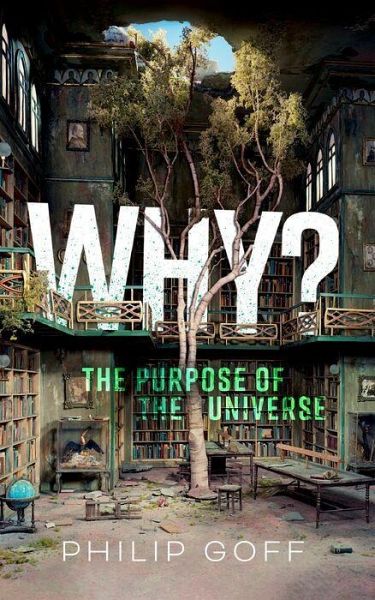
Western thought has been dominated by the dichotomy of traditional religion and secular atheism. But do we have to choose between these options? In this pioneering work, Philip Goff argues that it is time to move on from both God and atheism. Through an exploration of contemporary cosmology and cutting-edge philosophical research on consciousness, Goff argues for cosmic purpose: the idea that the universe is directed towards certain goals, such as the emergence of life. In contrast to religious thinkers, Goff argues that the traditional God is a bad explanation of cosmic purpose. Instead, he…mehr
Western thought has been dominated by the dichotomy of traditional religion and secular atheism. But do we have to choose between these options? In this pioneering work, Philip Goff argues that it is time to move on from both God and atheism. Through an exploration of contemporary cosmology and cutting-edge philosophical research on consciousness, Goff argues for cosmic purpose: the idea that the universe is directed towards certain goals, such as the emergence of life. In contrast to religious thinkers, Goff argues that the traditional God is a bad explanation of cosmic purpose. Instead, he explores a range of alternative possibilities for accounting for cosmic purpose, from the speculation that we live in a computer simulation to the hypothesis that the universe itself is a conscious mind. Goff scrutinizes these options with analytical rigour, laying the foundations for a new paradigm of philosophical enquiry into the middle ground between God and atheism. Ultimately, Goff outlines a way of living in hope that cosmic purpose is still unfolding, involving political engagement and a non-literalist interpretation of traditional religion.
Philip Goff is Professor of Philosophy at Durham University, UK. His research focuses on consciousness and the ultimate nature of reality. Goff is best known for defending panpsychism, the view that consciousness pervades the universe and is a fundamental feature of it. On that theme, Goff has published three books, Consciousness and Fundamental Reality (2017), Galileo's Error: Foundations for a New Science of Consciousness (2020), and a co-edited volume, Is Consciousness Everywhere? Essays on Panpsychism (2022). Goff has published many academic articles, as well as writing extensively for newspapers and magazines, including Scientific American, The Guardian, Aeon, and the Times Literary Supplement.
Inhaltsangabe
1: What's the point of living? 2: Why science points to purpose 3: Why consciousness points to purpose 4: Why the omni-God probably doesn't exist 5: Where does purpose come from? 6: Why are we here? 1: What's the point of living? 2: Why science points to purpose 3: Why consciousness points to purpose 4: Why the omni-God probably doesn't exist 5: Where does purpose come from? 6: Why are we here?
1: What's the point of living? 2: Why science points to purpose 3: Why consciousness points to purpose 4: Why the omni-God probably doesn't exist 5: Where does purpose come from? 6: Why are we here? 1: What's the point of living? 2: Why science points to purpose 3: Why consciousness points to purpose 4: Why the omni-God probably doesn't exist 5: Where does purpose come from? 6: Why are we here?
Es gelten unsere Allgemeinen Geschäftsbedingungen: www.buecher.de/agb
Impressum
www.buecher.de ist ein Internetauftritt der buecher.de internetstores GmbH
Geschäftsführung: Monica Sawhney | Roland Kölbl | Günter Hilger
Sitz der Gesellschaft: Batheyer Straße 115 - 117, 58099 Hagen
Postanschrift: Bürgermeister-Wegele-Str. 12, 86167 Augsburg
Amtsgericht Hagen HRB 13257
Steuernummer: 321/5800/1497
USt-IdNr: DE450055826