27,99 €
inkl. MwSt.
Versandkostenfrei*
Versandfertig in über 4 Wochen
payback
14 °P sammeln
  • Broschiertes Buch

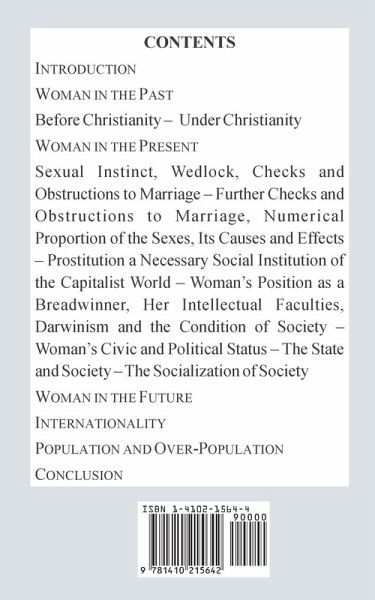
CONTENTS Introduction Woman in the Past Before Christianity - Under Christianity Woman in the Present Sexual Instinct, Wedlock, Checks and Obstructions to Marriage - Further Checks and Obstructions to Marriage, Numerical Proportion of the Sexes, Its Causes and Effects - Prostitution a Necessary Social Institution of the Capitalist World - Woman's Position as a Breadwinner, Her Intellectual Faculties, Darwinism and the Condition of Society - Woman's Civic and Political Status - The State and Society - The Socialization of Society Woman in the Future Internationality Population and Over-Population Conclusion…mehr

Produktbeschreibung
CONTENTS Introduction Woman in the Past Before Christianity - Under Christianity Woman in the Present Sexual Instinct, Wedlock, Checks and Obstructions to Marriage - Further Checks and Obstructions to Marriage, Numerical Proportion of the Sexes, Its Causes and Effects - Prostitution a Necessary Social Institution of the Capitalist World - Woman's Position as a Breadwinner, Her Intellectual Faculties, Darwinism and the Condition of Society - Woman's Civic and Political Status - The State and Society - The Socialization of Society Woman in the Future Internationality Population and Over-Population Conclusion
Autorenporträt
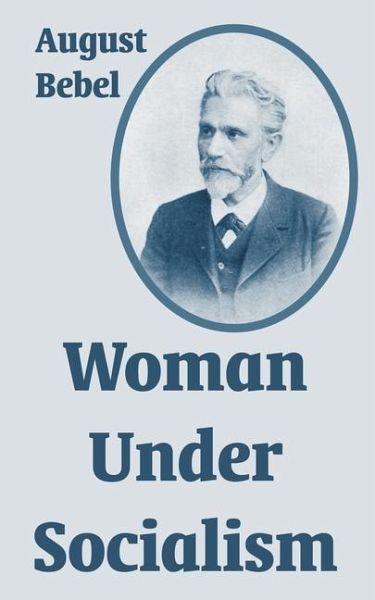
Ferdinand August Bebel was a German socialist activist and politician, recognized as one of the principal founders of the Social Democratic Party of Germany. Born in 1840 in Deutz, Cologne, Bebel trained as a woodworker before turning to politics. In 1866, he co-founded the Saxon People's Party alongside Wilhelm Liebknecht. His political career was marked by a commitment to socialist ideals, and he became a key figure in advocating for workers' rights and gender equality. Bebel was a staunch critic of the capitalist system and played a vital role in shaping the early socialist movement in Germany. He was married to Julie Bebel from 1866 until her death in 1910, and they had a daughter, Bertha Friederike Bebel. Throughout his life, Bebel's work focused on challenging societal norms, including his influential work "Woman under Socialism," which examined the oppression of women. He passed away in 1913 in Passugg, Churwalden, Switzerland, at the age of 73. His parents were Johann Gottlob Bebel and Wilhelmine Johanna Bebel.