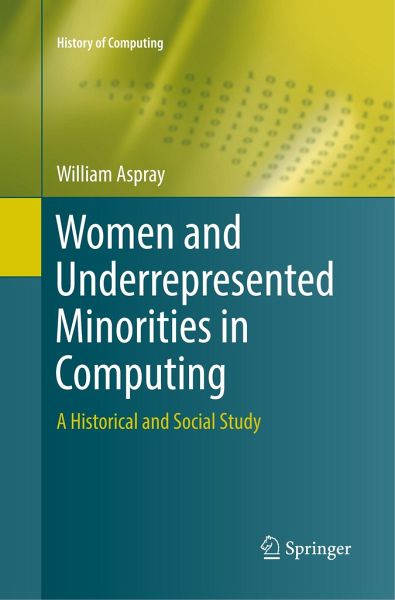
This text examines in detail the issue of the underrepresentation of women, African Americans, American Indians, and Hispanics in the computing disciplines in the U.S. The work reviews the underlying causes, as well as the efforts of various nonprofit organizations to correct the situation, in order to both improve social equity and address the shortage of skilled workers in this area. Topics and features: presents a digest and historical overview of the relevant literature from a range of disciplines, including leading historical and social science sources; discusses the social and political…mehr
This text examines in detail the issue of the underrepresentation of women, African Americans, American Indians, and Hispanics in the computing disciplines in the U.S. The work reviews the underlying causes, as well as the efforts of various nonprofit organizations to correct the situation, in order to both improve social equity and address the shortage of skilled workers in this area. Topics and features: presents a digest and historical overview of the relevant literature from a range of disciplines, including leading historical and social science sources; discusses the social and political factors that have affected the demographics of the workforce from the end of WWII to the present day; provides historical case studies on organizations that have sought to broaden participation in computing and the STEM disciplines; reviews the different approaches that have been applied to address underrepresentation, at the individual, system-wide, and pathway-focused level; profiles the colleges and universities that have been successful in opening up computer science or engineering to female students; describes the impact of individual change-agents as well as whole organizations.
William Aspray is a full professor in the Department of Information Science at the University of Colorado Boulder. He has also taught at the University of Texas Austin, Indiana University Bloomington, Virginia Tech, University of Pennsylvania, and Harvard University, among others. He holds a Ph.D. in the history of science from the University of Wisconsin-Madison. He has served as the Director of the IEEE Center for the History of Electrical Engineering, Associate Director of the Charles Babbage Institute for the History of Information Processing at the University of Minnesota, and Executive Director at the Computing Research Association. He is the author or editor of over two dozen books dealing with the history of computing, mathematics, and information. He has published more than 100 articles in the key information history journals and served on their editorial boards, including Information Research, The Information Society, IEEE Annals of the History of Computing, Information & Culture: A Journal of History, and Communications of the ACM. James W. Cortada is a Senior Research Fellow at the Charles Babbage Institute at the University of Minnesota. He holds a Ph.D. in modern history and worked at IBM in various sales, consulting, management, and executive positions for 38 years, including in IBM's management research institute, The IBM Institute for Business Value (IBV). There, he led and participated in over three dozen global studies on the use of information and business managerial practices. He is also the author of over a dozen books on the management of business, information technologies, and management. He also authored nearly two dozen books on the history of information technology, its business practices and industry, and about knowledge management. His articles on the history of information have appeared in many of the "journals of record" for each topic he has studied, including Information and Culture, Library and Information History, Business History Review, IEEE Annals of the History of Computing, Enterprise and Society, and Technology and Culture, among others. He serves on the editorial boards of Information and Culture, Library and Information History, and IEEE Annals of the History of Computing.
Inhaltsangabe
Introduction.- Part I: Digest of Relevant Literatures.- Opening STEM Careers to Women.- Opening STEM Careers to African Americans.- Opening STEM Careers to Hispanics.- Opening STEM Careers to American Indians.- Part II: Case Studies.- Organizations That Help Women to Build STEM Careers.- Organizations That Help Underrepresented Minorities to Build STEM Careers.- Organizations That Help Women Build Computing Careers.- Organizations That Help Underrepresented Minorities Build Computing Careers.- Building Educational Infrastructures for Broadening Participation in Computing.
Introduction.- Part I: Digest of Relevant Literatures.- Opening STEM Careers to Women.- Opening STEM Careers to African Americans.- Opening STEM Careers to Hispanics.- Opening STEM Careers to American Indians.- Part II: Case Studies.- Organizations That Help Women to Build STEM Careers.- Organizations That Help Underrepresented Minorities to Build STEM Careers.- Organizations That Help Women Build Computing Careers.- Organizations That Help Underrepresented Minorities Build Computing Careers.- Building Educational Infrastructures for Broadening Participation in Computing.
Rezensionen
"Aspray (Univ. of Colorado Boulder), a well-known historian of the computer, aims to encourage primary source research into the participation and contributions of women, African Americans, Hispanics, and American Indians. ... Summing Up: Recommended. All readers." (A. K. Ackerberg-Hastings, Choice, Vol. 54 (6), February, 2017)
Es gelten unsere Allgemeinen Geschäftsbedingungen: www.buecher.de/agb
Impressum
www.buecher.de ist ein Internetauftritt der buecher.de internetstores GmbH
Geschäftsführung: Monica Sawhney | Roland Kölbl | Günter Hilger
Sitz der Gesellschaft: Batheyer Straße 115 - 117, 58099 Hagen
Postanschrift: Bürgermeister-Wegele-Str. 12, 86167 Augsburg
Amtsgericht Hagen HRB 13257
Steuernummer: 321/5800/1497
USt-IdNr: DE450055826