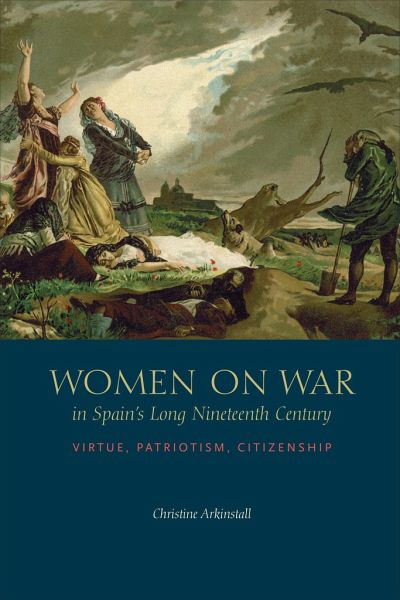
Drawing on feminist theories and cultural histories, this book interweaves historical and literary contexts of Spanish female writers and their works on war.
Drawing on feminist theories and cultural histories, this book interweaves historical and literary contexts of Spanish female writers and their works on war.
Christine Arkinstall is a professor of Spanish at the University of Auckland.
Inhaltsangabe
List of Illustrations Acknowledgments Introduction: From behind the Lines to Writing War’s Texts: Redrawing the Boundaries of War and Gender 1. Love of Nation and Women’s Citizenship in Rosario de Acuña’s Amor a la patria (1877) 2. Gender, Casticismo, and Imperial Nations in Spain’s fin de siècle: Blanca de los Ríos’s Sangre española (1899) 3. Charity, Patria, and Painting War’s Pain: Concepción Arenal’s Writings, 1869-79 4. The Monstrosity of War and Justpeace: Concepción Arenal’s Cuadros de la guerra and Ensayo sobre el Derecho de Gentes 5. Getting Intimate with Empire: Fin-de-Siècle Women Writing a Psychology of the Disaster 6. Disordering the Imperial Home: Blanca de los Ríos’s La niña de Sanabria (1907) 7. Purity of Blood in the National Family? Spain’s War in Morocco in Carmen de Burgos’s En la guerra (Episodios de Melilla) (1909) 8. Between Feminist Aspirations and Pacifist Ideals: Burgos’s Essays on World War I and Women in War 9. Denouncing War’s Broken Syntax: Burgos’s World War I Novellas Conclusion: Transforming Moral Maps, Then and Now Notes References Index
List of Illustrations Acknowledgments Introduction: From behind the Lines to Writing War’s Texts: Redrawing the Boundaries of War and Gender 1. Love of Nation and Women’s Citizenship in Rosario de Acuña’s Amor a la patria (1877) 2. Gender, Casticismo, and Imperial Nations in Spain’s fin de siècle: Blanca de los Ríos’s Sangre española (1899) 3. Charity, Patria, and Painting War’s Pain: Concepción Arenal’s Writings, 1869-79 4. The Monstrosity of War and Justpeace: Concepción Arenal’s Cuadros de la guerra and Ensayo sobre el Derecho de Gentes 5. Getting Intimate with Empire: Fin-de-Siècle Women Writing a Psychology of the Disaster 6. Disordering the Imperial Home: Blanca de los Ríos’s La niña de Sanabria (1907) 7. Purity of Blood in the National Family? Spain’s War in Morocco in Carmen de Burgos’s En la guerra (Episodios de Melilla) (1909) 8. Between Feminist Aspirations and Pacifist Ideals: Burgos’s Essays on World War I and Women in War 9. Denouncing War’s Broken Syntax: Burgos’s World War I Novellas Conclusion: Transforming Moral Maps, Then and Now Notes References Index
Es gelten unsere Allgemeinen Geschäftsbedingungen: www.buecher.de/agb
Impressum
www.buecher.de ist ein Internetauftritt der buecher.de internetstores GmbH
Geschäftsführung: Monica Sawhney | Roland Kölbl | Günter Hilger
Sitz der Gesellschaft: Batheyer Straße 115 - 117, 58099 Hagen
Postanschrift: Bürgermeister-Wegele-Str. 12, 86167 Augsburg
Amtsgericht Hagen HRB 13257
Steuernummer: 321/5800/1497
USt-IdNr: DE450055826