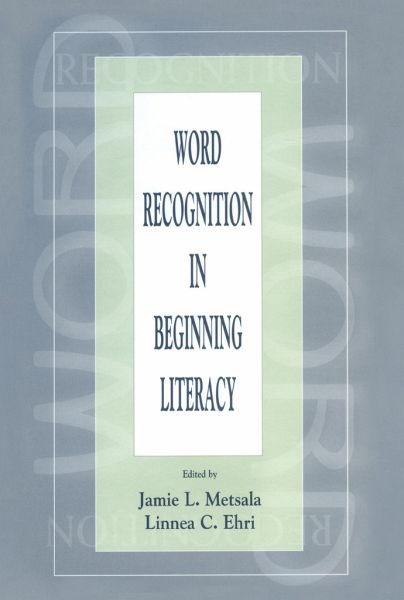
This edited volume grew out of a conference that brought together beginning reading experts from the fields of education and the psychology of reading and reading disabilities so that they could present and discuss their research findings and theories about how children learn to read words, instructional contexts that facilitate this learning, background experiences prior to formal schooling that contribute, and sources of difficulty in disabled readers. The chapters bring a variety of perspectives to bear on a single cluster of problems involving the acquisition of word reading ability. It is…mehr
This edited volume grew out of a conference that brought together beginning reading experts from the fields of education and the psychology of reading and reading disabilities so that they could present and discuss their research findings and theories about how children learn to read words, instructional contexts that facilitate this learning, background experiences prior to formal schooling that contribute, and sources of difficulty in disabled readers. The chapters bring a variety of perspectives to bear on a single cluster of problems involving the acquisition of word reading ability. It is the editors' keen hope that the insights and findings of the research reported here will influence and become incorporated into the development of practicable, classroom-based instructional programs that succeed in improving children's ability to become skilled readers. Furthermore, they hope that these insights and findings will become incorporated into the working knowledge that teachers apply when they teach their students to read, and into further research on reading acquisition.
Contents: Preface. Part I: Basic Processes in Beginning Word Recognition. L.C. Ehri Grapheme-Phoneme Knowledge Is Essential for Learning to Read Words in English. U. Goswami The Role of Analogies in the Development of Word Recognition. S.A. Stahl B. Murray Issues Involved in Defining Phonological Awareness and Its Relation to Early Reading. J.L. Metsala A.C. Walley Spoken Vocabulary Growth and the Segmental Restructuring of Lexical Representations: Precursors to Phonemic Awareness and Early Reading Ability. G.D.A. Brown The Endpoint of Skilled Word Recognition: The ROAR Model. Part II: Processes and Instruction for Disabled Readers.L.S. Siegel Phonological Processing Deficits and Reading Disabilities. J.K. Torgesen S.R. Burgess Consistency of Reading-Related Phonological Processes Throughout Early Childhood: Evidence From Longitudinal-Correlational and Instructional Studies. B.W. Wise R.K. Olson J. Ring M. Johnson Interactive Computer Support for Improving Phonological Skills. I.W. Gaskins A Beginning Literacy Program for At-Risk and Delayed Readers. Part III: Word Recognition in Context.A.E. Cunningham K.E. Stanovich The Impact of Print Exposure on Word Recognition. L. Baker S. Fernandez-Fein D. Scher H. Williams Home Experiences Related to the Development of Word Recognition. R. Treiman Why Spelling? The Benefits of Incorporating Spelling Into Beginning Reading Instruction. R. Calfee Phonics and Phonemes: Learning to Decode and Spell in a Literature-Based Program. D.H. Tracey L.M. Morrow Motivating Contexts for Young Children's Literacy Development: Implications for Word Recognition. M. Pressley R. Wharton-McDonald J. Mistretta Effective Beginning Literacy Instruction: Dialectial Scaffolded and Contextualized.
Es gelten unsere Allgemeinen Geschäftsbedingungen: www.buecher.de/agb
Impressum
www.buecher.de ist ein Internetauftritt der buecher.de internetstores GmbH
Geschäftsführung: Monica Sawhney | Roland Kölbl | Günter Hilger
Sitz der Gesellschaft: Batheyer Straße 115 - 117, 58099 Hagen
Postanschrift: Bürgermeister-Wegele-Str. 12, 86167 Augsburg
Amtsgericht Hagen HRB 13257
Steuernummer: 321/5800/1497
USt-IdNr: DE450055826