
Arlene F. Marks
Wordsmithing
Classroom Ready Materials for Teaching Nonfiction Writing and Analysis Skills in the High School Grades
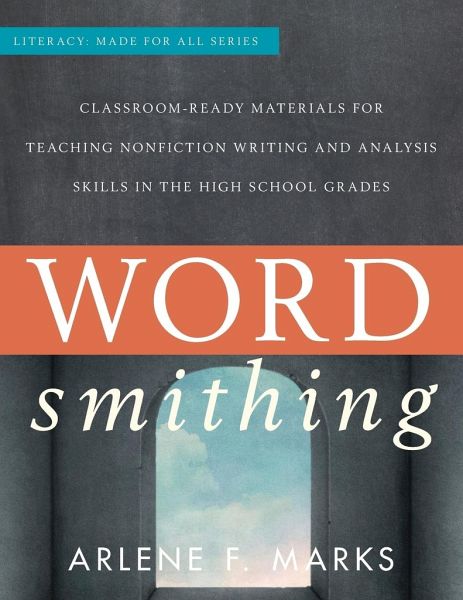
Arlene F. Marks
Wordsmithing
Classroom Ready Materials for Teaching Nonfiction Writing and Analysis Skills in the High School Grades
- Broschiertes Buch
- Merkliste
- Auf die Merkliste
- Bewerten Bewerten
- Teilen
- Produkt teilen
- Produkterinnerung
- Produkterinnerung
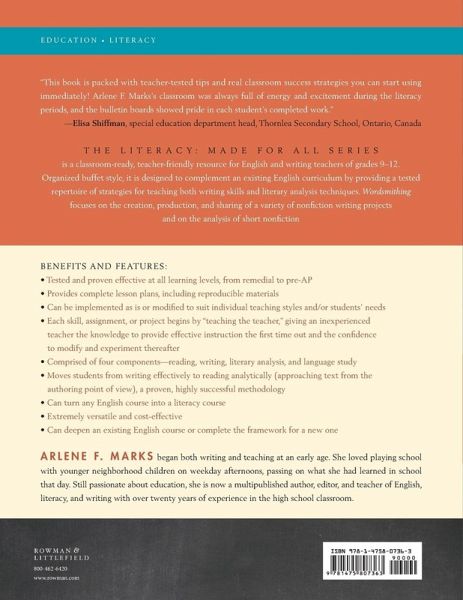
WORDSMITHING focuses on the creation, production and sharing of a variety of nonfiction writing projects.
Andere Kunden interessierten sich auch für
 Arlene F. MarksPlot Building68,99 €
 Arlene F. MarksEnjoying Literature80,99 €
 Kathleen AdamsYour Brain on Ink44,99 €
 Rona F. FlippoStudying and Learning in a High-Stakes World55,99 €
 Nicholas D. YoungBeyond the Bedtime Story74,99 €
 Stages of Literacy Development74,99 €
 Vanessa DomineHealthy Teens, Healthy Schools78,99 €
-
-
-

WORDSMITHING focuses on the creation, production and sharing of a variety of nonfiction writing projects.
Produktdetails
- Produktdetails
- Verlag: Rowman & Littlefield Publishers
- Seitenzahl: 248
- Erscheinungstermin: 4. Juni 2014
- Englisch
- Abmessung: 280mm x 216mm x 14mm
- Gewicht: 634g
- ISBN-13: 9781475807363
- ISBN-10: 1475807368
- Artikelnr.: 40449199
- Herstellerkennzeichnung
- Libri GmbH
- Europaallee 1
- 36244 Bad Hersfeld
- gpsr@libri.de
- Verlag: Rowman & Littlefield Publishers
- Seitenzahl: 248
- Erscheinungstermin: 4. Juni 2014
- Englisch
- Abmessung: 280mm x 216mm x 14mm
- Gewicht: 634g
- ISBN-13: 9781475807363
- ISBN-10: 1475807368
- Artikelnr.: 40449199
- Herstellerkennzeichnung
- Libri GmbH
- Europaallee 1
- 36244 Bad Hersfeld
- gpsr@libri.de
Born and raised in Toronto, Arlene F. Marks found her storytelling muse at the age of 6, and she has been writing and sharing her imaginative tales ever since. She is also a retired educator and veteran teacher of the craft, having authored two literacy programs for the classroom, as well as From First Word to Last: The Craft of Writing Popular Fiction. During her life, she has worked as everything from a travel agent to a fashion consultant. However, her first love and current obsession is writing speculative fiction.Arlene lives with her husband on the shore of beautiful Nottawasaga Bay. She spends an inordinate amount of time following her characters around the universes in her mind, but she can be lured away from them by dark chocolate... and interesting owls to add to her collection. www.thewritersnest.ca
About Literacy Made for All
Aims and Objectives of the Program
Introduction to Wordsmithing
A. WRITING PROJECTS
Introduction/Aims and Objectives
Project 1: Write an Advertising Campaign
...in 3 different media: Video/Television, Print/Magazine, Billboard or
Teeshirt
Reproducibles/Media:WDR 1 -- Questions Advertisers Must Ask
WDR 2 -- Advertising Plan Sheet
WDR 3 -- Sample TV Script Page
WDR 4 -- Magazine Ad Strategies
WDR 5 - Proofread with a Partner Checklist: Video Ad Script
WDR 6 -- Writing an Ad Campaign Assessment Sheet
Project 2: Write and Deliver a Speech
Debating Speech, Election speech, Acceptance speech, Speech for
evaluation/competition
Reproducibles/Media:WDR 7 -- Speech Planner Sheet
WDR 8 -- Speech Outline Chart
WDR 9 -- Debate Assessment Sheet
WDR 10 -- Acceptance Speech Questions
WDR 11 - Second Draft Questions
WDR 12 -- Written Speech Assessment Sheet
WDR 13 -- Speech Assessment Criteria
Project 3: Write a Personal Essay
Sharing an experience, Sharing an opinion, Opening a window on the author's
world
Reproducibles/Media:WDR 14 -- Essay and Article Outline
WDR 15 - Proofread with a Partner Checklist - Personal Essay
WDR 16 -- Personal Essay Assessment Sheet
Project 4: Write a Biographical/Personality Profile
Profile a family member, an historical figure, a fictional character
Reproducibles/Media:WDR 17 --Present Situation Bio Sheet
WDR 18 -- Past History Bio Sheet
WDR 19 -- Future Goals Bio Sheet
WDR 20 -- How to Interview
WDR 21 -- Personality Profile Planner
WDR 22 -- Proofread with a Partner Checklist - Personality Profile
WDR 23 -- Personality Profile Assessment Sheet
Project 5: Write a Review
...of a television show, a movie sequel or prequel, a music CD/album, a
game
Reproducibles/Media:WDR 24 -- Review Planner
WDR 25 - Proofread with a Partner Checklist - A Review
WDR 26 -- Review Assessment Sheet
Project 6: Write a Researched Article
...for submission to a magazine
Reproducibles/Media:WDR 27 -- Tracking Sheet -- Individuals
WDR 28 -- Letter to Parents
WDR 29 -- Student Researcher ID Cards
WDR 30 -- Article Planner
WDR 31 -- Research Report Sheet
WDR 32 -- Proofread with a Partner Checklist
- A Researched Article
WDR 33 -- Researched Article Assessment Sheet
Project 7: Write Documentation
...to accompany things that do not usually come with instructions for care:
teenagers, families, new babies, your health....
Reproducibles/Media:WDR 28 - Letter to Parents
WDR 34 -- Tracking Sheet - Groups
WDR 35 -- Documentation Planner
WDR 29 - Student Researcher ID Cards
WDR 31 - Research Report Sheet
WDR 36 -- Documentation Assessment Sheet
Project 8: Write a Formal Letter
Covering letter, Letter of complaint, Letter of application, , Letter of
apology, thanks, congratulations, or condolences
Reproducibles/Media:WDR 37 -- Formal Letter Format
WDR 38 -- Formal Letter Assessment Sheet
Project 9: Write a Report
Book report, Resumé, Researched report on teen behavior
Reproducibles/Media:WDR 39 -- Book Report Assessment Sheet
WDR 40 - Resumé Assessment Sheet
WDR 41 -- Letter to Parents (re Survey Assignment)
WDR 42 -- Information Report Assessment Sheet
B. STUDYING THE ESSAY
Introduction/Aims and Objectives
Part 1: Build Your Toolkit
Students familiarize themselves with literary terminology as they describe
and discuss short nonfiction at three levels of analytical complexity.
Assignment 1: Define the Essay
Identifying and charting the characteristics of 5 different kinds of
essays.
Reproducibles/Media:SER 1 - Types of Essays Information Sheet
SER 2 - Types of Essays Worksheet
SER 2A -Types of Essays Worksheet - exemplar filled in
SER 3 - Essay Analysis Worksheet
Assignment 2: Methods of Development and Thesis Support
Identifying and classifying the steps in building an essay and appealing to
the reader.
Reproducibles/Media:SER 4 - Methods of Development
Assignment 3: Analyze on the Technical Level
An introduction to rhetorical devices that determine how the essay looks
and sounds.
Reproducibles/Media:SER 5 - A Glossary Of Rhetorical/Literary Terms
SER 6 - Rhetorical Devices/Levels of Analysis
SER 7 - Answering An Effectiveness Question (Technical)
Assignment 4: Analyze on the Associative Level
An introduction to rhetorical devices that compare and contrast the essay's
content with the real world.
Reproducibles/Media:SER 8 - Answering an Effectiveness Question
(Associative)
Assignment 5: Analyze on the Thematic Level
An introduction to rhetorical devices that focus on what the reader brings
to the reading of the essay.
Reproducibles/Media:SER 9 - Answering an Effectiveness Question (Thematic)
Assignment 6: Practice Close Reading of an Essay
How each word of an essay can contribute to its depth of meaning and its
impact on the reader.
Assignment 7: Practice Analyzing an Essay
How to answer effectiveness questions about examples from an essay.
Reproducibles/Media:SER 10 - Levels of Analysis -- Effectiveness
Summative Product: Write a Sight Test
Reproducibles/Media:SER 11 - Tips for Writing a Sight Test
Summative Product: Answer an Effectiveness Question
Reproducibles/Media: SER 12 - Answering an Effectiveness Question Editing
Checklist
SER 13 - Answering an Effectiveness Question Assessment Sheet
Part 2: Write a Literary Response
As students practice writing three different kinds of responses to short
essays they will be honing both their writing and their critical thinking
skills.
Assignment 1: Write a Dialectical Response to an Essay
Two columns on a sheet of paper, point form personal response to selected
words or sentences.
Assignment 2: Write a Personal Response to an Essay
A short personal essay inspired by a work of short nonfiction.
Reproducibles/Media:SER 14 - Writing a Personal Response
SER 14A - The Writing Process (verso of SER 14)
Assignment 3: Write an Analytical Response to an Essay
A short essay critically examining the effectiveness of another essayist's
choices.
Reproducibles/Media:SER 15 - Writing an Analytical Response
Completing The Final Draft, All Responses
Practicing the writing process to arrive at a finished product.
Reproducibles/Media:SER 16 - Proofread with a Partner - Dialectical
Response
SER 17 - Proofread with a Partner - Personal Response
SER 18 - Proofread with a Partner - Analytical ResponseSER 19 - Assessment
Checklist - Dialectical Response
SER 20 - Assessment Checklist - Personal Response
SER 21 - Assessment Checklist - Analytical Response
Part 3: Timed Writing Practice
Students learn and practice techniques that will help them do their best
when answering essay-response questions on English examinations.
Assignment 1: Lay the Foundations
An introduction to syntax and diction.
Reproducibles/Media:SER 22- Introduction to Syntax
SER 23 - Clauses Determine Sentence Patterns
SER 24 - Phrases Enhance Sentence Meaning
SER 25 - Syntactical Effects
SER 26 - Diction: The Art of Carefully Choosing Words
Assignment 2: Practice Unpacking Prompts
Closely reading a question to determine how to respond.
Reproducibles/Media:SER 27 - Analyzing Tone in Literature
SER 28 - How to Read a Literary Question
Assignment 3: Develop a Supporting Example
Fully analyzing a selected quotation in the body of a written response.
Reproducibles/Media:SER 6 - Rhetorical Devices/Levels of Analysis
SER 10 - Levels Of Analysis - Effectiveness
Assignment 4: Organize an Essay Length Response (DFAR)
A tested and efficient template for a written response to a prompt.
Assignment 5: Write a Timed Response in 40 minutes or less
A proven effective way to help students prepare for final/AP exams.
Reproducibles/Media:SER 29 to 32 - Timed Writing Formative Assessment
Sheets
SER 33 - Tips For Success in Timed Writing Exercises
C. WORD WORKS: A SUPPLEMENTARY LIBRARY OF MATERIAL
Introduction
Segment 1: Words Make Music
An introduction to Linguistics
Segment 2: Words Have Histories
An introduction to Etymology
Reproducibles/Media:WTR 1 - You Know More German Than You Think
WTR 1A - You Know More German Than You Think (Key)
WTR 2 - The Etymologies of Words
Segment 3: Words Do Different Jobs
An introduction to the Parts of Speech
Reproducibles/Media:WTR 3 - Nouns Worksheet
WTR 4 - Proper Nouns Worksheet
WTR 5 - Verbs Worksheet
Segment 4: Words Belong to Families
An introduction to Roots, Prefixes and Suffixes
Reproducibles/Media:WTR 6 - Word Study Worksheet
WTR 7 - Word Study Quiz
Segment 5: The Namesake Project
A unit on the meanings of names
Reproducibles/Media:WTR 8 - Names and Naming
WTR 9 - Where Surnames Come From
WTR 10 - Names of Names
WTR 11 - Pick A Name
WTR 12 - The Namesake Project Assignment Sheet
WTR 12A - So, What About You...? (verso of WTR 12)
Aims and Objectives of the Program
Introduction to Wordsmithing
A. WRITING PROJECTS
Introduction/Aims and Objectives
Project 1: Write an Advertising Campaign
...in 3 different media: Video/Television, Print/Magazine, Billboard or
Teeshirt
Reproducibles/Media:WDR 1 -- Questions Advertisers Must Ask
WDR 2 -- Advertising Plan Sheet
WDR 3 -- Sample TV Script Page
WDR 4 -- Magazine Ad Strategies
WDR 5 - Proofread with a Partner Checklist: Video Ad Script
WDR 6 -- Writing an Ad Campaign Assessment Sheet
Project 2: Write and Deliver a Speech
Debating Speech, Election speech, Acceptance speech, Speech for
evaluation/competition
Reproducibles/Media:WDR 7 -- Speech Planner Sheet
WDR 8 -- Speech Outline Chart
WDR 9 -- Debate Assessment Sheet
WDR 10 -- Acceptance Speech Questions
WDR 11 - Second Draft Questions
WDR 12 -- Written Speech Assessment Sheet
WDR 13 -- Speech Assessment Criteria
Project 3: Write a Personal Essay
Sharing an experience, Sharing an opinion, Opening a window on the author's
world
Reproducibles/Media:WDR 14 -- Essay and Article Outline
WDR 15 - Proofread with a Partner Checklist - Personal Essay
WDR 16 -- Personal Essay Assessment Sheet
Project 4: Write a Biographical/Personality Profile
Profile a family member, an historical figure, a fictional character
Reproducibles/Media:WDR 17 --Present Situation Bio Sheet
WDR 18 -- Past History Bio Sheet
WDR 19 -- Future Goals Bio Sheet
WDR 20 -- How to Interview
WDR 21 -- Personality Profile Planner
WDR 22 -- Proofread with a Partner Checklist - Personality Profile
WDR 23 -- Personality Profile Assessment Sheet
Project 5: Write a Review
...of a television show, a movie sequel or prequel, a music CD/album, a
game
Reproducibles/Media:WDR 24 -- Review Planner
WDR 25 - Proofread with a Partner Checklist - A Review
WDR 26 -- Review Assessment Sheet
Project 6: Write a Researched Article
...for submission to a magazine
Reproducibles/Media:WDR 27 -- Tracking Sheet -- Individuals
WDR 28 -- Letter to Parents
WDR 29 -- Student Researcher ID Cards
WDR 30 -- Article Planner
WDR 31 -- Research Report Sheet
WDR 32 -- Proofread with a Partner Checklist
- A Researched Article
WDR 33 -- Researched Article Assessment Sheet
Project 7: Write Documentation
...to accompany things that do not usually come with instructions for care:
teenagers, families, new babies, your health....
Reproducibles/Media:WDR 28 - Letter to Parents
WDR 34 -- Tracking Sheet - Groups
WDR 35 -- Documentation Planner
WDR 29 - Student Researcher ID Cards
WDR 31 - Research Report Sheet
WDR 36 -- Documentation Assessment Sheet
Project 8: Write a Formal Letter
Covering letter, Letter of complaint, Letter of application, , Letter of
apology, thanks, congratulations, or condolences
Reproducibles/Media:WDR 37 -- Formal Letter Format
WDR 38 -- Formal Letter Assessment Sheet
Project 9: Write a Report
Book report, Resumé, Researched report on teen behavior
Reproducibles/Media:WDR 39 -- Book Report Assessment Sheet
WDR 40 - Resumé Assessment Sheet
WDR 41 -- Letter to Parents (re Survey Assignment)
WDR 42 -- Information Report Assessment Sheet
B. STUDYING THE ESSAY
Introduction/Aims and Objectives
Part 1: Build Your Toolkit
Students familiarize themselves with literary terminology as they describe
and discuss short nonfiction at three levels of analytical complexity.
Assignment 1: Define the Essay
Identifying and charting the characteristics of 5 different kinds of
essays.
Reproducibles/Media:SER 1 - Types of Essays Information Sheet
SER 2 - Types of Essays Worksheet
SER 2A -Types of Essays Worksheet - exemplar filled in
SER 3 - Essay Analysis Worksheet
Assignment 2: Methods of Development and Thesis Support
Identifying and classifying the steps in building an essay and appealing to
the reader.
Reproducibles/Media:SER 4 - Methods of Development
Assignment 3: Analyze on the Technical Level
An introduction to rhetorical devices that determine how the essay looks
and sounds.
Reproducibles/Media:SER 5 - A Glossary Of Rhetorical/Literary Terms
SER 6 - Rhetorical Devices/Levels of Analysis
SER 7 - Answering An Effectiveness Question (Technical)
Assignment 4: Analyze on the Associative Level
An introduction to rhetorical devices that compare and contrast the essay's
content with the real world.
Reproducibles/Media:SER 8 - Answering an Effectiveness Question
(Associative)
Assignment 5: Analyze on the Thematic Level
An introduction to rhetorical devices that focus on what the reader brings
to the reading of the essay.
Reproducibles/Media:SER 9 - Answering an Effectiveness Question (Thematic)
Assignment 6: Practice Close Reading of an Essay
How each word of an essay can contribute to its depth of meaning and its
impact on the reader.
Assignment 7: Practice Analyzing an Essay
How to answer effectiveness questions about examples from an essay.
Reproducibles/Media:SER 10 - Levels of Analysis -- Effectiveness
Summative Product: Write a Sight Test
Reproducibles/Media:SER 11 - Tips for Writing a Sight Test
Summative Product: Answer an Effectiveness Question
Reproducibles/Media: SER 12 - Answering an Effectiveness Question Editing
Checklist
SER 13 - Answering an Effectiveness Question Assessment Sheet
Part 2: Write a Literary Response
As students practice writing three different kinds of responses to short
essays they will be honing both their writing and their critical thinking
skills.
Assignment 1: Write a Dialectical Response to an Essay
Two columns on a sheet of paper, point form personal response to selected
words or sentences.
Assignment 2: Write a Personal Response to an Essay
A short personal essay inspired by a work of short nonfiction.
Reproducibles/Media:SER 14 - Writing a Personal Response
SER 14A - The Writing Process (verso of SER 14)
Assignment 3: Write an Analytical Response to an Essay
A short essay critically examining the effectiveness of another essayist's
choices.
Reproducibles/Media:SER 15 - Writing an Analytical Response
Completing The Final Draft, All Responses
Practicing the writing process to arrive at a finished product.
Reproducibles/Media:SER 16 - Proofread with a Partner - Dialectical
Response
SER 17 - Proofread with a Partner - Personal Response
SER 18 - Proofread with a Partner - Analytical ResponseSER 19 - Assessment
Checklist - Dialectical Response
SER 20 - Assessment Checklist - Personal Response
SER 21 - Assessment Checklist - Analytical Response
Part 3: Timed Writing Practice
Students learn and practice techniques that will help them do their best
when answering essay-response questions on English examinations.
Assignment 1: Lay the Foundations
An introduction to syntax and diction.
Reproducibles/Media:SER 22- Introduction to Syntax
SER 23 - Clauses Determine Sentence Patterns
SER 24 - Phrases Enhance Sentence Meaning
SER 25 - Syntactical Effects
SER 26 - Diction: The Art of Carefully Choosing Words
Assignment 2: Practice Unpacking Prompts
Closely reading a question to determine how to respond.
Reproducibles/Media:SER 27 - Analyzing Tone in Literature
SER 28 - How to Read a Literary Question
Assignment 3: Develop a Supporting Example
Fully analyzing a selected quotation in the body of a written response.
Reproducibles/Media:SER 6 - Rhetorical Devices/Levels of Analysis
SER 10 - Levels Of Analysis - Effectiveness
Assignment 4: Organize an Essay Length Response (DFAR)
A tested and efficient template for a written response to a prompt.
Assignment 5: Write a Timed Response in 40 minutes or less
A proven effective way to help students prepare for final/AP exams.
Reproducibles/Media:SER 29 to 32 - Timed Writing Formative Assessment
Sheets
SER 33 - Tips For Success in Timed Writing Exercises
C. WORD WORKS: A SUPPLEMENTARY LIBRARY OF MATERIAL
Introduction
Segment 1: Words Make Music
An introduction to Linguistics
Segment 2: Words Have Histories
An introduction to Etymology
Reproducibles/Media:WTR 1 - You Know More German Than You Think
WTR 1A - You Know More German Than You Think (Key)
WTR 2 - The Etymologies of Words
Segment 3: Words Do Different Jobs
An introduction to the Parts of Speech
Reproducibles/Media:WTR 3 - Nouns Worksheet
WTR 4 - Proper Nouns Worksheet
WTR 5 - Verbs Worksheet
Segment 4: Words Belong to Families
An introduction to Roots, Prefixes and Suffixes
Reproducibles/Media:WTR 6 - Word Study Worksheet
WTR 7 - Word Study Quiz
Segment 5: The Namesake Project
A unit on the meanings of names
Reproducibles/Media:WTR 8 - Names and Naming
WTR 9 - Where Surnames Come From
WTR 10 - Names of Names
WTR 11 - Pick A Name
WTR 12 - The Namesake Project Assignment Sheet
WTR 12A - So, What About You...? (verso of WTR 12)
About Literacy Made for All
Aims and Objectives of the Program
Introduction to Wordsmithing
A. WRITING PROJECTS
Introduction/Aims and Objectives
Project 1: Write an Advertising Campaign
...in 3 different media: Video/Television, Print/Magazine, Billboard or
Teeshirt
Reproducibles/Media:WDR 1 -- Questions Advertisers Must Ask
WDR 2 -- Advertising Plan Sheet
WDR 3 -- Sample TV Script Page
WDR 4 -- Magazine Ad Strategies
WDR 5 - Proofread with a Partner Checklist: Video Ad Script
WDR 6 -- Writing an Ad Campaign Assessment Sheet
Project 2: Write and Deliver a Speech
Debating Speech, Election speech, Acceptance speech, Speech for
evaluation/competition
Reproducibles/Media:WDR 7 -- Speech Planner Sheet
WDR 8 -- Speech Outline Chart
WDR 9 -- Debate Assessment Sheet
WDR 10 -- Acceptance Speech Questions
WDR 11 - Second Draft Questions
WDR 12 -- Written Speech Assessment Sheet
WDR 13 -- Speech Assessment Criteria
Project 3: Write a Personal Essay
Sharing an experience, Sharing an opinion, Opening a window on the author's
world
Reproducibles/Media:WDR 14 -- Essay and Article Outline
WDR 15 - Proofread with a Partner Checklist - Personal Essay
WDR 16 -- Personal Essay Assessment Sheet
Project 4: Write a Biographical/Personality Profile
Profile a family member, an historical figure, a fictional character
Reproducibles/Media:WDR 17 --Present Situation Bio Sheet
WDR 18 -- Past History Bio Sheet
WDR 19 -- Future Goals Bio Sheet
WDR 20 -- How to Interview
WDR 21 -- Personality Profile Planner
WDR 22 -- Proofread with a Partner Checklist - Personality Profile
WDR 23 -- Personality Profile Assessment Sheet
Project 5: Write a Review
...of a television show, a movie sequel or prequel, a music CD/album, a
game
Reproducibles/Media:WDR 24 -- Review Planner
WDR 25 - Proofread with a Partner Checklist - A Review
WDR 26 -- Review Assessment Sheet
Project 6: Write a Researched Article
...for submission to a magazine
Reproducibles/Media:WDR 27 -- Tracking Sheet -- Individuals
WDR 28 -- Letter to Parents
WDR 29 -- Student Researcher ID Cards
WDR 30 -- Article Planner
WDR 31 -- Research Report Sheet
WDR 32 -- Proofread with a Partner Checklist
- A Researched Article
WDR 33 -- Researched Article Assessment Sheet
Project 7: Write Documentation
...to accompany things that do not usually come with instructions for care:
teenagers, families, new babies, your health....
Reproducibles/Media:WDR 28 - Letter to Parents
WDR 34 -- Tracking Sheet - Groups
WDR 35 -- Documentation Planner
WDR 29 - Student Researcher ID Cards
WDR 31 - Research Report Sheet
WDR 36 -- Documentation Assessment Sheet
Project 8: Write a Formal Letter
Covering letter, Letter of complaint, Letter of application, , Letter of
apology, thanks, congratulations, or condolences
Reproducibles/Media:WDR 37 -- Formal Letter Format
WDR 38 -- Formal Letter Assessment Sheet
Project 9: Write a Report
Book report, Resumé, Researched report on teen behavior
Reproducibles/Media:WDR 39 -- Book Report Assessment Sheet
WDR 40 - Resumé Assessment Sheet
WDR 41 -- Letter to Parents (re Survey Assignment)
WDR 42 -- Information Report Assessment Sheet
B. STUDYING THE ESSAY
Introduction/Aims and Objectives
Part 1: Build Your Toolkit
Students familiarize themselves with literary terminology as they describe
and discuss short nonfiction at three levels of analytical complexity.
Assignment 1: Define the Essay
Identifying and charting the characteristics of 5 different kinds of
essays.
Reproducibles/Media:SER 1 - Types of Essays Information Sheet
SER 2 - Types of Essays Worksheet
SER 2A -Types of Essays Worksheet - exemplar filled in
SER 3 - Essay Analysis Worksheet
Assignment 2: Methods of Development and Thesis Support
Identifying and classifying the steps in building an essay and appealing to
the reader.
Reproducibles/Media:SER 4 - Methods of Development
Assignment 3: Analyze on the Technical Level
An introduction to rhetorical devices that determine how the essay looks
and sounds.
Reproducibles/Media:SER 5 - A Glossary Of Rhetorical/Literary Terms
SER 6 - Rhetorical Devices/Levels of Analysis
SER 7 - Answering An Effectiveness Question (Technical)
Assignment 4: Analyze on the Associative Level
An introduction to rhetorical devices that compare and contrast the essay's
content with the real world.
Reproducibles/Media:SER 8 - Answering an Effectiveness Question
(Associative)
Assignment 5: Analyze on the Thematic Level
An introduction to rhetorical devices that focus on what the reader brings
to the reading of the essay.
Reproducibles/Media:SER 9 - Answering an Effectiveness Question (Thematic)
Assignment 6: Practice Close Reading of an Essay
How each word of an essay can contribute to its depth of meaning and its
impact on the reader.
Assignment 7: Practice Analyzing an Essay
How to answer effectiveness questions about examples from an essay.
Reproducibles/Media:SER 10 - Levels of Analysis -- Effectiveness
Summative Product: Write a Sight Test
Reproducibles/Media:SER 11 - Tips for Writing a Sight Test
Summative Product: Answer an Effectiveness Question
Reproducibles/Media: SER 12 - Answering an Effectiveness Question Editing
Checklist
SER 13 - Answering an Effectiveness Question Assessment Sheet
Part 2: Write a Literary Response
As students practice writing three different kinds of responses to short
essays they will be honing both their writing and their critical thinking
skills.
Assignment 1: Write a Dialectical Response to an Essay
Two columns on a sheet of paper, point form personal response to selected
words or sentences.
Assignment 2: Write a Personal Response to an Essay
A short personal essay inspired by a work of short nonfiction.
Reproducibles/Media:SER 14 - Writing a Personal Response
SER 14A - The Writing Process (verso of SER 14)
Assignment 3: Write an Analytical Response to an Essay
A short essay critically examining the effectiveness of another essayist's
choices.
Reproducibles/Media:SER 15 - Writing an Analytical Response
Completing The Final Draft, All Responses
Practicing the writing process to arrive at a finished product.
Reproducibles/Media:SER 16 - Proofread with a Partner - Dialectical
Response
SER 17 - Proofread with a Partner - Personal Response
SER 18 - Proofread with a Partner - Analytical ResponseSER 19 - Assessment
Checklist - Dialectical Response
SER 20 - Assessment Checklist - Personal Response
SER 21 - Assessment Checklist - Analytical Response
Part 3: Timed Writing Practice
Students learn and practice techniques that will help them do their best
when answering essay-response questions on English examinations.
Assignment 1: Lay the Foundations
An introduction to syntax and diction.
Reproducibles/Media:SER 22- Introduction to Syntax
SER 23 - Clauses Determine Sentence Patterns
SER 24 - Phrases Enhance Sentence Meaning
SER 25 - Syntactical Effects
SER 26 - Diction: The Art of Carefully Choosing Words
Assignment 2: Practice Unpacking Prompts
Closely reading a question to determine how to respond.
Reproducibles/Media:SER 27 - Analyzing Tone in Literature
SER 28 - How to Read a Literary Question
Assignment 3: Develop a Supporting Example
Fully analyzing a selected quotation in the body of a written response.
Reproducibles/Media:SER 6 - Rhetorical Devices/Levels of Analysis
SER 10 - Levels Of Analysis - Effectiveness
Assignment 4: Organize an Essay Length Response (DFAR)
A tested and efficient template for a written response to a prompt.
Assignment 5: Write a Timed Response in 40 minutes or less
A proven effective way to help students prepare for final/AP exams.
Reproducibles/Media:SER 29 to 32 - Timed Writing Formative Assessment
Sheets
SER 33 - Tips For Success in Timed Writing Exercises
C. WORD WORKS: A SUPPLEMENTARY LIBRARY OF MATERIAL
Introduction
Segment 1: Words Make Music
An introduction to Linguistics
Segment 2: Words Have Histories
An introduction to Etymology
Reproducibles/Media:WTR 1 - You Know More German Than You Think
WTR 1A - You Know More German Than You Think (Key)
WTR 2 - The Etymologies of Words
Segment 3: Words Do Different Jobs
An introduction to the Parts of Speech
Reproducibles/Media:WTR 3 - Nouns Worksheet
WTR 4 - Proper Nouns Worksheet
WTR 5 - Verbs Worksheet
Segment 4: Words Belong to Families
An introduction to Roots, Prefixes and Suffixes
Reproducibles/Media:WTR 6 - Word Study Worksheet
WTR 7 - Word Study Quiz
Segment 5: The Namesake Project
A unit on the meanings of names
Reproducibles/Media:WTR 8 - Names and Naming
WTR 9 - Where Surnames Come From
WTR 10 - Names of Names
WTR 11 - Pick A Name
WTR 12 - The Namesake Project Assignment Sheet
WTR 12A - So, What About You...? (verso of WTR 12)
Aims and Objectives of the Program
Introduction to Wordsmithing
A. WRITING PROJECTS
Introduction/Aims and Objectives
Project 1: Write an Advertising Campaign
...in 3 different media: Video/Television, Print/Magazine, Billboard or
Teeshirt
Reproducibles/Media:WDR 1 -- Questions Advertisers Must Ask
WDR 2 -- Advertising Plan Sheet
WDR 3 -- Sample TV Script Page
WDR 4 -- Magazine Ad Strategies
WDR 5 - Proofread with a Partner Checklist: Video Ad Script
WDR 6 -- Writing an Ad Campaign Assessment Sheet
Project 2: Write and Deliver a Speech
Debating Speech, Election speech, Acceptance speech, Speech for
evaluation/competition
Reproducibles/Media:WDR 7 -- Speech Planner Sheet
WDR 8 -- Speech Outline Chart
WDR 9 -- Debate Assessment Sheet
WDR 10 -- Acceptance Speech Questions
WDR 11 - Second Draft Questions
WDR 12 -- Written Speech Assessment Sheet
WDR 13 -- Speech Assessment Criteria
Project 3: Write a Personal Essay
Sharing an experience, Sharing an opinion, Opening a window on the author's
world
Reproducibles/Media:WDR 14 -- Essay and Article Outline
WDR 15 - Proofread with a Partner Checklist - Personal Essay
WDR 16 -- Personal Essay Assessment Sheet
Project 4: Write a Biographical/Personality Profile
Profile a family member, an historical figure, a fictional character
Reproducibles/Media:WDR 17 --Present Situation Bio Sheet
WDR 18 -- Past History Bio Sheet
WDR 19 -- Future Goals Bio Sheet
WDR 20 -- How to Interview
WDR 21 -- Personality Profile Planner
WDR 22 -- Proofread with a Partner Checklist - Personality Profile
WDR 23 -- Personality Profile Assessment Sheet
Project 5: Write a Review
...of a television show, a movie sequel or prequel, a music CD/album, a
game
Reproducibles/Media:WDR 24 -- Review Planner
WDR 25 - Proofread with a Partner Checklist - A Review
WDR 26 -- Review Assessment Sheet
Project 6: Write a Researched Article
...for submission to a magazine
Reproducibles/Media:WDR 27 -- Tracking Sheet -- Individuals
WDR 28 -- Letter to Parents
WDR 29 -- Student Researcher ID Cards
WDR 30 -- Article Planner
WDR 31 -- Research Report Sheet
WDR 32 -- Proofread with a Partner Checklist
- A Researched Article
WDR 33 -- Researched Article Assessment Sheet
Project 7: Write Documentation
...to accompany things that do not usually come with instructions for care:
teenagers, families, new babies, your health....
Reproducibles/Media:WDR 28 - Letter to Parents
WDR 34 -- Tracking Sheet - Groups
WDR 35 -- Documentation Planner
WDR 29 - Student Researcher ID Cards
WDR 31 - Research Report Sheet
WDR 36 -- Documentation Assessment Sheet
Project 8: Write a Formal Letter
Covering letter, Letter of complaint, Letter of application, , Letter of
apology, thanks, congratulations, or condolences
Reproducibles/Media:WDR 37 -- Formal Letter Format
WDR 38 -- Formal Letter Assessment Sheet
Project 9: Write a Report
Book report, Resumé, Researched report on teen behavior
Reproducibles/Media:WDR 39 -- Book Report Assessment Sheet
WDR 40 - Resumé Assessment Sheet
WDR 41 -- Letter to Parents (re Survey Assignment)
WDR 42 -- Information Report Assessment Sheet
B. STUDYING THE ESSAY
Introduction/Aims and Objectives
Part 1: Build Your Toolkit
Students familiarize themselves with literary terminology as they describe
and discuss short nonfiction at three levels of analytical complexity.
Assignment 1: Define the Essay
Identifying and charting the characteristics of 5 different kinds of
essays.
Reproducibles/Media:SER 1 - Types of Essays Information Sheet
SER 2 - Types of Essays Worksheet
SER 2A -Types of Essays Worksheet - exemplar filled in
SER 3 - Essay Analysis Worksheet
Assignment 2: Methods of Development and Thesis Support
Identifying and classifying the steps in building an essay and appealing to
the reader.
Reproducibles/Media:SER 4 - Methods of Development
Assignment 3: Analyze on the Technical Level
An introduction to rhetorical devices that determine how the essay looks
and sounds.
Reproducibles/Media:SER 5 - A Glossary Of Rhetorical/Literary Terms
SER 6 - Rhetorical Devices/Levels of Analysis
SER 7 - Answering An Effectiveness Question (Technical)
Assignment 4: Analyze on the Associative Level
An introduction to rhetorical devices that compare and contrast the essay's
content with the real world.
Reproducibles/Media:SER 8 - Answering an Effectiveness Question
(Associative)
Assignment 5: Analyze on the Thematic Level
An introduction to rhetorical devices that focus on what the reader brings
to the reading of the essay.
Reproducibles/Media:SER 9 - Answering an Effectiveness Question (Thematic)
Assignment 6: Practice Close Reading of an Essay
How each word of an essay can contribute to its depth of meaning and its
impact on the reader.
Assignment 7: Practice Analyzing an Essay
How to answer effectiveness questions about examples from an essay.
Reproducibles/Media:SER 10 - Levels of Analysis -- Effectiveness
Summative Product: Write a Sight Test
Reproducibles/Media:SER 11 - Tips for Writing a Sight Test
Summative Product: Answer an Effectiveness Question
Reproducibles/Media: SER 12 - Answering an Effectiveness Question Editing
Checklist
SER 13 - Answering an Effectiveness Question Assessment Sheet
Part 2: Write a Literary Response
As students practice writing three different kinds of responses to short
essays they will be honing both their writing and their critical thinking
skills.
Assignment 1: Write a Dialectical Response to an Essay
Two columns on a sheet of paper, point form personal response to selected
words or sentences.
Assignment 2: Write a Personal Response to an Essay
A short personal essay inspired by a work of short nonfiction.
Reproducibles/Media:SER 14 - Writing a Personal Response
SER 14A - The Writing Process (verso of SER 14)
Assignment 3: Write an Analytical Response to an Essay
A short essay critically examining the effectiveness of another essayist's
choices.
Reproducibles/Media:SER 15 - Writing an Analytical Response
Completing The Final Draft, All Responses
Practicing the writing process to arrive at a finished product.
Reproducibles/Media:SER 16 - Proofread with a Partner - Dialectical
Response
SER 17 - Proofread with a Partner - Personal Response
SER 18 - Proofread with a Partner - Analytical ResponseSER 19 - Assessment
Checklist - Dialectical Response
SER 20 - Assessment Checklist - Personal Response
SER 21 - Assessment Checklist - Analytical Response
Part 3: Timed Writing Practice
Students learn and practice techniques that will help them do their best
when answering essay-response questions on English examinations.
Assignment 1: Lay the Foundations
An introduction to syntax and diction.
Reproducibles/Media:SER 22- Introduction to Syntax
SER 23 - Clauses Determine Sentence Patterns
SER 24 - Phrases Enhance Sentence Meaning
SER 25 - Syntactical Effects
SER 26 - Diction: The Art of Carefully Choosing Words
Assignment 2: Practice Unpacking Prompts
Closely reading a question to determine how to respond.
Reproducibles/Media:SER 27 - Analyzing Tone in Literature
SER 28 - How to Read a Literary Question
Assignment 3: Develop a Supporting Example
Fully analyzing a selected quotation in the body of a written response.
Reproducibles/Media:SER 6 - Rhetorical Devices/Levels of Analysis
SER 10 - Levels Of Analysis - Effectiveness
Assignment 4: Organize an Essay Length Response (DFAR)
A tested and efficient template for a written response to a prompt.
Assignment 5: Write a Timed Response in 40 minutes or less
A proven effective way to help students prepare for final/AP exams.
Reproducibles/Media:SER 29 to 32 - Timed Writing Formative Assessment
Sheets
SER 33 - Tips For Success in Timed Writing Exercises
C. WORD WORKS: A SUPPLEMENTARY LIBRARY OF MATERIAL
Introduction
Segment 1: Words Make Music
An introduction to Linguistics
Segment 2: Words Have Histories
An introduction to Etymology
Reproducibles/Media:WTR 1 - You Know More German Than You Think
WTR 1A - You Know More German Than You Think (Key)
WTR 2 - The Etymologies of Words
Segment 3: Words Do Different Jobs
An introduction to the Parts of Speech
Reproducibles/Media:WTR 3 - Nouns Worksheet
WTR 4 - Proper Nouns Worksheet
WTR 5 - Verbs Worksheet
Segment 4: Words Belong to Families
An introduction to Roots, Prefixes and Suffixes
Reproducibles/Media:WTR 6 - Word Study Worksheet
WTR 7 - Word Study Quiz
Segment 5: The Namesake Project
A unit on the meanings of names
Reproducibles/Media:WTR 8 - Names and Naming
WTR 9 - Where Surnames Come From
WTR 10 - Names of Names
WTR 11 - Pick A Name
WTR 12 - The Namesake Project Assignment Sheet
WTR 12A - So, What About You...? (verso of WTR 12)