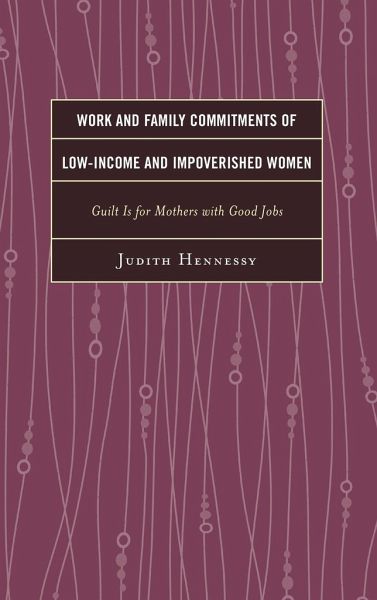
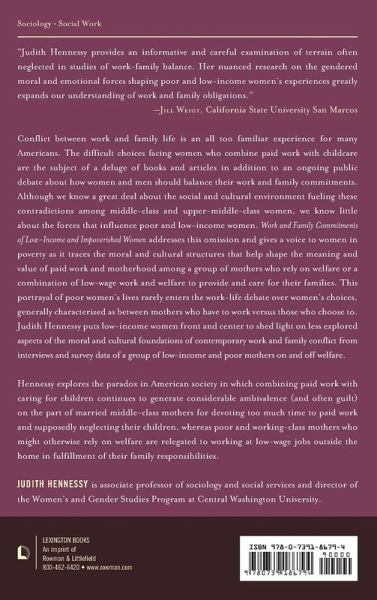
This book explores a paradox in the contemporary work-life debate where dual-earner mothers’ decisions to limit or withdraw from the workforce to spend time with children yields understanding from the American public, while poor women who would otherwise limit work and rely on welfare are seen as shirking their responsibility to their children.
This book explores a paradox in the contemporary work-life debate where dual-earner mothers’ decisions to limit or withdraw from the workforce to spend time with children yields understanding from the American public, while poor women who would otherwise limit work and rely on welfare are seen as shirking their responsibility to their children.
The ParadoxWomen's Work and Family Choices Opting Out Welfare Assistance and Work and Family Decisions Divergent Values Devotion Schemas Poor Mothers' Schemas Work Commitment Schema Family Commitment Schema The Study Overview of the Book Historical Context From Mothers' Aid to Personal ResponsibilityMaternalist Welfare State ADC to AFDC The War on Poverty-1960s Work Incentive Program The Family Assistance Plan Retrenchment Family Support Act Ending Welfare As We Knew It: PRWORA The Cultural Contradiction in PRWORA Work Commitment: Learning to Love LaborTheorizing Work and Family Conflict through Cultural Schema Work Commitment Work Commitment Defined I Never Give Up Rewards From Working Outside the Home Personal Rewards Character Examples for Children Working for Family Working Mothers Are Not Welfare Mothers Mothers Need to Work Job Quality Work and Family Trade-offs Giving up on June Cleaver Work or Family? Family Commitment: Guilt is for Mothers with Good JobsFamily Commitment Schema Family Commitment Defined Competing Schemas Paid Work and Caring for Children Are Two Opposite Things Family Commitment: The "Natural" Gendered Schema The Social Costs of Mothers' Work outside the Home Actually It Is Freedom of Choice "Mommy Wars" Family Values I Just Thought I Would Take Care of the Children Conclusion Work and Family at the Welfare OfficeNobody Likes Welfare Welfare Mothers We'll Give You Help, but Not a Gravy Train They're Not There to Help You Paying the Daycare but Not the Moms? They Want You to Work You Can't Just Throw Somebody into a Job Support for Educational Goals Penalties for Work and Family Choices What if Your Kid Gets Sick? Sending Three-Month-Old Infants to Daycare Conclusion Survey FindingsDescriptive Findings Regression Analysis Independent Variables Dependent Variables OLS Regression Findings Compatibility of Paid Work and Childrearing Traditional Family Values Welfare to Work ConclusionWork and Family Paradox Why Study Low-income Mothers? Gendered Schemas The End of Welfare Work Commitment Family Commitment At the Welfare Office Public Policy Meeting the Needs of Families Appendix A: Methods and Data Interview process Survey Design and Sample Survey Instrument Administering the Survey Quantitative Analysis Dependent Variables Independent Variables References
The ParadoxWomen's Work and Family Choices Opting Out Welfare Assistance and Work and Family Decisions Divergent Values Devotion Schemas Poor Mothers' Schemas Work Commitment Schema Family Commitment Schema The Study Overview of the Book Historical Context From Mothers' Aid to Personal ResponsibilityMaternalist Welfare State ADC to AFDC The War on Poverty-1960s Work Incentive Program The Family Assistance Plan Retrenchment Family Support Act Ending Welfare As We Knew It: PRWORA The Cultural Contradiction in PRWORA Work Commitment: Learning to Love LaborTheorizing Work and Family Conflict through Cultural Schema Work Commitment Work Commitment Defined I Never Give Up Rewards From Working Outside the Home Personal Rewards Character Examples for Children Working for Family Working Mothers Are Not Welfare Mothers Mothers Need to Work Job Quality Work and Family Trade-offs Giving up on June Cleaver Work or Family? Family Commitment: Guilt is for Mothers with Good JobsFamily Commitment Schema Family Commitment Defined Competing Schemas Paid Work and Caring for Children Are Two Opposite Things Family Commitment: The "Natural" Gendered Schema The Social Costs of Mothers' Work outside the Home Actually It Is Freedom of Choice "Mommy Wars" Family Values I Just Thought I Would Take Care of the Children Conclusion Work and Family at the Welfare OfficeNobody Likes Welfare Welfare Mothers We'll Give You Help, but Not a Gravy Train They're Not There to Help You Paying the Daycare but Not the Moms? They Want You to Work You Can't Just Throw Somebody into a Job Support for Educational Goals Penalties for Work and Family Choices What if Your Kid Gets Sick? Sending Three-Month-Old Infants to Daycare Conclusion Survey FindingsDescriptive Findings Regression Analysis Independent Variables Dependent Variables OLS Regression Findings Compatibility of Paid Work and Childrearing Traditional Family Values Welfare to Work ConclusionWork and Family Paradox Why Study Low-income Mothers? Gendered Schemas The End of Welfare Work Commitment Family Commitment At the Welfare Office Public Policy Meeting the Needs of Families Appendix A: Methods and Data Interview process Survey Design and Sample Survey Instrument Administering the Survey Quantitative Analysis Dependent Variables Independent Variables References
Es gelten unsere Allgemeinen Geschäftsbedingungen: www.buecher.de/agb
Impressum
www.buecher.de ist ein Internetauftritt der buecher.de internetstores GmbH
Geschäftsführung: Monica Sawhney | Roland Kölbl | Günter Hilger
Sitz der Gesellschaft: Batheyer Straße 115 - 117, 58099 Hagen
Postanschrift: Bürgermeister-Wegele-Str. 12, 86167 Augsburg
Amtsgericht Hagen HRB 13257
Steuernummer: 321/5800/1497
USt-IdNr: DE450055826