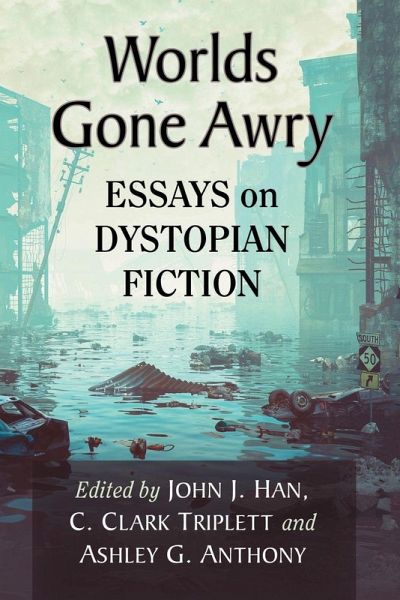
Dystopian fiction captivates us by depicting future worlds at once eerily similar and shockingly foreign to our own. This collection of new essays presents some of the most recent scholarship on a genre whose popularity has surged dramatically since the 1990s. Contributors explore such novels as The Lord of the Flies, The Heart Goes Last, The Giver and The Strain Trilogy as social critique, revealing how they appeal to the same impulse as utopian fiction: the desire for an idealized yet illusory society in which evil is purged and justice prevails.
Dystopian fiction captivates us by depicting future worlds at once eerily similar and shockingly foreign to our own. This collection of new essays presents some of the most recent scholarship on a genre whose popularity has surged dramatically since the 1990s. Contributors explore such novels as The Lord of the Flies, The Heart Goes Last, The Giver and The Strain Trilogy as social critique, revealing how they appeal to the same impulse as utopian fiction: the desire for an idealized yet illusory society in which evil is purged and justice prevails.
John J. Han is professor of English and creative writing and chair of the humanities division at Missouri Baptist University in St. Louis and is the author, editor, co-editor, compiler, or translator of 18 books. C. Clark Triplett is vice president for graduate studies and academic program review and professor of psychology/sociology at Missouri Baptist University in St. Louis. Ashley G. Anthony is an associate instructor of English at Maryville University, in St. Louis.
Inhaltsangabe
Table of Contents Acknowledgments Introduction (John J. Han, C. Clark Triplett and Ashley G. Anthony) Part One: Classical Dystopian Fiction Feminine Subterfuge in Margaret Atwood's The Heart Goes Last (Megan E. Cannella) "Forget sad things": Kurt Vonnegut's Dystopian Short Fiction as Social Critique (Ashley G. Anthony) "A secure but partly demented society": Reconsidering Human Depravity in William Golding's Lord of the Flies (Natasha W. Vashisht) Streets of Spectrality: Kevin Barry's Dystopian City of Bohane (Deirdre Flynn) Interrogating Utopia: On Colin MacInnes' Absolute Beginners (Andrew Hammond) "What if I said that he's a god?": Messianism in Cormac McCarthy's The Road (Wes Yeary) "Maps and mazes": Mapping as Metaphor in Postsecular America (Harold K. Bush) Part Two: Popular Dystopian Fiction Unmasking the Deception: The Hermeneutic of Suspicion in Lois Lowry's The Giver (C. Clark Triplett and John J. Han )111 Ending Dystopia: The Feminist Critique of Culture in Suzanne Collins' Hunger Games Trilogy (Jane Beal) Commodifying the Revolution: Dystopian Young Adult Literature and Cultural Critique (Jillian L. Canode) Dystopia, Competition and Reality Television Tropes in The Bachman Books: "The Long Walk" and "The Running Man" (Alissa Burger) Stranger Than Fiction: Locating the Digital Dystopia in Contemporary Fiction (Robyn N. Rowley) Disembodied Heads and Headless Philosophies: C.S. Lewis' Aesthetic Rejoinder to Dystopian Utility in That Hideous Strength (Matthew Bardowell) The Creation of the Future from Remnants of the Past: Order from Disorder in William Gibson's All Tomorrow's Parties and Neal Stephenson's Snow Crash (Melanie A. Marotta) The Future Is White, the Future Is Undead: Reframing the American Vampire Dystopia in Guillermo del Toro and Chuck Hogan's The Strain Trilogy (Simon Bacon) Here's Looking at You, Kids: The Urgency of Dystopian Texts in the Secondary Classroom (Michael A. Soares) About the Contributors Index
Table of Contents Acknowledgments Introduction (John J. Han, C. Clark Triplett and Ashley G. Anthony) Part One: Classical Dystopian Fiction Feminine Subterfuge in Margaret Atwood's The Heart Goes Last (Megan E. Cannella) "Forget sad things": Kurt Vonnegut's Dystopian Short Fiction as Social Critique (Ashley G. Anthony) "A secure but partly demented society": Reconsidering Human Depravity in William Golding's Lord of the Flies (Natasha W. Vashisht) Streets of Spectrality: Kevin Barry's Dystopian City of Bohane (Deirdre Flynn) Interrogating Utopia: On Colin MacInnes' Absolute Beginners (Andrew Hammond) "What if I said that he's a god?": Messianism in Cormac McCarthy's The Road (Wes Yeary) "Maps and mazes": Mapping as Metaphor in Postsecular America (Harold K. Bush) Part Two: Popular Dystopian Fiction Unmasking the Deception: The Hermeneutic of Suspicion in Lois Lowry's The Giver (C. Clark Triplett and John J. Han )111 Ending Dystopia: The Feminist Critique of Culture in Suzanne Collins' Hunger Games Trilogy (Jane Beal) Commodifying the Revolution: Dystopian Young Adult Literature and Cultural Critique (Jillian L. Canode) Dystopia, Competition and Reality Television Tropes in The Bachman Books: "The Long Walk" and "The Running Man" (Alissa Burger) Stranger Than Fiction: Locating the Digital Dystopia in Contemporary Fiction (Robyn N. Rowley) Disembodied Heads and Headless Philosophies: C.S. Lewis' Aesthetic Rejoinder to Dystopian Utility in That Hideous Strength (Matthew Bardowell) The Creation of the Future from Remnants of the Past: Order from Disorder in William Gibson's All Tomorrow's Parties and Neal Stephenson's Snow Crash (Melanie A. Marotta) The Future Is White, the Future Is Undead: Reframing the American Vampire Dystopia in Guillermo del Toro and Chuck Hogan's The Strain Trilogy (Simon Bacon) Here's Looking at You, Kids: The Urgency of Dystopian Texts in the Secondary Classroom (Michael A. Soares) About the Contributors Index
Es gelten unsere Allgemeinen Geschäftsbedingungen: www.buecher.de/agb
Impressum
www.buecher.de ist ein Internetauftritt der buecher.de internetstores GmbH
Geschäftsführung: Monica Sawhney | Roland Kölbl | Günter Hilger
Sitz der Gesellschaft: Batheyer Straße 115 - 117, 58099 Hagen
Postanschrift: Bürgermeister-Wegele-Str. 12, 86167 Augsburg
Amtsgericht Hagen HRB 13257
Steuernummer: 321/5800/1497
USt-IdNr: DE450055826