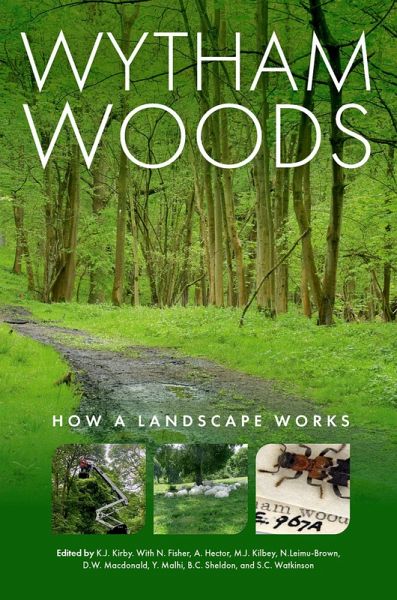
Since the woods, grassland and farmland of the 1000 hectare Wytham Estate in Oxfordshire, England, came to the University of Oxford in 1943, the Estate has been the subject of an immense amount of research. The pioneering studies of Charles Elton and colleagues laid some of the foundations of ecological science in the 1950s while students today gather insights using the latest technology from DNA analysis to remote sensing from drones and satellites. Wytham Woods: How a Landscape Works provides an account of one of the most researched landscapes in Britain, charting its evolution over the last…mehr
Since the woods, grassland and farmland of the 1000 hectare Wytham Estate in Oxfordshire, England, came to the University of Oxford in 1943, the Estate has been the subject of an immense amount of research. The pioneering studies of Charles Elton and colleagues laid some of the foundations of ecological science in the 1950s while students today gather insights using the latest technology from DNA analysis to remote sensing from drones and satellites. Wytham Woods: How a Landscape Works provides an account of one of the most researched landscapes in Britain, charting its evolution over the last 10,000 years. The book's focus is on the most recent studies conducted at Wytham Woods, continuing the story of the earlier book (Wytham Woods: Oxford's Ecological Laboratory), to include work on the carbon balance, forest dynamics and grassland restoration as well as links to conservation in other parts of Britain. This new volume also synthesizes long-term work on badgers and great tits and new understanding of the archaeology and history of the Estate. It highlights how Wytham is an influential node in a global network of research sites which continues to shape our understanding of ecology world-wide, from microbes to global climate change. Written by scholars and experts, this volume combines different strands to show how and why the landscape has developed as it has and where it might go in future as climate change, new tree diseases, and changing public policies impact the Woods and the surrounding Estate. Combining new research and interpretations of a world-famous site, this volume is an engaging exploration of the past, present and future of the Wytham Estate and provides insights that can be applied more widely both in Britain and across the world.
Keith Kirby joined the Nature Conservancy Council (NCC) in 1979, a predecessor to Natural England, as woodland ecologist/forestry policy officer and worked with them for 33 years. Throughout this period, he maintained an interest in Wytham Woods, re-surveying permanent vegetation plots spread over the Woods every 5-10 years and has published extensively on his work in the Estate. Since retiring from Natural England in 2012 he has continued his work in Wytham as a visiting researcher in the Department of Biology. For this book he has worked with leading scientists across the University of Oxford. The team of co-editors (Nick Leimu-Brown, Nigel Fisher, Andrew Hector, Maggie Kilbey, David Macdonald, Yadvinder Malhi, Ben Sheldon and Sarah Watkinson) have decades of first-hand experience of the Woods and the Wytham Estate more generally. Together they have produced this new account of one of the most famous ecological research sites in the world.
Inhaltsangabe
* Acknowledgements * INTRODUCTION * 1. Welcome to the Wytham Estate * THE SHAPING OF THE WYTHAM LANDSCAPE OVER TIME * 2. The history of the Estate prior to the University's aqquisition * 3. The Estate under the University's stewardship * THE STRUCTURE AND DYNAMICS OF THE WYTHAM LANDSCAPE * 4. Stocks and flows across the landscape: carbon, trace gases and energy * 5. Woodland structure and composition * 6. Maintenance and restoration of open habitats * CHANGES IN THE FAUNA AND THEIR CAUSES * 7. Changes in the fauna * 8. A 50-year glimpse of the badgers of Wytham Woods * 9. New ways of understanding the biology of tits: from nest boxes to integrative ecology and evolution * THE ESTATE AND THE WIDER WORLD * 10.The Estate as a social landscape * 11. Wytham's place in the wider landscape * 12. From the past to the future * APPENDICES * REFERENCES
* Acknowledgements * INTRODUCTION * 1. Welcome to the Wytham Estate * THE SHAPING OF THE WYTHAM LANDSCAPE OVER TIME * 2. The history of the Estate prior to the University's aqquisition * 3. The Estate under the University's stewardship * THE STRUCTURE AND DYNAMICS OF THE WYTHAM LANDSCAPE * 4. Stocks and flows across the landscape: carbon, trace gases and energy * 5. Woodland structure and composition * 6. Maintenance and restoration of open habitats * CHANGES IN THE FAUNA AND THEIR CAUSES * 7. Changes in the fauna * 8. A 50-year glimpse of the badgers of Wytham Woods * 9. New ways of understanding the biology of tits: from nest boxes to integrative ecology and evolution * THE ESTATE AND THE WIDER WORLD * 10.The Estate as a social landscape * 11. Wytham's place in the wider landscape * 12. From the past to the future * APPENDICES * REFERENCES
Es gelten unsere Allgemeinen Geschäftsbedingungen: www.buecher.de/agb
Impressum
www.buecher.de ist ein Internetauftritt der buecher.de internetstores GmbH
Geschäftsführung: Monica Sawhney | Roland Kölbl | Günter Hilger
Sitz der Gesellschaft: Batheyer Straße 115 - 117, 58099 Hagen
Postanschrift: Bürgermeister-Wegele-Str. 12, 86167 Augsburg
Amtsgericht Hagen HRB 13257
Steuernummer: 321/5800/1497
USt-IdNr: DE450055826