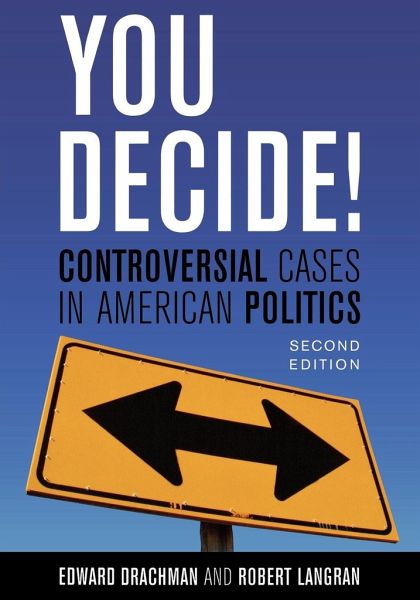
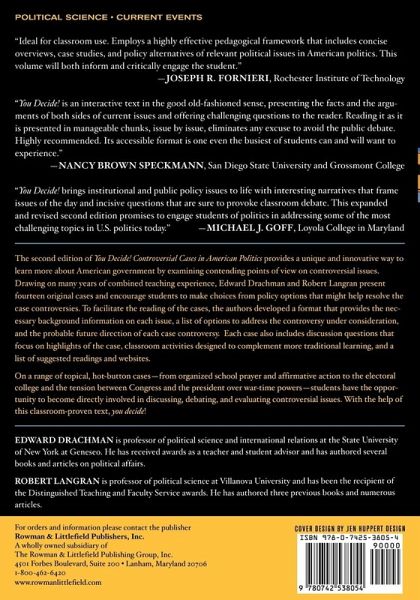
The book is a unique and innovative assembly of 14 originally written cases on controversial topics in American government and politics. It is intended to engage students in active learning through discussion, debate and participation in the introductory American Government course.
The book is a unique and innovative assembly of 14 originally written cases on controversial topics in American government and politics. It is intended to engage students in active learning through discussion, debate and participation in the introductory American Government course.
Edward Drachman is professor of political science and international relations at the State University of New York at Geneseo. He has received awards as a teacher and student advisor and has authored several books and articles on political affairs. He resides in Geneseo, New York. Robert Langran is professor of political science at Villanova University and has been the recipient of the Distinguished Teaching and Faculty Service awards. He has authored three previous books and numerous articles. He resides in Villanova, Pennsylvania.
Inhaltsangabe
Chapter 1 The Constitution: Is Original Intent the Proper Model for Constitutional Interpretation? Chapter 2 Federalism: Shoud Undocumented Students Quaify for In-State Tuition Benefits from Pubic Colleges and Universities? Chapter 3 Civil Liberties: Should Government-Sponsored Prayer Be Allowed in the Public Schools? Chapter 4 Civil Rights: Race-Based Affirmative Action in College Admissions: Keep it, Mend it, or End it? Chapter 5 Political Socialization and Culture: Are Bilingual Programs the Best Way to Teach Students with Limited English Proficiency? Chapter 6 The Media: Should the U.S. media have shown the cartoons of the Prophet Mohammed originally published in a Danish newspaper? Chapter 7 Political Interest Groups: Are School Vouchers a Key to Meaningful Educational Reform? Chapter 8 Political Parties and Campaigns: Is Campaign Reform Needed? Chapter 9 Voting: What is the fairest method of redistricting? Chapter 10 Elections: Is the Electoral College the Best Way to Elect U.S. Presidents? Chapter 11 Congress: Should the Senate Continue the Practice of the Filibuster? Chapter 12 The Presidency: How Limited Should Presidential Power in Wartime? Chapter 13 The Judiciary: Should the case Kelo v. City of New London be revisited? Chapter 14 Foreign Policy: What is the Best Exit Plan for the U.S. in Iraq?
Chapter 1 The Constitution: Is Original Intent the Proper Model for Constitutional Interpretation? Chapter 2 Federalism: Shoud Undocumented Students Quaify for In-State Tuition Benefits from Pubic Colleges and Universities? Chapter 3 Civil Liberties: Should Government-Sponsored Prayer Be Allowed in the Public Schools? Chapter 4 Civil Rights: Race-Based Affirmative Action in College Admissions: Keep it, Mend it, or End it? Chapter 5 Political Socialization and Culture: Are Bilingual Programs the Best Way to Teach Students with Limited English Proficiency? Chapter 6 The Media: Should the U.S. media have shown the cartoons of the Prophet Mohammed originally published in a Danish newspaper? Chapter 7 Political Interest Groups: Are School Vouchers a Key to Meaningful Educational Reform? Chapter 8 Political Parties and Campaigns: Is Campaign Reform Needed? Chapter 9 Voting: What is the fairest method of redistricting? Chapter 10 Elections: Is the Electoral College the Best Way to Elect U.S. Presidents? Chapter 11 Congress: Should the Senate Continue the Practice of the Filibuster? Chapter 12 The Presidency: How Limited Should Presidential Power in Wartime? Chapter 13 The Judiciary: Should the case Kelo v. City of New London be revisited? Chapter 14 Foreign Policy: What is the Best Exit Plan for the U.S. in Iraq?
Es gelten unsere Allgemeinen Geschäftsbedingungen: www.buecher.de/agb
Impressum
www.buecher.de ist ein Internetauftritt der buecher.de internetstores GmbH
Geschäftsführung: Monica Sawhney | Roland Kölbl | Günter Hilger
Sitz der Gesellschaft: Batheyer Straße 115 - 117, 58099 Hagen
Postanschrift: Bürgermeister-Wegele-Str. 12, 86167 Augsburg
Amtsgericht Hagen HRB 13257
Steuernummer: 321/5800/1497
USt-IdNr: DE450055826