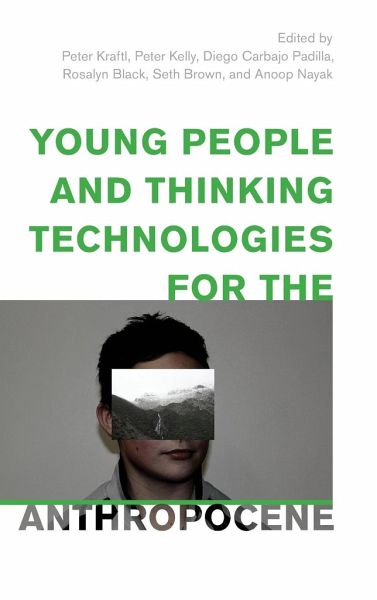
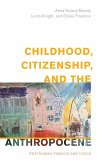
This book brings a multi-disciplinary focus to discussions about children and young people’s well-being, resilience, and enterprise to develop new ways of troubling these keywords at a time when planetary systems are in crisis.
This book brings a multi-disciplinary focus to discussions about children and young people’s well-being, resilience, and enterprise to develop new ways of troubling these keywords at a time when planetary systems are in crisis.
Peter Kraftl is Professor of Human Geography at the University of Birmingham, UK. His research looks at the intersection between children, young people and the environment, with a particular interest in urban and education spaces. He has published ten books (most recently, After Childhood, Routledge) and over 100 journal articles and book chapters on these topics. Peter has been an Editor of the journals Children's Geographies and Area and is a Fellow of the Academy of Social Sciences (UK). Peter Kelly is a Professor of Education in the School of Education at Deakin University. Peter's current research interests include a critical engagement with young people, their well-being, resilience and enterprise, and the challenges associated with the emergence of the Anthropocene. In the context of the COVID-19 pandemic, these interests are framing the development of a research agenda titled: COVID-19 and Young People's Well-being, Education, Training and Employment Pathways: Scenarios for Young People's Sustainable Futures. Diego Carbajo Padilla is an assistant professor and researcher of the Department of Sociology and Social Work at the University of the Basque Country UPV/EHU (Spain). His main research interests articulate concepts such as youth, precarity and/or entrepreneurship. These interests are concretised in publications around the concept of global grammars of entreprise, young people's residential transitions and the squatter social movement in the Basque Country. Rosalyn Black is a Senior Lecturer within the School of Education at Deakin University, Australia. Her research interests meet at the intersection of the sociologies of education and youth. It draws on poststructuralist perspectives to critically analyse young people's relationship to democratic systems; the role of schools and universities in constructing young people as citizens; and the geographies of young people's lived experiences of citizenship, especially in contexts of social inequality. Seth Brown is a Lecturer in the School of Education at RMIT University, Australia. His research interest is in the socio-cultural studies of education and youth in the context of wider social and cultural change. He is Head of UNEVOC@RMIT University and a member of Co-Lab SDGs and the Young People's Sustainable Futures Lab. His most recent jointly written book includes Belonging, Identity, Time and Young People's Engagement in the Middle Years of School with co-authors Peter Kelly and Scott Phillips (Palgrave Macmillan 2020). Anoop Nayak is Professor in Social and Cultural Geography at Newcastle University, UK. His research interests include race, ethnicity and migration; youth cultures and social class inequalities; masculinities and global transformations. His current research explores young people, diversity and belonging in a post-Brexit age (Research Excellence Academy) and an ESRC co-production award seeking to develop new templates for masculinities in primary schools.
Inhaltsangabe
Part 1 Plastics, Soils, Water, Weather and Waste: The Materialities of Childhoods in the Anthropocene Chapter 1: Plastic childhoods (and more): visceralities, vortices, vectors, virtualities Peter Kraftl Chapter 2: Resilience as more-than-human Mindy Blaise, Jo Pollitt, Jane Merewether, and Veronica Pacini-Ketchabaw Chapter 3: Soil as Kin: Unearthing Old Ways Aviva Reed Chapter 4: Living in the Anthropocene Adrianne Bacelar de Castro and Sarah Hennessy Part 2 Temporalities and Spaces: Young People's Anthropocenes Chapter 5: Blasted Places: Smog, Steel and Stigma in a Post-industrial Town Anoop Nayak Chapter 6: The net of heaven is vast, vast.': Rethinking a philosophy for youth work in the Anthropocene Kerry Montero Chapter 7: The Anthropocene and the two-faced responsibility of young people in the European welfare regimes Kari Paakkunainen, Juhani Saari, and Juri Mykkanen Chapter 8: Young People and the Anthropocene: Futures, Past and Present? Peter Kelly Part 3 Knowing and Naming Young People a
Part 1 Plastics, Soils, Water, Weather and Waste: The Materialities of Childhoods in the Anthropocene Chapter 1: Plastic childhoods (and more): visceralities, vortices, vectors, virtualities Peter Kraftl Chapter 2: Resilience as more-than-human Mindy Blaise, Jo Pollitt, Jane Merewether, and Veronica Pacini-Ketchabaw Chapter 3: Soil as Kin: Unearthing Old Ways Aviva Reed Chapter 4: Living in the Anthropocene Adrianne Bacelar de Castro and Sarah Hennessy Part 2 Temporalities and Spaces: Young People's Anthropocenes Chapter 5: Blasted Places: Smog, Steel and Stigma in a Post-industrial Town Anoop Nayak Chapter 6: The net of heaven is vast, vast.': Rethinking a philosophy for youth work in the Anthropocene Kerry Montero Chapter 7: The Anthropocene and the two-faced responsibility of young people in the European welfare regimes Kari Paakkunainen, Juhani Saari, and Juri Mykkanen Chapter 8: Young People and the Anthropocene: Futures, Past and Present? Peter Kelly Part 3 Knowing and Naming Young People a
Es gelten unsere Allgemeinen Geschäftsbedingungen: www.buecher.de/agb
Impressum
www.buecher.de ist ein Internetauftritt der buecher.de internetstores GmbH
Geschäftsführung: Monica Sawhney | Roland Kölbl | Günter Hilger
Sitz der Gesellschaft: Batheyer Straße 115 - 117, 58099 Hagen
Postanschrift: Bürgermeister-Wegele-Str. 12, 86167 Augsburg
Amtsgericht Hagen HRB 13257
Steuernummer: 321/5800/1497
USt-IdNr: DE450055826