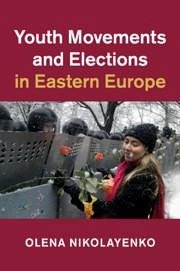
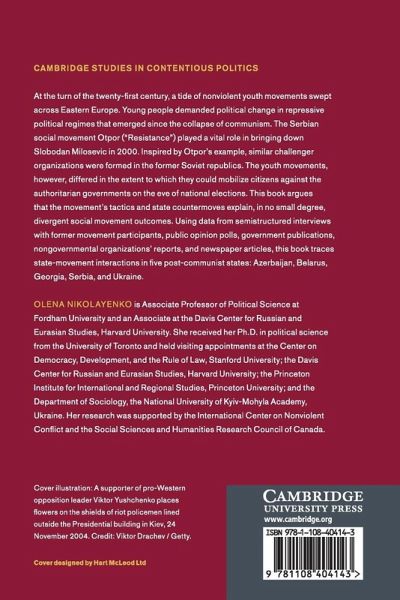
At the turn of the twenty-first century, a tide of nonviolent youth movements swept across Eastern Europe. Young people demanded political change in repressive political regimes that emerged since the collapse of communism. The Serbian social movement Otpor (Resistance) played a vital role in bringing down Slobodan Milosevic in 2000. Inspired by Otpor's example, similar challenger organizations were formed in Azerbaijan, Belarus, Georgia, and Ukraine. The youth movements, however, differed in the extent to which they could mobilize citizens against the authoritarian governments on the eve of…mehr
At the turn of the twenty-first century, a tide of nonviolent youth movements swept across Eastern Europe. Young people demanded political change in repressive political regimes that emerged since the collapse of communism. The Serbian social movement Otpor (Resistance) played a vital role in bringing down Slobodan Milosevic in 2000. Inspired by Otpor's example, similar challenger organizations were formed in Azerbaijan, Belarus, Georgia, and Ukraine. The youth movements, however, differed in the extent to which they could mobilize citizens against the authoritarian governments on the eve of national elections. This book argues that the movement's tactics and state countermoves explain, in no small degree, divergent social movement outcomes. Using data from semi-structured interviews with former movement participants, public opinion polls, government publications, non-governmental organization (NGO) reports, and newspaper articles, the book traces state-movement interactions in five post-communist societies: Azerbaijan, Belarus, Georgia, Serbia, and Ukraine.
Olena Nikolayenko is Associate Professor of Political Science at Fordham University, New York. She received her Ph.D. in Political Science from the University of Toronto, and held visiting appointments at Harvard University's Davis Center for Russian and Eurasian Studies, the Princeton Institute for International and Regional Studies, Stanford University's Center on Democracy, Development, and the Rule of Law, and the National University of Kyiv-Mohyla Academy, Ukraine. Her research was supported by the International Center on Nonviolent Conflict and the Social Sciences and Humanities Research Council of Canada. Her articles have appeared in the Canadian Journal of Political Science, Comparative Politics, Comparative Sociology, Europe-Asia Studies, International Journal of Public Opinion Research, International Political Science Review, Research in Social Movements, Conflicts and Change, Youth and Society, and other journals.
Inhaltsangabe
1. Introduction 2. Elections as an opportunity for political change 3. Youth's revolt against the regime 4. Otpor's nonviolent resistance in Serbia 5. Zubr's struggle against authoritarianism in Belarus 6. Kmara! Enough of corruption and poverty in Georgia 7. Pora! Youth's mobilization in Ukraine 8. The emergence of youth movements in Azerbaijan 9. Conclusion.
1. Introduction 2. Elections as an opportunity for political change 3. Youth's revolt against the regime 4. Otpor's nonviolent resistance in Serbia 5. Zubr's struggle against authoritarianism in Belarus 6. Kmara! Enough of corruption and poverty in Georgia 7. Pora! Youth's mobilization in Ukraine 8. The emergence of youth movements in Azerbaijan 9. Conclusion.
Es gelten unsere Allgemeinen Geschäftsbedingungen: www.buecher.de/agb
Impressum
www.buecher.de ist ein Internetauftritt der buecher.de internetstores GmbH
Geschäftsführung: Monica Sawhney | Roland Kölbl | Günter Hilger
Sitz der Gesellschaft: Batheyer Straße 115 - 117, 58099 Hagen
Postanschrift: Bürgermeister-Wegele-Str. 12, 86167 Augsburg
Amtsgericht Hagen HRB 13257
Steuernummer: 321/5800/1497
USt-IdNr: DE450055826