22,49 €
inkl. MwSt.
Sofort per Download lieferbar
0 °P sammeln

Andere Kunden interessierten sich auch für
") Le souffle de la machine (eBook, ePUB)7,99 €
Le souffle de la machine (eBook, ePUB)7,99 €") Morphing Intelligence (eBook, ePUB)16,95 €
Morphing Intelligence (eBook, ePUB)16,95 € (eBook, ePUB)") The Silent Algorithm (The Harmony Codex, #2) (eBook, ePUB)21,49 €
The Silent Algorithm (The Harmony Codex, #2) (eBook, ePUB)21,49 €") The Philosophy of Power (eBook, ePUB)34,49 €
The Philosophy of Power (eBook, ePUB)34,49 €") I Am a Strange Loop (eBook, ePUB)12,99 €
I Am a Strange Loop (eBook, ePUB)12,99 €") The Singularity (eBook, ePUB)3,49 €
The Singularity (eBook, ePUB)3,49 €") The Sentient AI Revolution: How Artificial Intelligence Gained Consciousness and What It Means for Humanity (eBook, ePUB)4,99 €
The Sentient AI Revolution: How Artificial Intelligence Gained Consciousness and What It Means for Humanity (eBook, ePUB)4,99 €


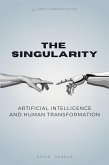

Intelligence is everywhere today-embedded in machines, systems, and everyday tools. Yet clarity about what intelligence actually is has never been more fragile.
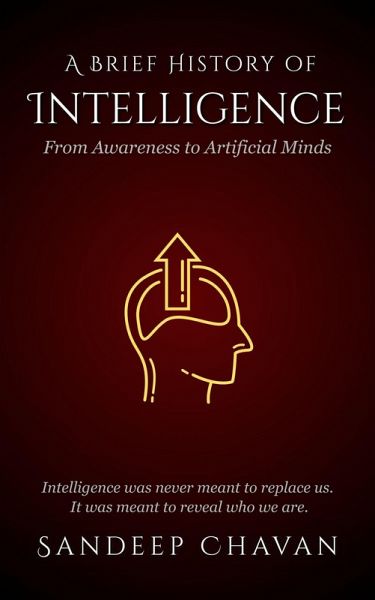
A Brief History of Intelligence: From Awareness to Artificial Minds offers a first-principles reframing of intelligence itself. Rather than treating artificial intelligence as a rival to humanity, the book shows how modern AI is the result of centuries of cognitive offloading-memory to writing, calculation to machines, judgment to systems-while the generative source of intelligence has always remained human awareness.
Moving beyond technical hype and philosophical abstraction, the book traces intelligence from its earliest form as lived awareness, through the mechanics of mind and pattern recognition, to the rise of artificial intelligence as a powerful but fundamentally derivative system. It introduces the Law of Generative Intelligence, clarifying why true intelligence cannot be programmed and why awareness cannot be engineered.
The book explores the human consequences of this shift: fear of replacement, growing inequality, the misuse of intelligence as power, and the failure of education systems built for a pre-AI world. It then turns forward, arguing that the next threshold of intelligence is not technological but existential-requiring a transition from problem-solving to sense-making, from efficiency to wisdom, and from automation to responsibility.
Written in a calm, rigorous, and accessible style, this book is not a manual for using AI, nor a prediction of technological futures. It is a conceptual compass for educators, thinkers, designers, and reflective readers seeking clarity in an age where intelligence is abundant, but understanding is not.
This is a book about intelligence as it has always been-and what it must become-if humanity is to live consciously in an intelligent world.
A Brief History of Intelligence: From Awareness to Artificial Minds offers a first-principles reframing of intelligence itself. Rather than treating artificial intelligence as a rival to humanity, the book shows how modern AI is the result of centuries of cognitive offloading-memory to writing, calculation to machines, judgment to systems-while the generative source of intelligence has always remained human awareness.
Moving beyond technical hype and philosophical abstraction, the book traces intelligence from its earliest form as lived awareness, through the mechanics of mind and pattern recognition, to the rise of artificial intelligence as a powerful but fundamentally derivative system. It introduces the Law of Generative Intelligence, clarifying why true intelligence cannot be programmed and why awareness cannot be engineered.
The book explores the human consequences of this shift: fear of replacement, growing inequality, the misuse of intelligence as power, and the failure of education systems built for a pre-AI world. It then turns forward, arguing that the next threshold of intelligence is not technological but existential-requiring a transition from problem-solving to sense-making, from efficiency to wisdom, and from automation to responsibility.
Written in a calm, rigorous, and accessible style, this book is not a manual for using AI, nor a prediction of technological futures. It is a conceptual compass for educators, thinkers, designers, and reflective readers seeking clarity in an age where intelligence is abundant, but understanding is not.
This is a book about intelligence as it has always been-and what it must become-if humanity is to live consciously in an intelligent world.
Dieser Download kann aus rechtlichen Gründen nur mit Rechnungsadresse in A, B, CY, CZ, D, DK, EW, E, FIN, F, GR, H, IRL, I, LT, L, LR, M, NL, PL, P, R, S, SLO, SK ausgeliefert werden.