1,99 €
1,99 €
inkl. MwSt.
Sofort per Download lieferbar

0 °P sammeln
1,99 €
Als Download kaufen
1,99 €
inkl. MwSt.
Sofort per Download lieferbar
0 °P sammeln
Jetzt verschenken
Alle Infos zum eBook verschenken
1,99 €
inkl. MwSt.
Sofort per Download lieferbar
Alle Infos zum eBook verschenken
0 °P sammeln

Andere Kunden interessierten sich auch für
") The Middle Class Comeback (eBook, ePUB)1,99 €
The Middle Class Comeback (eBook, ePUB)1,99 €") The British Labour Party and twentieth-century Ireland (eBook, ePUB)76,95 €
The British Labour Party and twentieth-century Ireland (eBook, ePUB)76,95 €") American Restoration: How to Unshackle the Great Middle Class (eBook, ePUB)8,99 €
American Restoration: How to Unshackle the Great Middle Class (eBook, ePUB)8,99 €") What Is To Be Done? Class Struggle in the 21st Century (eBook, ePUB)0,99 €
What Is To Be Done? Class Struggle in the 21st Century (eBook, ePUB)0,99 €") How the GOP Establishment Is Co-Opting the Freshman Tea Party Class (eBook, ePUB)14,97 €
How the GOP Establishment Is Co-Opting the Freshman Tea Party Class (eBook, ePUB)14,97 €") Debt by Design: The Downfall of the Middle Class (eBook, ePUB)2,99 €
Debt by Design: The Downfall of the Middle Class (eBook, ePUB)2,99 €") The Selfie Vote (eBook, ePUB)13,99 €
The Selfie Vote (eBook, ePUB)13,99 €






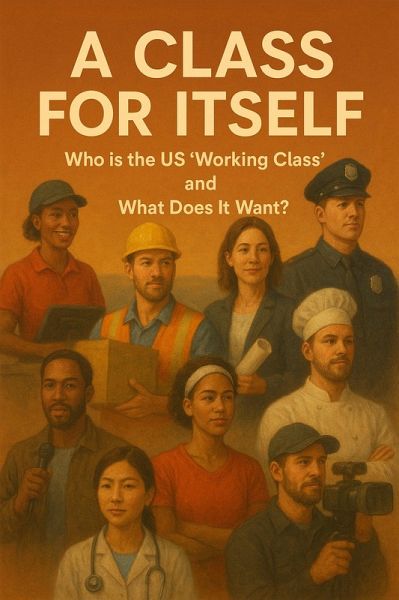
Since Donald Trump's 2024 election, the Democrats have been rightly damned for their failure to stand up for the interests of the nation's working class majority.
On the outs now and enduring Trump's autocracy, many Democrats insist on changing their party's stance. Too frequently, however, their alternative is some vague resurrection of the New Deal, the social contract that got the nation -- and, in many ways, the world -- out of the Great Depression and World War II and, then, girded reconstruction in the postwar era. That social contract was founded in America's industrial might, and it championed the interests of the then-surging, US Labor movement, led by the Congress of Industrial Unions (CIO).
Yet, the US did not remain an industrial superpower for too much longer. Instead, through the decades since WWII, the US became a superpower -- not in industrial production -- but in science, research, design, management, law, health, academics, technology, marketing, retailing, communications and finance. Today, nine out of every ten American workers earn their living, one way or another, by serving others. Documenting this reality and elaborating a cultural materialist framework to explicate its rise, A Class for Itself reveals that providing service is the post-industrial mode of production and the way of life of our world's future. The class of Labor that survives by providing service -- of any and every kind -- is the class whose interests must now guide our politics.
Though political power in the US is still in the hands of corporate capitalism, most people -- worldwide and, in particular, in the US and China -- already work in the service sector and are well-positioned to fight for the collaborative, problem-solving future that civilization and the planet now so desperately need.
Of course, people still need food, and they need tools and commodities to make life work. But, in Service Age societies such long-standing, fundamental necessities are handled by ever-smaller segments of Labor that are supported by creative, labor-saving innovations of the service economy.
So, the vast majority of American workers are "servicers," not mill or factory workers. Further, as A Class for Itself demonstrates, the lives and necessities of servicers are actually sharply different and distinct from those of their class allies in today's factories and on its farms.
If progressives and, ultimately, the Democratic Party are ever to succeed in articulating a practical, yet programmatic vision that resonates with today's workforce -- its working class -- our nation needs an up-to-date understanding of who does the work in our country. What kind of work do they do? What values do they hold? How are they connected as a class? Who controls and exploits their labor? And, most crucially, what are the strategic, moral and practical necessities of the nation's increasingly disgruntled and defiant, service class majority?
On the outs now and enduring Trump's autocracy, many Democrats insist on changing their party's stance. Too frequently, however, their alternative is some vague resurrection of the New Deal, the social contract that got the nation -- and, in many ways, the world -- out of the Great Depression and World War II and, then, girded reconstruction in the postwar era. That social contract was founded in America's industrial might, and it championed the interests of the then-surging, US Labor movement, led by the Congress of Industrial Unions (CIO).
Yet, the US did not remain an industrial superpower for too much longer. Instead, through the decades since WWII, the US became a superpower -- not in industrial production -- but in science, research, design, management, law, health, academics, technology, marketing, retailing, communications and finance. Today, nine out of every ten American workers earn their living, one way or another, by serving others. Documenting this reality and elaborating a cultural materialist framework to explicate its rise, A Class for Itself reveals that providing service is the post-industrial mode of production and the way of life of our world's future. The class of Labor that survives by providing service -- of any and every kind -- is the class whose interests must now guide our politics.
Though political power in the US is still in the hands of corporate capitalism, most people -- worldwide and, in particular, in the US and China -- already work in the service sector and are well-positioned to fight for the collaborative, problem-solving future that civilization and the planet now so desperately need.
Of course, people still need food, and they need tools and commodities to make life work. But, in Service Age societies such long-standing, fundamental necessities are handled by ever-smaller segments of Labor that are supported by creative, labor-saving innovations of the service economy.
So, the vast majority of American workers are "servicers," not mill or factory workers. Further, as A Class for Itself demonstrates, the lives and necessities of servicers are actually sharply different and distinct from those of their class allies in today's factories and on its farms.
If progressives and, ultimately, the Democratic Party are ever to succeed in articulating a practical, yet programmatic vision that resonates with today's workforce -- its working class -- our nation needs an up-to-date understanding of who does the work in our country. What kind of work do they do? What values do they hold? How are they connected as a class? Who controls and exploits their labor? And, most crucially, what are the strategic, moral and practical necessities of the nation's increasingly disgruntled and defiant, service class majority?
Dieser Download kann aus rechtlichen Gründen nur mit Rechnungsadresse in A, B, CY, CZ, D, DK, EW, E, FIN, F, GR, H, IRL, I, LT, L, LR, M, NL, PL, P, R, S, SLO, SK ausgeliefert werden.