Sie sind bereits eingeloggt. Klicken Sie auf 2. tolino select Abo, um fortzufahren.
Bitte loggen Sie sich zunächst in Ihr Kundenkonto ein oder registrieren Sie sich bei bücher.de, um das eBook-Abo tolino select nutzen zu können.
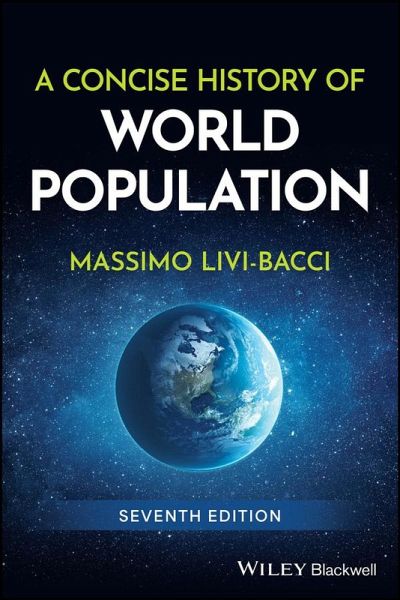
Explores the forces that have shaped global population growth over millennia Understanding the mechanisms that govern the size and trajectory of the human population is essential to navigating today's most pressing global challenges. A Concise History of World Population, offers a sweeping overview of the key demographic patterns that have defined human history and influenced the world's population structure. Drawing on disciplines as diverse as ecology, history, economics, and epidemiology, this new edition provides students and scholars with an interdisciplinary guide to the major…mehr
Explores the forces that have shaped global population growth over millennia
Understanding the mechanisms that govern the size and trajectory of the human population is essential to navigating today's most pressing global challenges. A Concise History of World Population, offers a sweeping overview of the key demographic patterns that have defined human history and influenced the world's population structure. Drawing on disciplines as diverse as ecology, history, economics, and epidemiology, this new edition provides students and scholars with an interdisciplinary guide to the major forces-both natural and human-made-that have determined demographic growth, stagnation, or decline across civilizations.
Acclaimed demographer Massimo Livi-Bacci addresses enduring questions about the balance between people, resources, and environment through careful analysis of catastrophic disruptions, technological revolutions, and slowly evolving reproductive behaviors. Reader-friendly chapters provide the intellectual tools needed to understand the shifting dynamics of global population-paying special attention to emerging demographic trends and the sustainability challenges they pose in the twenty-first century. The result is not just a concise history, but a rich framework for thinking critically about the demographic future.
An essential resource for anyone seeking to understand how population and society co-evolve-and the delicate equilibrium they must maintain-A Concise History of World Population:
Offers a clear and accessible narrative of global population history from pre-agricultural societies to the present
Highlights demographic mechanisms often overlooked in traditional population studies
Includes in-depth analysis of catastrophic events and their demographic impact, including pandemics and climate shocks
Addresses sustainability and future population trends in the context of limited global resources
Engages with long-term patterns and short-term fluctuations in population-resource equilibrium
Employing an interdisciplinary approach that integrates history, anthropology, ecology, economics, and political science, A Concise History of World Population, Seventh Edition, is perfect for advanced undergraduate and graduate courses such as Population Studies, Demographic History, Global History, and Political Demography within degree programs in Sociology, Political Science, History, and Development Studies.
Dieser Download kann aus rechtlichen Gründen nur mit Rechnungsadresse in D ausgeliefert werden.
Die Herstellerinformationen sind derzeit nicht verfügbar.
Autorenporträt
MASSIMO LIVI-BACCI is Emeritus Professor of Demography at the University of Florence. He is a former President of the International Union for the Scientific Study of Population (IUSSP) and served as a Senator of the Italian Republic. Livi-Bacci is widely recognized for his work on historical demography and migration, with notable publications including The Population of Europe: A History and A Short History of Migration.
Inhaltsangabe
Preface ix 1 The Space and Strategy of Demographic Growth 1 1.1 Humans and Animals 1 1.2 Divide and Multiply 5 1.3 Jacopo Bichi and Domenica Del Buono, Jean Guyon, and Mathurine Robin 8 1.4 Reproduction and Survival 11 1.4.1 The Frequency of Births 12 1.4.2 The Fecund Period Used for Reproduction 13 1.5 The Space of Growth 20 1.6 Environmental Constraints 22 1.7 A Few Figures 28 Notes 32 Further Reading 37 2 Demographic Growth: Between Choice and Constraint 39 2.1 Constraint, Choice, Adaptation 39 2.2 From Hunters to Farmers: The Neolithic Demographic Transition 42 2.3 Black Death and Demographic Decline in Europe 50 2.4 The Tragedy of the American Indios: Old Microbes and New Populations 56 2.5 Africa, America, and the Slave Trade 63 2.6 The French Canadians: A Demographic Success Story 68 2.7 Ireland and Japan: Two Islands, Two Histories 73 2.8 On the Threshold of the Contemporary World: China and Europe 80 Notes 88 Further Reading 99 3 Land, Labor, and Population 101 3.1 Diminishing Returns and Demographic Growth 101 3.2 Historical Confirmations 106 3.3 Demographic Pressure and Economic Development 112 3.4 More on Demographic Pressure and Development: Examples from the Stone Age to the Present Day 116 3.5 Space, Land, and Development 120 3.5.1 The Occupation of Uninhabited or Sparsely Populated Regions 123 3.5.2 Transformation and Land Reclamation 124 3.5.3 External Expansion 125 3.6 Population Size and Prosperity 128 3.7 Increasing or Decreasing Returns? 132 Notes 134 Further Reading 139 4 Toward Order and Efficiency: The Demography of Europe and the Developed World 141 4.1 From Waste to Economy 141 4.2 From Disorder to Order: The Lengthening of Life 147 4.3 From High to Low Fertility 154 4.4 European Emigration: A Unique Phenomenon 161 4.5 A Summing Up: The Results of the Transition 167 4.6 Theoretical Considerations on the Relationship between Demographic and Economic Growth 170 4.6.1 Purely Demographic Factors 174 4.6.2 Factors of Scale and Dimensional Factors in General 174 4.6.3 The Stock of Knowledge and Technological Progress 175 4.7 More on the Relationship between Demographic and Economic Growth: Empirical Observations 176 Notes 185 Further Reading 192 5 The Populations of Poor Countries 195 5.1 An Extraordinary Phase 195 5.2 The Conditions of Survival 200 5.3 A Brief Geography of Fertility 208 5.4 The Conditions and Prospects for Fertility Decline and Demographic Policy 214 5.5 India and China 222 5.6 Fertilia and Sterilia 234 5.7 Explaining a Paradox 240 Notes 246 Further Reading 257 6 Microbes, Food, and Space, and Sustainability of Population Change 259 6.1 Moving Limits 259 6.2 Microbes, Virus, and Longevity: Biological Sustainability 264 6.2.1 Biological Sustainability 265 6.2.2 AIDS Epidemic: Sustainable for the Rich, Unsustainable for the Poor 266 6.2.3 COVID- 19: Unexpected Visitor 271 6.3 Microbes, Virus, Longevity 272 6.3.1 Political Sustainability 272 6.4 Microbes, Virus, and Longevity: Economic Sustainability 274 6.5 Food for All? 277 6.5.1 First Topic: Food, Nutrition, and Hunger 277 6.5.2 Second Topic: Productivity, Extension, and Intensification of Agricultural Systems 280 6.5.3 Third Topic: Production, Consumption, and Greenhouse Gases 283 6.6 Nonrenewable Resources and the Parable of Pauperia and Tycoonia 284 6.7 Space and Environment in a Smaller Planet 289 6.7.1 First Critical Issue: Deforestation and Intrusion in the Pluvial Forests 292 6.7.2 Second Critical Issue: Increasing Human Settlement in the Coastal Areas 295 6.7.3 Third Critical Issue: Megacities Energy Consumption and Pollution Champions 297 6.7.4 Population and Environment: Adaptation and Mitigation 298 Notes 300 Further Reading 305 7 The Future 307 7.1 Population and Self- Regulation 307 7.2 The Numbers of the Future 309 7.3 The North- South Divide and International Migration 315 7.3.1 Demographic Inequalities 321 7.3.2 Economic Inequalities 321 7.3.3 Migration Policies 322 7.3.4 Climate Change 323 7.3.5 Geography and Migratory Systems 324 7.4 Downward Fertility and the Role of Policies 326 7.5 Geodemography 328 7.6 A Different World 333 7.7 Calculations and Values 335 Notes 339 Further Reading 341 Index 343
Es gelten unsere Allgemeinen Geschäftsbedingungen: www.buecher.de/agb
Impressum
www.buecher.de ist ein Internetauftritt der buecher.de internetstores GmbH
Geschäftsführung: Monica Sawhney | Roland Kölbl | Günter Hilger
Sitz der Gesellschaft: Batheyer Straße 115 - 117, 58099 Hagen
Postanschrift: Bürgermeister-Wegele-Str. 12, 86167 Augsburg
Amtsgericht Hagen HRB 13257
Steuernummer: 321/5800/1497
USt-IdNr: DE450055826