96,95 €
96,95 €
inkl. MwSt.
Sofort per Download lieferbar

48 °P sammeln
96,95 €
Als Download kaufen
96,95 €
inkl. MwSt.
Sofort per Download lieferbar
48 °P sammeln
Jetzt verschenken
Alle Infos zum eBook verschenken
96,95 €
inkl. MwSt.
Sofort per Download lieferbar
Alle Infos zum eBook verschenken
48 °P sammeln

Andere Kunden interessierten sich auch für
") Erosion and Environment (eBook, PDF)40,95 €
Erosion and Environment (eBook, PDF)40,95 €") Global Degradation of Soil and Water Resources (eBook, PDF)191,95 €
Global Degradation of Soil and Water Resources (eBook, PDF)191,95 €") Soil, Water Pollution and Mitigation Strategies (eBook, PDF)112,95 €
Soil, Water Pollution and Mitigation Strategies (eBook, PDF)112,95 €") Geopedology (eBook, PDF)80,95 €
Geopedology (eBook, PDF)80,95 €") Geoinformatics (eBook, PDF)177,95 €
Geoinformatics (eBook, PDF)177,95 €") The Soils of the Philippines (eBook, PDF)112,95 €
The Soils of the Philippines (eBook, PDF)112,95 €") Soil Degradation, Desertification and Restoration (eBook, PDF)160,95 €
Soil Degradation, Desertification and Restoration (eBook, PDF)160,95 €


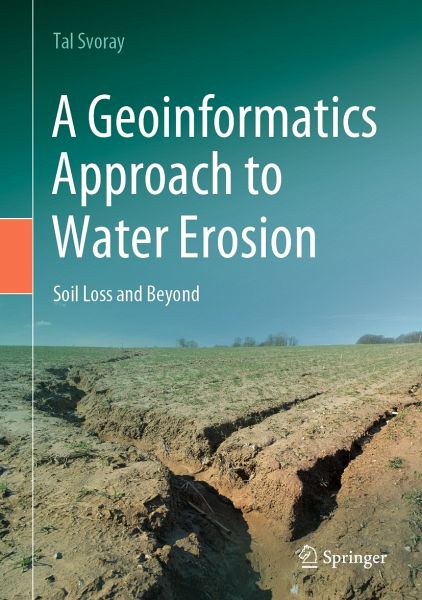
Degradation of agricultural catchments due to water erosion is a major environmental threat at the global scale, with long-lasting destructive consequences valued at tens of billions of dollars per annum. Eroded soils lead to reduced crop yields and deprived agroecosystem's functioning through, for example, decreased water holding capacity, poor aeration, scarce microbial activity, and loose soil structure. This can result in reduced carbon sequestration, limited nutrient cycling, contamination of water bodies due to eutrophication, low protection from floods and poor attention restoration-consequences that go far beyond the commonly modelled soil loss and deposition budgets.
This book demonstrates, using data from the Harod catchment in northern Israel, how cutting-edge geoinformatics, data science methodologies and soil health indicators can be used to measure, predict, and regulate these major environmental hazards. It shows how these approaches are used to quantify-in timeand space-the effect of water erosion not only on the soil layer, soil minerals, and soil loss, but also on the wide-range of services that agricultural ecosystems might supply for the benefit and well-being of humans. The algorithms described in this book play a major role in this paradigm shift and they include, for example, extraction of photogrammetric DEMs from drone's data, advanced drainage structure calculations, fuzzy process-based modelling and spatial topographic threshold computations, multicriteria analyses and expert-based systems development using analytic hierarchal processes, innovative data-mining and machine learning tools, autocorrelation and interpolation of soil health, physically-based soil evolution models, spatial decision support systems and many more.
This book demonstrates, using data from the Harod catchment in northern Israel, how cutting-edge geoinformatics, data science methodologies and soil health indicators can be used to measure, predict, and regulate these major environmental hazards. It shows how these approaches are used to quantify-in timeand space-the effect of water erosion not only on the soil layer, soil minerals, and soil loss, but also on the wide-range of services that agricultural ecosystems might supply for the benefit and well-being of humans. The algorithms described in this book play a major role in this paradigm shift and they include, for example, extraction of photogrammetric DEMs from drone's data, advanced drainage structure calculations, fuzzy process-based modelling and spatial topographic threshold computations, multicriteria analyses and expert-based systems development using analytic hierarchal processes, innovative data-mining and machine learning tools, autocorrelation and interpolation of soil health, physically-based soil evolution models, spatial decision support systems and many more.
Dieser Download kann aus rechtlichen Gründen nur mit Rechnungsadresse in A, B, BG, CY, CZ, D, DK, EW, E, FIN, F, GR, HR, H, IRL, I, LT, L, LR, M, NL, PL, P, R, S, SLO, SK ausgeliefert werden.