22,95 €
22,95 €
inkl. MwSt.
Sofort per Download lieferbar

11 °P sammeln
22,95 €
Als Download kaufen
22,95 €
inkl. MwSt.
Sofort per Download lieferbar
11 °P sammeln
Jetzt verschenken
Alle Infos zum eBook verschenken
22,95 €
inkl. MwSt.
Sofort per Download lieferbar
Alle Infos zum eBook verschenken
11 °P sammeln

Andere Kunden interessierten sich auch für
") Puerto Rico in the American Century (eBook, ePUB)16,95 €
Puerto Rico in the American Century (eBook, ePUB)16,95 €") Winds of Change (eBook, ePUB)22,95 €
Winds of Change (eBook, ePUB)22,95 €") Reproducing the British Caribbean (eBook, ePUB)14,95 €
Reproducing the British Caribbean (eBook, ePUB)14,95 €") Entangled Lands (eBook, ePUB)14,99 €
Entangled Lands (eBook, ePUB)14,99 €") Sugar, Slavery, and Freedom in Nineteenth-Century Puerto Rico (eBook, ePUB)14,95 €
Sugar, Slavery, and Freedom in Nineteenth-Century Puerto Rico (eBook, ePUB)14,95 €") Taking Haiti (eBook, ePUB)22,95 €
Taking Haiti (eBook, ePUB)22,95 €") The Political Languages of Emancipation in the British Caribbean and the U.S. South (eBook, ePUB)22,95 €
The Political Languages of Emancipation in the British Caribbean and the U.S. South (eBook, ePUB)22,95 €







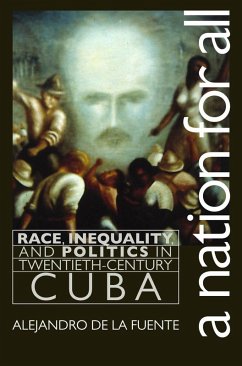
After thirty years of anticolonial struggle against Spain and four years of military occupation by the United States, Cuba formally became an independent republic in 1902. The nationalist coalition that fought for Cuba’s freedom, a movement in which blacks and mulattoes were well represented, had envisioned an egalitarian and inclusive country — a nation for all, as Jose Marti described it. But did the Cuban republic, and later the Cuban revolution, live up to these expectations? Tracing the formation and reformulation of nationalist ideologies, government policies, and different forms of social and political mobilization in republican and postrevolutionary Cuba, Alejandro de la Fuente explores the opportunities and limitations that Afro-Cubans experienced in such areas as job access, education, and political representation. Challenging assumptions of both underlying racism and racial democracy, he contends that racism and antiracism coexisted within Cuban nationalism and, in turn, Cuban society. This coexistence has persisted to this day, despite significant efforts by the revolutionary government to improve the lot of the poor and build a nation that was truly for all.
Dieser Download kann aus rechtlichen Gründen nur mit Rechnungsadresse in A, D ausgeliefert werden.