19,99 €
inkl. MwSt.
Sofort per Download lieferbar
0 °P sammeln

Andere Kunden interessierten sich auch für
") Standard Measures of United States, Great Britain and France (eBook, ePUB)19,99 €
Standard Measures of United States, Great Britain and France (eBook, ePUB)19,99 €") Experiments and Observations on the Following Subjects (eBook, ePUB)19,99 €
Experiments and Observations on the Following Subjects (eBook, ePUB)19,99 €") Finding Longitude (eBook, ePUB)17,49 €
Finding Longitude (eBook, ePUB)17,49 €") An account of a useful discovery to distill double the usual quantity of sea-water, by blowing showers of air up through the distilling liquor (eBook, ePUB)19,99 €
An account of a useful discovery to distill double the usual quantity of sea-water, by blowing showers of air up through the distilling liquor (eBook, ePUB)19,99 €") Gunpowder and Ammunition, Their Origin and Progress (eBook, ePUB)19,99 €
Gunpowder and Ammunition, Their Origin and Progress (eBook, ePUB)19,99 €") The Glass Universe (eBook, ePUB)7,99 €
The Glass Universe (eBook, ePUB)7,99 €") An Essay to Shew the Cause of Electricity; and Why Some Things are Non-Electricable. (eBook, ePUB)19,99 €
An Essay to Shew the Cause of Electricity; and Why Some Things are Non-Electricable. (eBook, ePUB)19,99 €







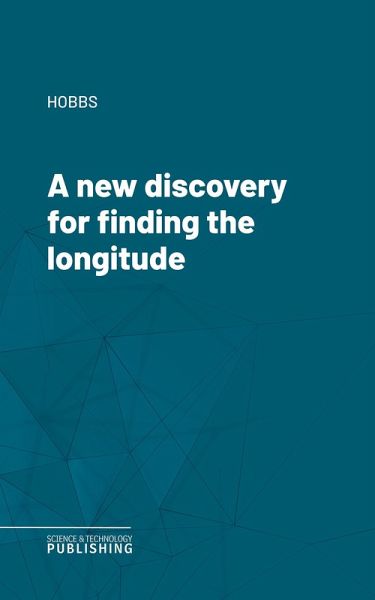
A New Discovery for Finding the Longitude is a fascinating historical treatise published in 1721 by William Whiston, a renowned English mathematician, theologian, and successor to Isaac Newton as Lucasian Professor of Mathematics at Cambridge. This book addresses one of the most pressing scientific challenges of the 17th and 18th centuries: the accurate determination of longitude at sea, a problem that had confounded navigators and led to countless maritime disasters. In this work, Whiston presents his innovative method for finding longitude, which he developed in collaboration with Humphrey Ditton. The book outlines the theoretical foundations of their approach, which involves the use of time signals-specifically, the firing of mortars or the detonation of gunpowder at predetermined intervals along the coast. By observing the time at which the sound or flash of these signals reached ships at sea, navigators could calculate their longitudinal position with unprecedented accuracy. Whiston meticulously details the scientific principles underlying his proposal, including the speed of sound, the challenges of accurate timekeeping, and the practicalities of implementing such a system on a large scale. He also addresses potential objections and offers solutions to anticipated difficulties, demonstrating both his deep understanding of the subject and his commitment to practical application. The book is not only a technical manual but also a passionate plea to the British government and the scientific community to adopt and support his method. Whiston emphasizes the immense benefits that accurate longitude determination would bring to navigation, commerce, and national security, and he situates his work within the broader context of contemporary efforts to solve the longitude problem, including the famous Longitude Act of 1714. A New Discovery for Finding the Longitude is a remarkable document of scientific ingenuity and ambition. It offers modern readers a window into the intellectual climate of the early Enlightenment, the challenges of maritime navigation, and the relentless pursuit of knowledge that characterized the era. For historians of science, maritime enthusiasts, and anyone interested in the history of navigation, Whiston's book remains a compelling and insightful read.
Dieser Download kann aus rechtlichen Gründen nur mit Rechnungsadresse in A, B, BG, CY, CZ, D, DK, EW, E, FIN, F, GR, HR, H, IRL, I, LT, L, LR, M, NL, PL, P, R, S, SLO, SK ausgeliefert werden.