47,95 €
47,95 €
inkl. MwSt.
Sofort per Download lieferbar

24 °P sammeln
47,95 €
Als Download kaufen
47,95 €
inkl. MwSt.
Sofort per Download lieferbar
24 °P sammeln
Jetzt verschenken
Alle Infos zum eBook verschenken
47,95 €
inkl. MwSt.
Sofort per Download lieferbar
Alle Infos zum eBook verschenken
24 °P sammeln

Andere Kunden interessierten sich auch für
") The Routledge Companion to Employment Relations (eBook, PDF)43,95 €
The Routledge Companion to Employment Relations (eBook, PDF)43,95 €") Employment Relations as Networks (eBook, PDF)49,95 €
Employment Relations as Networks (eBook, PDF)49,95 €") Trade Unions and the British Industrial Relations Crisis (eBook, PDF)42,95 €
Trade Unions and the British Industrial Relations Crisis (eBook, PDF)42,95 €") Work and Labor Relations in the Construction Industry (eBook, PDF)41,95 €
Work and Labor Relations in the Construction Industry (eBook, PDF)41,95 €") Contemporary Employers' Organizations (eBook, PDF)41,95 €
Contemporary Employers' Organizations (eBook, PDF)41,95 €") Posted Work in the European Union (eBook, PDF)41,95 €
Posted Work in the European Union (eBook, PDF)41,95 €") Performance through Diversity and Inclusion (eBook, PDF)38,95 €
Performance through Diversity and Inclusion (eBook, PDF)38,95 €



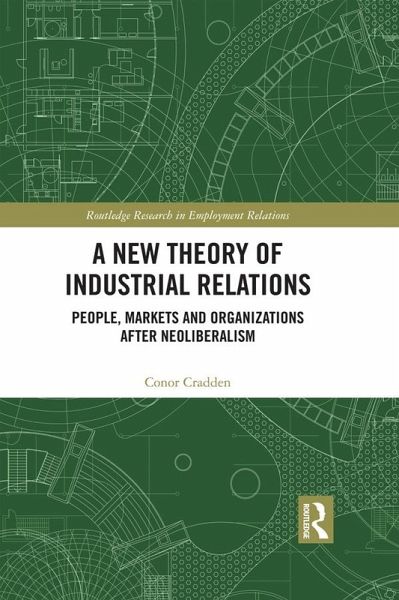
Most existing theoretical approaches to industrial relations and human resources management (IR/HRM) build their analyses and policy prescriptions on one of two foundational assumptions. They assume either that conflict between workers and employers is the natural and inevitable state of affairs; or that under normal circumstances, cooperation is what employers can and should expect from workers. By contrast, A New Theory of Industrial Relations: People, Markets and Organizations after Neoliberalism proposes a theoretical framework for IR/HRM that treats the existence of conflict or cooperation at work as an outcome that needs to be explained rather than an initial presupposition. By identifying the social and organizational roots of reasoned, positively chosen cooperation at work, this framework shows what is needed to construct a genuinely consensual form of capitalism. In broader terms, the book offers a critical theory of the governance of work under capitalism. 'The governance of work' refers to the structures of incentives and sanctions, authority, accountability and direct and representative participation within and beyond the workplace by which decisions about the content, conditions and remuneration of work are made, applied, challenged and revised.
The most basic proposition made in the book is that work will be consensual-and, hence, that employees will actively and willingly cooperate with the implementation of organizational plans and strategies-when the governance of work is substantively legitimate. Although stable configurations of economic and organizational structures are possible in the context of a bare procedural legitimacy, it is only where work relationships are recognized as right and just that positive forms of cooperation will occur. The analytic purpose of the theory is to specify the conditions under which substantive legitimacy will arise. Drawing in particular on the work of Alan Fox, Robert Cox and Jürgen Habermas, the book argues that whether workers fight against, tolerate or willingly accept the web of relationships that constitutes the organization depends on the interplay between three empirically variable factors: the objective day-to-day experience of incentives, constraints and obligations at work; the subjective understanding of work as a social relationship; and the formal institutional structure of policies, rules and practices by which relationships at work are governed.
The most basic proposition made in the book is that work will be consensual-and, hence, that employees will actively and willingly cooperate with the implementation of organizational plans and strategies-when the governance of work is substantively legitimate. Although stable configurations of economic and organizational structures are possible in the context of a bare procedural legitimacy, it is only where work relationships are recognized as right and just that positive forms of cooperation will occur. The analytic purpose of the theory is to specify the conditions under which substantive legitimacy will arise. Drawing in particular on the work of Alan Fox, Robert Cox and Jürgen Habermas, the book argues that whether workers fight against, tolerate or willingly accept the web of relationships that constitutes the organization depends on the interplay between three empirically variable factors: the objective day-to-day experience of incentives, constraints and obligations at work; the subjective understanding of work as a social relationship; and the formal institutional structure of policies, rules and practices by which relationships at work are governed.
Dieser Download kann aus rechtlichen Gründen nur mit Rechnungsadresse in A, B, BG, CY, CZ, D, DK, EW, E, FIN, F, GR, HR, H, IRL, I, LT, L, LR, M, NL, PL, P, R, S, SLO, SK ausgeliefert werden.