Sie sind bereits eingeloggt. Klicken Sie auf 2. tolino select Abo, um fortzufahren.
Bitte loggen Sie sich zunächst in Ihr Kundenkonto ein oder registrieren Sie sich bei bücher.de, um das eBook-Abo tolino select nutzen zu können.
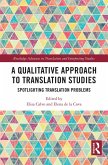
This collection invites readers to explore innovative or underexploited ways of working qualitatively with what in Translation Studies may be termed as elusive constructs. The volume adopts a functionalist approach to focus on one such concept, namely the notion of translation problem, using case studies to illustrate how a significant elusive construct can be addressed empirically. It explores different qualitative research methodologies which, although well established in other fields, are yet to be extensively used in TS but which may nevertheless prove to be of significance for future…mehr
This collection invites readers to explore innovative or underexploited ways of working qualitatively with what in Translation Studies may be termed as elusive constructs.
The volume adopts a functionalist approach to focus on one such concept, namely the notion of translation problem, using case studies to illustrate how a significant elusive construct can be addressed empirically. It explores different qualitative research methodologies which, although well established in other fields, are yet to be extensively used in TS but which may nevertheless prove to be of significance for future studies as they allow elusive concepts typically found in TS to be worked with more coherently. Chapters are structured around two core ideas: first, the qualitative, systematic analysis of source text content with emphasis on the detection of translation problems as a means of creating efficient frameworks for coherent decision-making from a functional perspective; and secondly, the practical process of stereotyping and profiling specific problems within different contexts, content types or services to help identify, manage and resolve them in a number of settings, from research to professional translator training and assessment environments.
This book will be of interest to scholars in translation studies, particularly those with an interest in qualitative approaches.
Dieser Download kann aus rechtlichen Gründen nur mit Rechnungsadresse in A, B, BG, CY, CZ, D, DK, EW, E, FIN, F, GR, HR, H, IRL, I, LT, L, LR, M, NL, PL, P, R, S, SLO, SK ausgeliefert werden.
Die Herstellerinformationen sind derzeit nicht verfügbar.
Autorenporträt
Elisa Calvo is a Senior Lecturer at the Department of Languages and Translation, UPO, Seville, where she co-founded the Interglosia Research Lab (HUM-996) in 2017. She has taught translation and interpreting for over 20 years (UPO, UAX, HWU) and has supervised a number of PhD dissertations at the UPO and the University of Seville. Elena de la Cova is a full time Lecturer at the Department of Languages and Translation, Universidad Pablo de Olavide (Seville), where she co-founded the Interglosia Research Lab (HUM-996) in 2017. She worked as a professional translator for over 16 years and has taught translation and localisation at the UPO since 2010.
Inhaltsangabe
List of contributors, Foreword. Christiane Nord, PART I: Concepts and Methods in Problem-Based Translation Research, Chapter 1: Why This Book? Elisa Calvo, Elena de la Cova, Chapter 2: A Functionalist Foundation. Elisa Calvo, Elena de la Cova, Chapter 3: Complex and Elusive Concepts in TS. Elisa Calvo, Elena de la Cova, Chapter 4: Qualitative coding: inducing and deducing. Elisa Calvo, Elena de la Cova, PART II: Real World Studies, Chapter 5: Categorising Problems in Court Translation. A Study of Essential Documents produced in Spanish Criminal Proceedings. Juan-Miguel Ortega-Herráez, Francisco J. Vigier-Moreno, Chapter 6: Categorisation of Translation Problems in University Transcripts. Julia Lobato, Mariana Relinque, Chapter 7: Study of Translation Problems in Superhero and Western Graphic Narratives. Robert Szymyslik, Francisco Rodríguez-Rodríguez, Chapter 8: A Proposal for the Categorisation of Translation Problems Arising from Culturally Marked Translation Units in Children's Literature. Nieves Jiménez-Carra, Inmaculada Mendoza-García, Chapter 9: Spotlighting and Managing Likely Losses of Meaning in Culturally-marked AVT: the Case of Ocho Apellidos Catalanes. Isabel Briales-Bellón, Mª José Rodríguez-Ruíz, Chapter 10: Translation Problems in App Localisation: The Case of Google Home. Elena de la Cova, Jesús Torres del Rey, Chapter 11: Translating the Louvre Abu Dhabi: Tourism Translation Problems in an Arabic-Spanish Corpus. Naima Ilhami, Hanan Saleh Hussein, Chapter 12: Translation of Self-care & Beauty Industry Content. Natividad Aguayo-Arrabal, Lorena Pérez-Macías, Chapter 13: The Extraordinary Nature of Transcreation Problems: The Apple Corpus. Oliver Carreira, Marián Morón, Chapter 14: Translating Psychometric Tests: When Skopos Gets Lost in Literality. Elisa Calvo, Cathy Way, Chapter 15: A Clash with Censorship: Applying a Grounded-Theory Approach to Arturo Barea's La llama. José Enrique García, Yolanda Morató, Chapter 16: Defining the Notion of Interpreting Problem in Multi-party Interactions (IPMI). Estela Martín-Ruel, Carmen Torrella, Chapter 17: Characterising Interpreting Problems in Two Public Service Settings. Eloísa Monteoliva-García, Natalia Rodríguez-Vicente, Chapter 18: Spotlighting Translations Problems Using Qualitative Methodology: Debriefing and Lessons Learnt. Elisa Calvo, Elena de la Cova
Es gelten unsere Allgemeinen Geschäftsbedingungen: www.buecher.de/agb
Impressum
www.buecher.de ist ein Internetauftritt der buecher.de internetstores GmbH
Geschäftsführung: Monica Sawhney | Roland Kölbl | Günter Hilger
Sitz der Gesellschaft: Batheyer Straße 115 - 117, 58099 Hagen
Postanschrift: Bürgermeister-Wegele-Str. 12, 86167 Augsburg
Amtsgericht Hagen HRB 13257
Steuernummer: 321/5800/1497
USt-IdNr: DE450055826