22,95 €
inkl. MwSt.
Sofort per Download lieferbar
11 °P sammeln

Andere Kunden interessierten sich auch für
") Dissidently Speaking (eBook, ePUB)7,99 €
Dissidently Speaking (eBook, ePUB)7,99 €") Speaking with the Dead in Early America (eBook, ePUB)25,95 €
Speaking with the Dead in Early America (eBook, ePUB)25,95 €") Contact Points (eBook, ePUB)22,95 €
Contact Points (eBook, ePUB)22,95 €") Meeting House and Counting House (eBook, ePUB)22,95 €
Meeting House and Counting House (eBook, ePUB)22,95 €") The Vice-Admiralty Courts and the American Revolution (eBook, ePUB)22,95 €
The Vice-Admiralty Courts and the American Revolution (eBook, ePUB)22,95 €") Darkness Falls on the Land of Light (eBook, ePUB)22,95 €
Darkness Falls on the Land of Light (eBook, ePUB)22,95 €") Sensibility and the American Revolution (eBook, ePUB)22,95 €
Sensibility and the American Revolution (eBook, ePUB)22,95 €



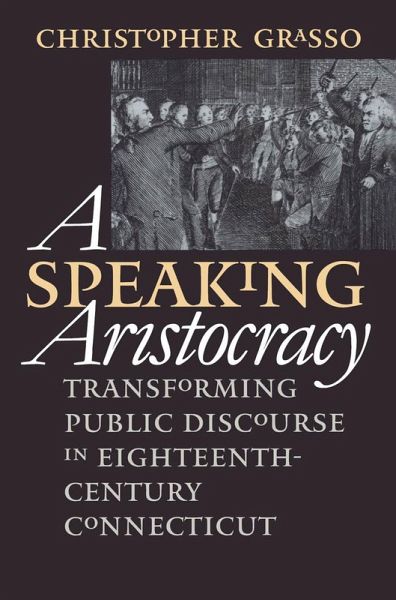
As cultural authority was reconstituted in the Revolutionary era, knowledge reconceived in the age of Enlightenment, and the means of communication radically altered by the proliferation of print, speakers and writers in eighteenth-century America began to describe themselves and their world in new ways. Drawing on hundreds of sermons, essays, speeches, letters, journals, plays, poems, and newspaper articles, Christopher Grasso explores how intellectuals, preachers, and polemicists transformed both the forms and the substance of public discussion in eighteenth-century Connecticut.
In New England through the first half of the century, only learned clergymen regularly addressed the public. After midcentury, however, newspapers, essays, and eventually lay orations introduced new rhetorical strategies to persuade or instruct an audience. With the rise of a print culture in the early Republic, the intellectual elite had to compete with other voices and address multiple audiences. By the end of the century, concludes Grasso, public discourse came to be understood not as the words of an authoritative few to the people but rather as a civic conversation of the people.
In New England through the first half of the century, only learned clergymen regularly addressed the public. After midcentury, however, newspapers, essays, and eventually lay orations introduced new rhetorical strategies to persuade or instruct an audience. With the rise of a print culture in the early Republic, the intellectual elite had to compete with other voices and address multiple audiences. By the end of the century, concludes Grasso, public discourse came to be understood not as the words of an authoritative few to the people but rather as a civic conversation of the people.
Dieser Download kann aus rechtlichen Gründen nur mit Rechnungsadresse in A, D ausgeliefert werden.