Sie sind bereits eingeloggt. Klicken Sie auf 2. tolino select Abo, um fortzufahren.
Bitte loggen Sie sich zunächst in Ihr Kundenkonto ein oder registrieren Sie sich bei bücher.de, um das eBook-Abo tolino select nutzen zu können.
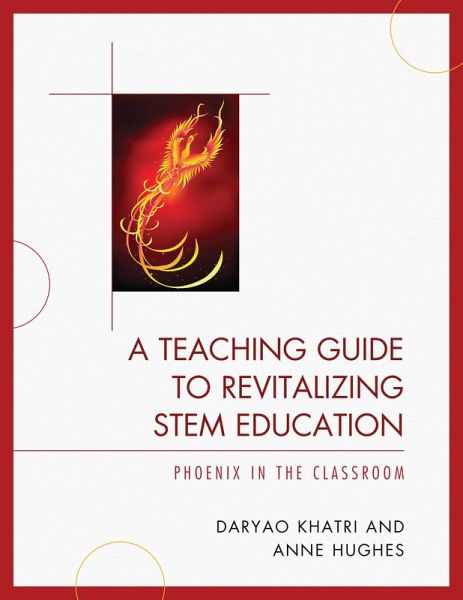
Standard math and science textbooks typically follow a deductive style of content presentation that involves too much lecturing, too much of the teacher's back at the chalkboard, too little interaction with students, and too little time for all of the students to take adequate notes. By reading and using A Teaching Guide to Revitalizing STEM Education, educators will rediscover how to streamline the subject matter- math, physics, statistics, and organic chemistry-by eliminating unnecessary difficulties and distractions from course textbooks. A useful guide for both high school teachers and…mehr
Standard math and science textbooks typically follow a deductive style of content presentation that involves too much lecturing, too much of the teacher's back at the chalkboard, too little interaction with students, and too little time for all of the students to take adequate notes. By reading and using A Teaching Guide to Revitalizing STEM Education, educators will rediscover how to streamline the subject matter- math, physics, statistics, and organic chemistry-by eliminating unnecessary difficulties and distractions from course textbooks. A useful guide for both high school teachers and postsecondary faculty, this book explains how to organize, arrange, and streamline STEM content so that it is approachable, understandable, and applicable for students. Likewise, this guide discusses important classroom management skills and pedagogical techniques that will help students master these critical subjects. Providing and explaining over a dozen lesson plans, A Teaching Guide to Revitalizing STEM Education will encourage educators to effectively optimize the recent emphases on science, technology, engineering, and math education.
Die Herstellerinformationen sind derzeit nicht verfügbar.
Autorenporträt
Daryao Khatri is president/CEO of TopTech, Inc. and professor of physics at the University of District of Columbia.
Inhaltsangabe
Acknowledgments IntroductionRevolutionizing Stem Teaching: A Guide to Parallel Course Design and Delivery Chapter 1Pedagogical Principles and Course Streamlining Chapter 2:Organization, Definitions, and Common Features Chapter 3:First Day of the Class Chapter 4Arithmetic Operations with Mixed Numerals: Basic Math Chapter 5Percents: Basic Math Chapter 6Solving Simultaneous Equations Using the Elimination Method: Determinants and Matrices in Matrix Algebra Chapter 7Three Coordinate Systems: Calculus and Mathematical Physics Chapter 8Horizontal and Vertical Linear Motions: College Physics I Chapter 9An Application of Newton's Second Law of Motion: College Physics I Chapter 10Hydrogen Spectral Lines in Visible, Ultraviolet, and Infrared Spectrums: College Physics II Chapter 11Simple Vector Operations: Physics, Mathematics, and Engineering Chapter 12Frequencies, Percents, Histograms, and Polygons: Statistics Chapter 13Mean, Median, and Mode: Measures of Central Tendency in Statistics Chapter 14Measures of Variability/Dispersion-Calculating the Range and the Standard Deviation: Mathematics and Statistics Chapter 15The Correlated "t" Test: Statistics Chapter 16Concepts and Skills Review: Organic Chemistry I Chapter 17Skills and Concepts for Molecular Geometry: Organic Chemistry I Chapter 18Molecular Geometry and Electron Domain Geometry: Organic Chemistry I Chapter 19Nomenclature: The System of Naming Hydrocarbons: Organic Chemistry I Conclusion About the Authors
Es gelten unsere Allgemeinen Geschäftsbedingungen: www.buecher.de/agb
Impressum
www.buecher.de ist ein Internetauftritt der buecher.de internetstores GmbH
Geschäftsführung: Monica Sawhney | Roland Kölbl | Günter Hilger
Sitz der Gesellschaft: Batheyer Straße 115 - 117, 58099 Hagen
Postanschrift: Bürgermeister-Wegele-Str. 12, 86167 Augsburg
Amtsgericht Hagen HRB 13257
Steuernummer: 321/5800/1497
USt-IdNr: DE450055826